


Page 10 - Journal of Special Operations Medicine - Spring 2014
P. 10
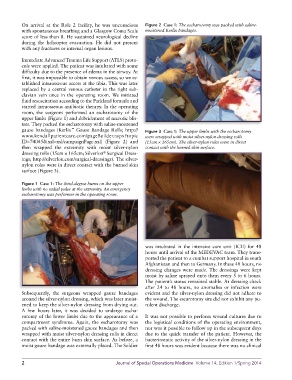
On arrival at the Role 2 facility, he was unconscious   Figure 2  Case 1: The escharotomy was packed with saline-
          with spontaneous breathing and a Glasgow Coma Scale   moistened Kerlix bandages.
          score of less than 8. He sustained neurological decline
          during the helicopter  evacuation. He did not present
          with any fractures or internal organ lesions.

          Immediate Advanced Trauma Life Support (ATLS) proto-
          cols were applied. The patient was intubated with some
          difficulty due to the presence of edema in the airway. At
          first, it was impossible to obtain venous access, so we es-
          tablished intraosseous access at the tibia. This was later
          replaced by a central venous catheter in the right sub-
          clavian vein once in the operating room. We initiated
          fluid resuscitation according to the Parkland formula and
          started intraosseous antibiotic therapy. In the operating
          room, the surgeons performed an escharotomy of the
          upper limbs (Figure 1) and debridement of necrotic blis-
          ters. They packed the escharotomy with saline-moistened
                               ™
          gauze bandages (Kerlix  Gauze Bandage Rolls; http://   Figure 3  Case 1: The upper limbs with the escharotomy
          www.kendallpatientcare.com/pageBuilder.aspx?topic   were wrapped with moist silver-nylon dressing rolls
          ID=74045&xsl=xsl/campaignPage.xsl) (Figure 2) and   (15cm × 165cm). The silver-nylon roles were in direct
          then  wrapped  the  extremity  with moist  silver-nylon   contact with the burned skin surface.
                                            ®
          dressing rolls (15cm × 165cm; Silverlon  Surgical Dress-
          ings; http://silverlon.com/surgical-dress ings). The silver-
          nylon roles were in direct contact with the burned skin
          surface (Figure 3).


          Figure 1  Case 1: The third-degree burns on the upper
          limbs with no radial pulse at the extremity. An emergency
          escharotomy was performer in the operating room.


                                                             was intubated in the intensive care unit (ICU) for 48
                                                             hours until arrival of the MEDEVAC team. They trans-
                                                             ported the patient to a combat support hospital in south
                                                             Afghanistan and then to Germany. In these 48 hours, no
                                                             dressing changes were made. The dressings were kept
                                                             moist by saline sprayed onto them every 5 to 6 hours.
                                                             The patient’s status remained stable. At dressing check
                                                             after 24 to 48 hours, no anomalies or infection were
          Subsequently, the surgeons wrapped gauze bandages   evident and the silver-nylon dressing did not adhere to
          around the silver-nylon dressing, which was later moist-  the wound. The escarotomy site did not exhibit any pu-
          ened to keep the silver-nylon dressing from drying out.   rulent discharge.
          A few hours later, it was decided to undergo escha-
          rotomy of the lower limbs due to the appearance of a   It was not possible to perform wound cultures due to
          compartment syndrome. Again, the escharotomy was   the logistical conditions of the operating environment,
          packed with saline-moistened gauze bandages and then   nor was it possible to follow up in the subsequent days
          wrapped with moist silver-nylon dressing rolls in direct   due to the quick transfer of the patient. However, the
          contact with the entire burn skin surface. As before, a   bacteriostatic activity of the silver-nylon dressing in the
          moist gauze bandage was externally placed. The Soldier   first 48 hours was evident because there was no clinical


          2                                      Journal of Special Operations Medicine  Volume 14, Edition 1/Spring 2014

