


Page 384 - ATP-P 11th Ed
P. 384
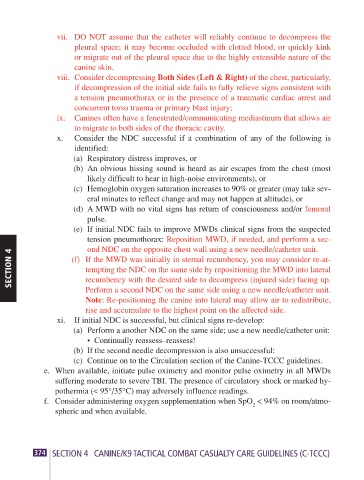
vii.  DO NOT assume that the catheter will reliably continue to decompress the
                 pleural space; it may become occluded with clotted blood, or quickly kink
                 or migrate out of the pleural space due to the highly extensible nature of the
                 canine skin.
             viii.  Consider decompressing Both Sides (Left & Right) of the chest, particularly,
                 if decompression of the initial side fails to fully relieve signs consistent with
                 a tension pneumothorax or in the presence of a traumatic cardiac arrest and
                 concurrent torso trauma or primary blast injury;
             ix.  Canines often have a fenestrated/communicating mediastinum that allows air
                 to migrate to both sides of the thoracic cavity.
             x.   Consider the NDC successful if a combination of any of the following is
                 identified:
                 (a)  Respiratory distress improves, or
                 (b)  An obvious hissing sound is heard as air escapes from the chest (most
                    likely difficult to hear in high-noise environments), or
                 (c)  Hemoglobin oxygen saturation increases to 90% or greater (may take sev-
                    eral minutes to reflect change and may not happen at altitude), or
                 (d)  A MWD with no vital signs has return of consciousness and/or femoral
                    pulse.
                 (e)  If initial NDC fails to improve MWDs clinical signs from the suspected
                    tension pneumothorax: Reposition MWD, if needed, and perform a sec-
                    ond NDC on the opposite chest wall using a new needle/catheter unit.
   SECTION 4     (f)  If the MWD was initially in sternal recumbency, you may consider re-at-
                    tempting the NDC on the same side by repositioning the MWD into lateral
                    recumbency with the desired side to decompress (injured side) facing up.
                    Perform a second NDC on the same side using a new needle/catheter unit.
                    Note: Re-positioning the canine into lateral may allow air to redistribute,
                    rise and accumulate to the highest point on the affected side.
             xi.  If initial NDC is successful, but clinical signs re-develop:
                 (a)  Perform a another NDC on the same side; use a new needle/catheter unit:
                    •  Continually reassess–reassess!
                 (b)  If the second needle decompression is also unsuccessful:
                 (c)  Continue on to the Circulation section of the Canine-TCCC guidelines.
           e.  When available, initiate pulse oximetry and monitor pulse oximetry in all MWDs
             suffering moderate to severe TBI. The presence of circulatory shock or marked hy-
             pothermia (< 95°/35°C) may adversely influence readings.
           f.  Consider administering oxygen supplementation when SpO  < 94% on room/atmo-
                                                        2
             spheric and when available.


          374  SECTION 4   CANINE/K9 TACTICAL COMBAT CASUALTY CARE GUIDELINES (C-TCCC)

