


Page 248 - ATP-P 11th Ed
P. 248
JOINT INFECTION PROTOCOL


           SPECIAL CONSIDERATIONS
           1.  May result from penetrating trauma (especially animal or human bites), gonorrhea,
             or iatrogenic causes (i.e., attempted aspiration of joint  effusion).
           2.  Consider also an acute joint effusion due to blunt trauma or overuse (usually less
             red and no fever).
   SECTION 2  Signs and Symptoms

        1.  History of adjacent penetrating trauma or infection
        2.  Single red, swollen joint
        3.  Fever
        4.  Pain
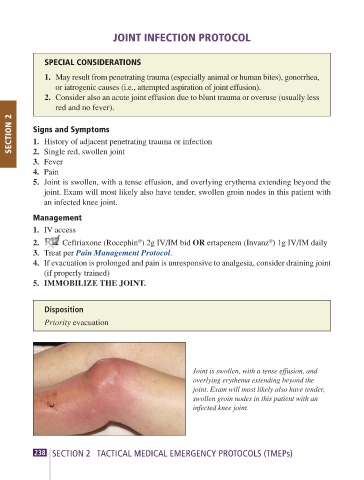
        5.  Joint is swollen, with a tense effusion, and overlying erythema extending beyond the
           joint. Exam will most likely also have tender, swollen groin nodes in this patient with
           an infected knee joint.
        Management
        1.  IV access
        2.     Ceftriaxone (Rocephin ) 2g IV/IM bid OR ertapenem (Invanz ) 1g IV/IM daily
                                                            ®
                               ®
        3.  Treat per Pain Management Protocol.
        4.   If evacuation is prolonged and pain is unresponsive to analgesia, consider draining joint
           (if properly trained)
        5.  IMMOBILIZE THE JOINT.

           Disposition
           Priority evacuation


                                           Joint is swollen, with a tense effusion, and
                                           overlying erythema extending beyond the
                                           joint. Exam will most likely also have tender,
                                           swollen groin nodes in this patient with an
                                           infected knee joint.


          238  SECTION 2   TACTICAL MEDICAL EMERGENCY PROTOCOLS (TMEPs)                                                       ATP-P Handbook 11th Edition 239

