


Page 253 - ATP-P 11th Ed
P. 253
Maintain a firm hold on the dogs leg as you place the cath-
        eter, as they will pull away from you while placing the
        catheter.
        Start distally on the vein. If you blow the vein, move more
        proximally and attempt the IV.
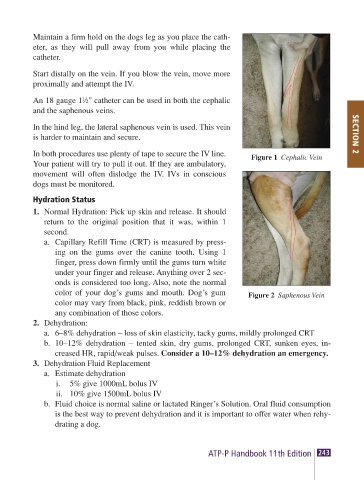
        An 18 gauge 1½" catheter can be used in both the cephalic
        and the saphenous veins.

        In the hind leg, the lateral saphenous vein is used. This vein
        is harder to maintain and secure.                                     SECTION 2
        In both procedures use plenty of tape to secure the IV line.   Figure 1  Cephalic Vein
        Your patient will try to pull it out. If they are ambulatory,
        movement will often dislodge the IV. IVs in conscious
        dogs must be monitored.
        Hydration Status
        1.  Normal Hydration: Pick up skin and release. It should
           return to the original position that it was, within 1
           second.
           a.  Capillary Refill Time (CRT) is measured by press-
             ing on the gums over the canine tooth. Using 1
             finger, press down firmly until the gums turn white
             under your finger and release. Anything over 2 sec-
             onds is considered too long. Also, note the normal
             color of your dog’s gums and mouth. Dog’s gum   Figure 2  Saphenous Vein
             color may vary from black, pink, reddish brown or
             any combination of those colors.
        2.  Dehydration:
           a.   6–8% dehydration – loss of skin elasticity, tacky gums, mildly prolonged CRT
           b.   10–12% dehydration – tented skin, dry gums, prolonged CRT, sunken eyes, in-
             creased HR, rapid/weak pulses. Consider a 10–12% dehydration an emergency.
        3.  Dehydration Fluid Replacement
           a.  Estimate dehydration
             i.  5% give 1000mL bolus IV
             ii.  10% give 1500mL bolus IV
           b.   Fluid choice is normal saline or lactated Ringer’s Solution. Oral fluid consumption
             is the best way to prevent dehydration and it is important to offer water when rehy-
             drating a dog.


   242  SECTION 2   TACTICAL MEDICAL EMERGENCY PROTOCOLS (TMEPs)     ATP-P Handbook 11th Edition 243

