


Page 246 - ATP-P 11th Ed
P. 246
INGROWN TOENAIL PROTOCOL


           SPECIAL CONSIDERATIONS
           1.  Consider toenail removal only if close follow-up is possible.
           2.    DO NOT USE local anesthetic with epinephrine.
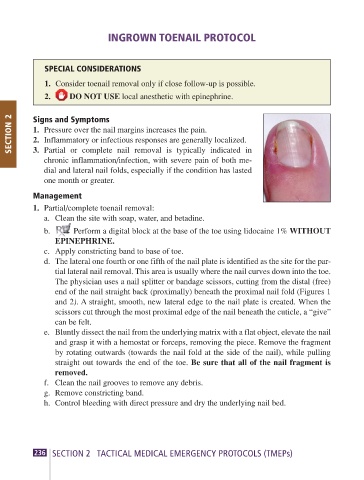
          Signs and Symptoms
   SECTION 2  1.  Pressure over the nail margins increases the pain.
        2.  Inflammatory or infectious responses are generally localized.
        3.  Partial or complete nail removal is typically indicated in
           chronic inflammation/infection, with severe pain of both me-
           dial and lateral nail folds, especially if the condition has lasted
           one month or greater.
        Management
        1.  Partial/complete toenail removal:
           a.  Clean the site with soap, water, and betadine.
           b.      Perform a digital block at the base of the toe using lidocaine 1% WITHOUT
             EPINEPHRINE.
           c.  Apply constricting band to base of toe.
           d.   The lateral one fourth or one fifth of the nail plate is identified as the site for the par-
             tial lateral nail removal. This area is usually where the nail curves down into the toe.
             The physician uses a nail splitter or bandage scissors, cutting from the distal (free)
             end of the nail straight back (proximally) beneath the proximal nail fold (Figures 1
             and 2). A straight, smooth, new lateral edge to the nail plate is created. When the
             scissors cut through the most proximal edge of the nail beneath the cuticle, a “give”
             can be felt.
           e.   Bluntly dissect the nail from the underlying matrix with a flat object, elevate the nail
             and grasp it with a hemostat or forceps, removing the piece. Remove the fragment
             by rotating outwards (towards the nail fold at the side of the nail), while pulling
             straight out towards the end of the toe. Be sure that all of the nail fragment is
             removed.
           f.   Clean the nail grooves to remove any debris.
           g.  Remove constricting band.
           h.  Control bleeding with direct pressure and dry the underlying nail bed.


          236  SECTION 2   TACTICAL MEDICAL EMERGENCY PROTOCOLS (TMEPs)                                                       ATP-P Handbook 11th Edition 237

