


Page 120 - ATP-P 11th Ed
P. 120
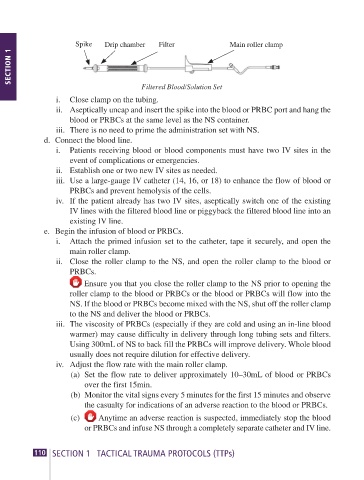
Spike  Drip chamber  Filter       Main roller clamp
   SECTION 1


                                Filtered Blood/Solution Set
             i.  Close clamp on the tubing.
             ii.  Aseptically uncap and insert the spike into the blood or PRBC port and hang the
                blood or PRBCs at the same level as the NS container.
             iii.  There is no need to prime the administration set with NS.
           d.  Connect the blood line.
             i.  Patients receiving blood or blood components must have two IV sites in the
                event of complications or emergencies.
             ii.  Establish one or two new IV sites as needed.
             iii.  Use a large-gauge IV catheter (14, 16, or 18) to enhance the flow of blood or
                PRBCs and prevent hemolysis of the cells.
             iv.  If the patient already has two IV sites, aseptically switch one of the existing
                IV lines with the filtered blood line or piggyback the filtered blood line into an
                existing IV line.
           e.  Begin the infusion of blood or PRBCs.
             i.  Attach the primed infusion set to the catheter, tape it securely, and open the
                main roller clamp.
             ii.  Close the roller clamp to the NS, and open the roller clamp to the blood or
                PRBCs.
                    Ensure you that you close the roller clamp to the NS prior to opening the
                roller clamp to the blood or PRBCs or the blood or PRBCs will flow into the
                NS. If the blood or PRBCs become mixed with the NS, shut off the roller clamp
                to the NS and deliver the blood or PRBCs.
             iii.  The viscosity of PRBCs (especially if they are cold and using an in-line blood
                warmer) may cause difficulty in delivery through long tubing sets and filters.
                Using 300mL of NS to back fill the PRBCs will improve delivery. Whole blood
                usually does not require dilution for effective delivery.
             iv.  Adjust the flow rate with the main roller clamp.
                (a)  Set the flow rate to deliver approximately 10–30mL of blood or PRBCs
                   over the first 15min.
                (b)  Monitor the vital signs every 5 minutes for the first 15 minutes and observe
                   the casualty for indications of an adverse reaction to the blood or PRBCs.
                (c)    Anytime an adverse reaction is suspected, immediately stop the blood
                   or PRBCs and infuse NS through a completely separate catheter and IV line.

          110  SECTION 1   TACTICAL TRAUMA PROTOCOLS (TTPs)                                                                   ATP-P Handbook 11th Edition 111

