


Page 118 - ATP-P 11th Ed
P. 118
a.  If you have access to a method of separating the plasma from a blood sample, you
             can attempt to perform a whole blood cross-match. This increases the safety of a
   SECTION 1  b.  After separating, take four drops of the recipient’s plasma and place them on a
             WB transfusion.
             smooth white tile, glass slide, or a clean smooth piece of glass.
           c.  Take one drop of whole blood from the donor and add it to the recipient’s plasma
             and gently mix using the tip of a needle or other sterile instrument.
           d.  If using a glass slide or piece of glass, place the mixture of plasma and whole blood
             against a bright white background.
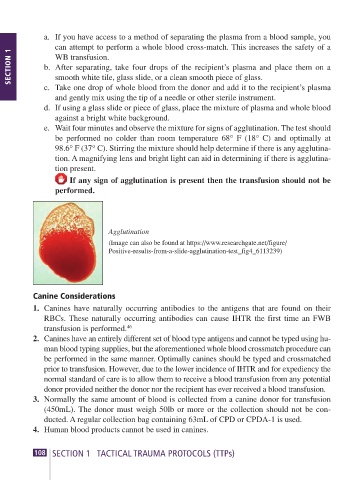
           e.  Wait four minutes and observe the mixture for signs of agglutination. The test should
             be  performed  no  colder  than  room  temperature  68°  F  (18°  C)  and  optimally  at
             98.6° F (37° C). Stirring the mixture should help determine if there is any agglutina-
             tion. A magnifying lens and bright light can aid in determining if there is agglutina-
             tion present.
                 If any sign of agglutination is present then the transfusion should not be
             performed.


                         Agglutination
                         (Image can also be found at https://www.researchgate.net/figure/
                         Positive-results-from-a-slide-agglutination-test_fig4_6113239)


        Canine Considerations
        1.  Canines have naturally occurring antibodies to the antigens that are found on their
           RBCs. These naturally occurring antibodies can cause IHTR the first time an FWB
           transfusion is performed. 46
        2.  Canines have an entirely different set of blood type antigens and cannot be typed using hu-
           man blood typing supplies, but the aforementioned whole blood crossmatch procedure can
           be performed in the same manner. Optimally canines should be typed and crossmatched
           prior to transfusion. However, due to the lower incidence of IHTR and for expediency the
           normal standard of care is to allow them to receive a blood transfusion from any potential
           donor provided neither the donor nor the recipient has ever received a blood transfusion.
        3.  Normally the same amount of blood is collected from a canine donor for transfusion
           (450mL). The donor must weigh 50lb or more or the collection should not be con-
           ducted. A regular collection bag containing 63mL of CPD or CPDA-1 is used.
        4.  Human blood products cannot be used in canines.

          108  SECTION 1   TACTICAL TRAUMA PROTOCOLS (TTPs)                                                                   ATP-P Handbook 11th Edition 109

