


Page 119 - ATP-P 11th Ed
P. 119
Administer Blood (WB, FWB, WFWB) or PRBCs
        1.  Store WB and PRBCs at 34–43° F (1–6° C). WB should only be stored at these tem-
           peratures if is not going to be transfused immediately, but never longer than 24 hours.
           Refrigeration of WB has shown to decrease platelet function.       SECTION 1
        2.  Ensure compatibility of recipient.
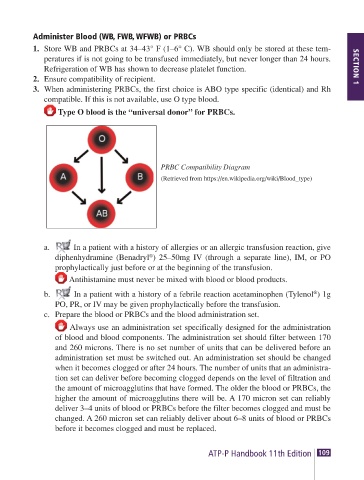
        3.  When administering PRBCs, the first choice is ABO type specific (identical) and Rh
           compatible. If this is not available, use O type blood.
              Type O blood is the “universal donor” for PRBCs.


                                    PRBC Compatibility Diagram
                                    (Retrieved from https://en.wikipedia.org/wiki/Blood_type)


           a.     In a patient with a history of allergies or an allergic transfusion reaction, give
             diphenhydramine (Benadryl ) 25–50mg IV (through a separate line), IM, or PO
                                  ®
             prophylactically just before or at the beginning of the transfusion.
                 Antihistamine must never be mixed with blood or blood products.
                                                                     ®
           b.     In a patient with a history of a febrile reaction acetaminophen (Tylenol ) 1g
             PO, PR, or IV may be given prophylactically before the transfusion.
           c.  Prepare the blood or PRBCs and the blood administration set.
                 Always use an administration set specifically designed for the administration
             of blood and blood components. The administration set should filter between 170
             and 260 microns. There is no set number of units that can be delivered before an
             administration set must be switched out. An administration set should be changed
             when it becomes clogged or after 24 hours. The number of units that an administra-
             tion set can deliver before becoming clogged depends on the level of filtration and
             the amount of microagglutins that have formed. The older the blood or PRBCs, the
             higher the amount of microagglutins there will be. A 170 micron set can reliably
             deliver 3–4 units of blood or PRBCs before the filter becomes clogged and must be
             changed. A 260 micron set can reliably deliver about 6–8 units of blood or PRBCs
             before it becomes clogged and must be replaced.

   108  SECTION 1   TACTICAL TRAUMA PROTOCOLS (TTPs)     ATP-P Handbook 11th Edition 109

