


Page 116 - ATP-P 11th Ed
P. 116
with the blood to prevent areas of high citrate concentration. Make every attempt to
             insulate the collection bag and keep it off of the ground in order to keep the collected
   SECTION 1  j.  Remove about 450mL of blood (enough so the bag is almost full). Overfilling the
             blood warm.
             bag may cause clotting. A trip scale should be used for accuracy (measure 450 ± 50g
             plus weight of blood bag). Alternatively, a 9.5-inch piece of 550-cord (NSN 4020-
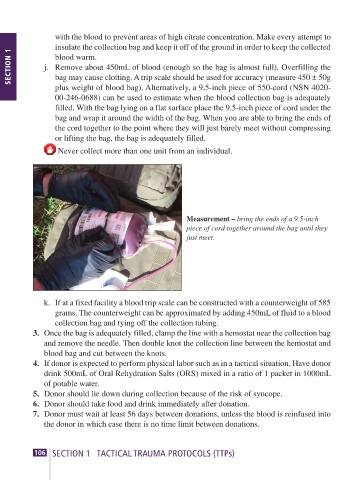
             00-246-0688) can be used to estimate when the blood collection bag is adequately
             filled. With the bag lying on a flat surface place the 9.5-inch piece of cord under the
             bag and wrap it around the width of the bag. When you are able to bring the ends of
             the cord together to the point where they will just barely meet without compressing
             or lifting the bag, the bag is adequately filled.
              Never collect more than one unit from an individual.


                                          Measurement – bring the ends of a 9.5-inch
                                          piece of cord together around the bag until they
                                          just meet.


           k.  If at a fixed facility a blood trip scale can be constructed with a counterweight of 585
             grams. The counterweight can be approximated by adding 450mL of fluid to a blood
             collection bag and tying off the collection tubing.
        3.  Once the bag is adequately filled, clamp the line with a hemostat near the collection bag
           and remove the needle. Then double knot the collection line between the hemostat and
           blood bag and cut between the knots.
        4.  If donor is expected to perform physical labor such as in a tactical situation. Have donor
           drink 500mL of Oral Rehydration Salts (ORS) mixed in a ratio of 1 packet in 1000mL
           of potable water.
        5.  Donor should lie down during collection because of the risk of syncope.
        6.  Donor should take food and drink immediately after donation.
        7.  Donor must wait at least 56 days between donations, unless the blood is reinfused into
           the donor in which case there is no time limit between donations.


          106  SECTION 1   TACTICAL TRAUMA PROTOCOLS (TTPs)                                                                   ATP-P Handbook 11th Edition 107

