


Page 93 - 2026 SMOG
P. 93
MWD SHOCK FLUID THERAPY
                    Indications                     Clinical Signs
         •  Hypotension                  •  Early, compensatory shock:
         •  Systolic <90mmHg                  ˚  Tachycardia
              ˚  MAP <65mmHg                  ˚  Tachypnea
              ˚
             Hypovolemia
                                             Alert mentation
         •  Massive hemorrhage (external, cavitary)    ˚   ˚  Rapid pulse
              ˚  Severe dehydration (heat injury, GI loss)    ˚  Normal to increased pulse pressure
              ˚  Cavitary pressure impeding arterial     ˚  Normal Capillary Refill Time (CRT) (<2
             perfusion or venous return
                                             sec)
                                              ˚  Normal to bright red mucous membranes
                                             (MM)
                                         •  Late, decompensatory shock:
                                              ˚  Bradycardia
                                              ˚  Prolonged or poor CRT (>2 sec)
                                              ˚  Pulses are poor or absent
                                              ˚  Hypothermia
                                             Stupor
                                     Treatment   ˚
         •  Place multiple largebore IV or IO catheters.
              ˚  If one percutaneous attempt is not successful in a shock patient, immediately choose an
             alternate percutaneous site or perform IO catheterization.
              ˚  Cephalic veins are ideal for peripheral catheterization
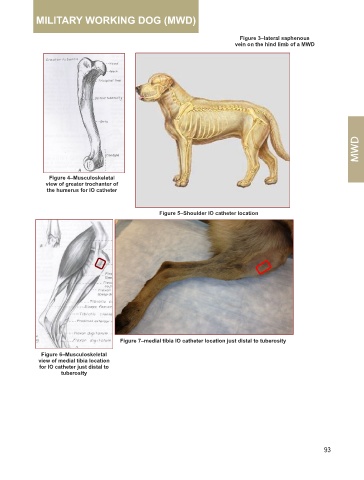
              ˚  IO catheter placement
             ■   Proximal cranial medial tibia or proximal lateral humerus
             ■   Most MWDs weigh >40lbs so use adult size IOC 25mm × 15g
             ■   Use pediatric size IOC 15mm × 15g in MWDs weighing <40lbs
         •  Give crystalloid fluids as firstline treatment
              ˚  Normosol-R or Plasmalyte-A is optimal for dogs; saline or LRS is acceptable in
             emergent cases.
              ˚  Administer up to 90mL/kg of crystalloids in the first hour (1 blood volume for the dog)
              ˚  Quick calculation for a bolus shock dose: Add a zero to the dog’s body weight (in pounds) to
             approximate a safe but effective bolus volume. For example, a 45lbs dog would need about a
             450mL bolus, and a 75lbs dog would need about 750mL as a bolus.
         •  Use synthetic colloids or hypertonic saline (HTS) in dogs with refractory shock.
              ˚  Give a Hydroxyethyl starch (HES) IV/IO bolus 10–20mL/kg over 50min if clinical signs of
             shock do not abate after the first 30min (first 2 quarter-shock IV challenges) of crystalloid
             fluids, or response to crystalloid challenges is not sustained.
             ■   Repeat this bolus if there is no response to therapy.
             ■   Give a Hypertonic saline (HTS) IV/IO bolus 4mL/kg over 5min (if 7–7.5% HTS
              is available) for MWDs that fail to respond to two or three quartershock boluses of
              crystalloids and/or one to two boluses of HES.
                                                                   (continues)


                           2026 Standard Medical Operating Guidelines (SMOG)  •   85

