


Page 37 - JSOM Spring 2026
P. 37
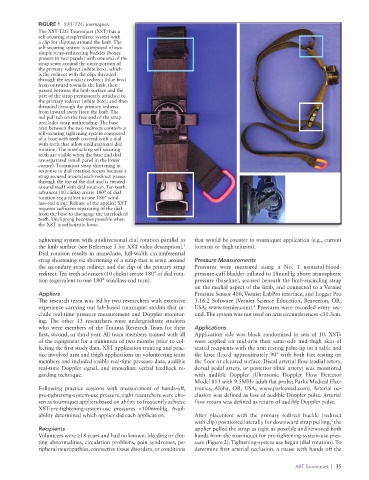
FIGURE 1  X8T-T2G tourniquet.
              The X8T-T2G Tourniquet (X8T) has a
              self-securing strap/redirect system with
              a clip for clipping around the limb. The
              self-securing system is composed of two
              simple strap-redirecting buckles (boxes
              present in two panels) with one end of the
              strap sewn around the outer portion of
              the primary redirect (white box), which
              is the redirect with the clip; threaded
              through the secondary redirect (blue box)
              from outward towards the limb; then
              passed between the limb surface and the
              part of the strap permanently attached to
              the primary redirect (white box); and then
              threaded through the primary redirect
              from inward away from the limb. The
              red pull tab on the free end of the strap
              precludes strap unthreading. The base
              area between the two redirects contains a
              self-securing tightening system composed
              of a base with teeth covered with a dial
              with teeth that allow unidirectional dial
              rotation. The interlocking self-securing
              teeth are visible when the base and dial
              are separated (small panel in the lower
              corner). Tourniquet strap shortening in
              response to dial rotation occurs because a
              strap secured around each redirect passes
              through the top of the dial and is twisted
              around itself with dial rotation. Ten teeth
              advances (10 clicks) create 180° of dial
              rotation (equivalent to one 180° wind-
              lass-rod turn). Release of the applied X8T
              requires sufficient separating of the dial
              from the base to disengage the interlocked
              teeth. Unclipping becomes possible when
              the X8T is sufficiently loose.

              tightening system with unidirectional dial rotation parallel to   that would be counter to tourniquet application (e.g., current
                                                             3
              the limb surface (see Reference 3 for X8T video description).    forearm or thigh injuries).
              Dial rotation results in immediate, full-width circumferential
              strap shortening via shortening of a strap that is sewn around   Pressure Measurements
              the secondary strap redirect and the clip of the primary strap   Pressures  were  measured  using  a No. 1  neonatal-blood-
              redirect. Ten teeth advances (10 clicks) create 180° of dial rota-  pressure-cuff bladder inflated to 18mmHg above atmospheric
              tion (equivalent to one 180° windlass-rod turn).   pressure (baseline), secured beneath the limb-encircling strap
                                                                 on the medial aspect of the limb, and connected to a Vernier
              Appliers                                           Pressure Sensor 400, Vernier LabPro interface, and Logger Pro
              The research team was led by two researchers with extensive   3.16.2 Software (Vernier Science Education, Beaverton, OR,
                                                                                    4
              experience carrying out lab-based tourniquet studies that in-  USA; www.vernier.com).  Pressures were recorded every sec-
              clude real-time pressure measurement and Doppler monitor-  ond. The system was not used on arm circumferences <31.3cm.
              ing.  The  other 13  researchers  were  undergraduate  students
              who were members of the Trauma Research Team for their   Applications
              first, second, or third year. All team members trained with all   Application side was block randomized in sets of 10. X8Ts
              of the equipment for a minimum of two months prior to col-  were  applied  on  mid-arm  then  same-side  mid-thigh  skin  of
              lecting the first study data. X8T application training and prac-  seated recipients with the arm resting palm-up on a table and
              tice involved arm and thigh applications on volunteering team   the knee flexed approximately 90° with both feet resting on
              members and included visible real-time pressure data, audible   the floor or elevated surface. Distal arterial flow (radial artery,
              real-time Doppler signal, and immediate verbal feedback re-  dorsal pedal artery, or posterior tibial artery) was monitored
              garding technique.                                 with audible Doppler (Ultrasonic Doppler Flow Detector
                                                                 Model 811 with 9.5MHz adult flat probe; Parks Medical Elec-
              Following  practice  sessions  with  measurement  of  hands-off,   tronics, Aloha,  OR,  USA;  www.parksmed.com). Arterial  oc-
              pre-tightening-system-use pressure, eight researchers were cho-  clusion was defined as loss of audible Doppler pulse. Arterial
              sen as tourniquet appliers based on ability to frequently achieve   flow return was defined as return of audible Doppler pulse.
              X8T-pre-tightening-system-use pressures >100mmHg.  Avail-
              ability determined which applier did each application.  After placement with the primary redirect buckle (redirect
                                                                 with clip) positioned laterally for downward strap pulling,  the
                                                                                                             5
              Recipients                                         applier pulled the strap as tight as possible and removed both
              Volunteers were ≥18 years and had no known: bleeding or clot-  hands from the tourniquet for pre-tightening-system-use pres-
              ting abnormalities, circulation problems, pain syndromes, pe-  sure (Figure 2). Tightening-system use began (dial rotation). To
              ripheral neuropathies, connective tissue disorders, or conditions   determine first arterial occlusion, a pause with hands off the

                                                                                                 X8T Tourniquet  |  35

