


Page 105 - JSOM Spring 2026
P. 105
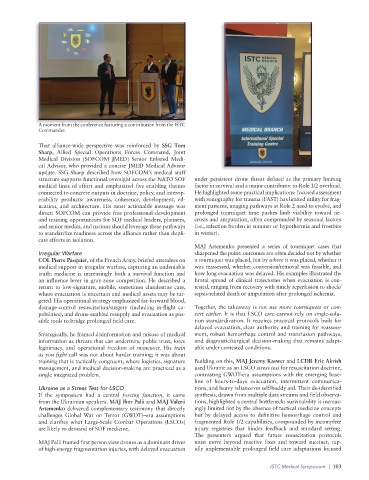
A moment from the conference featuring a contribution from the ISTC
              Commander.

              That alliance-wide perspective was reinforced by  SSG Tom
              Sharp,  Allied Special Operations Forces Command, Joint
              Medical Division (SOFCOM JMED) Senior Enlisted Medi-
              cal Advisor, who provided a concise JMED Medical Advisor
              update. SSG Sharp described how SOFCOM’s medical staff
              structure supports functional oversight across the NATO SOF   under persistent drone threat defined as the primary limiting
              medical lines of effort and emphasized five enabling themes   factor in survival and a major contributor to Role 1/2 overload.
              connected to concrete outputs in doctrine, policy, and interop-  He highlighted some practical implications: focused assessment
              erability products:  awareness, coherence,  development, ed-  with sonography for trauma (FAST) has limited utility for frag-
              ucation, and architecture. His most actionable message was   ment patterns, imaging pathways at Role 2 need to evolve, and
              direct:  SOFCOM can provide free professional development   prolonged tourniquet time pushes limb viability toward ne-
              and training opportunities for SOF medical leaders, planners,   crosis and amputation, often compounded by seasonal factors
              and senior medics, and nations should leverage these pathways   (i.e., infection burden in summer or hypothermia and frostbite
              to standardize readiness across the alliance rather than dupli-  in winter).
              cate efforts in isolation.
                                                                 MAJ  Artemenko presented a series of tourniquet cases that
              Irregular Warfare                                  sharpened the point: outcomes are often decided not by whether
              COL Pierre Pasquier, of the French Army, briefed attendees on   a tourniquet was placed, but by where it was placed, whether it
              medical support in irregular warfare, capturing an undeniable   was reassessed, whether conversion/removal was feasible, and
              truth: medicine is increasingly both a survival function and   how long evacuation was delayed. His examples illustrated the
              an influence lever in gray-zone competition. He described a   brutal spread of clinical trajectories when evacuation is con-
              return to low-signature, mobile, sometimes clandestine care,   tested, ranging from recovery with timely reperfusion to shock/
              where evacuation is uncertain and medical assets may be tar-  sepsis-related death or amputation after prolonged ischemia.
              geted. His operational strategy emphasized far-forward blood,
              damage-control resuscitation/surgery (including in-flight ca-  Together, the takeaway is not use more tourniquets or con-
              pabilities), and drone-enabled resupply and evacuation as pos-  vert earlier. It is that LSCO care cannot rely on single-solu-
              sible tools to bridge prolonged field care.        tion standardization. It requires practical protocols built for
                                                                 delayed evacuation, clear authority and training for reassess-
              Strategically, he framed disinformation and misuse of medical   ment, robust hemorrhage control and transfusion pathways,
              information as threats that can undermine public trust, force   and diagnostic/surgical decision-making that remains adapt-
              legitimacy, and operational freedom of maneuver. His  train   able under contested conditions.
              as you fight call was not about harder training; it was about
              training that is tactically congruent, where logistics, signature   Building on this, MAJ Jeremy Kaswer and LCDR Eric Akrish
              management, and medical decision-making are practiced as a   used Ukraine as an LSCO stress test for resuscitation doctrine,
              single integrated problem.                         contrasting GWOT-era assumptions with the emerging base-
                                                                 line of  hours-to-days evacuation, intermittent  communica-
              Ukraine as a Stress Test for LSCO                  tions, and heavy reliance on self/buddy aid. Their de- identified
              If the symposium had a central  forcing function, it came   synthesis, drawn from multiple data streams and field observa-
              from the Ukrainian speakers. MAJ Ihor Palii and MAJ Valerii   tions, highlighted a central bottleneck: survivability is increas-
                Artemenko delivered complementary testimony that directly   ingly limited not by the absence of tactical medicine concepts
              challenges Global War on Terror (GWOT)–era assumptions   but by delayed access to definitive hemorrhage control and
              and clarifies what Large-Scale Combat Operations (LSCOs)   fragmented Role 1/2 capabilities, compounded by incomplete
              are likely to demand of SOF medicine.              injury registries that hinder feedback and standard setting.
                                                                 The presenters argued that future resuscitation protocols
              MAJ Palii framed first person view drones as a dominant driver   must move beyond reactive fixes and toward succinct, rap-
              of high-energy fragmentation injuries, with delayed evacuation   idly implementable prolonged field care adaptations focused

                                                                                         ISTC Medical Symposium  |  103

