


Page 102 - JSOM Spring 2026
P. 102
week, he experienced symptom escalation, which is common   FIGURE 1  Changes in posttraumatic stress disorder severity during
          during trauma-focused EBPs, such as CPT, as patients begin   treatment.
          to  engage  more  directly  with  distressing  memories  and  en-
                                                   20
          trenched negative posttraumatic cognitions (NPCs).  Session
          4 was pivotal, because he began more openly describing beliefs
          related to moral injury. During this session, he began learning
          and applying Socratic techniques to examine trauma-related
          beliefs. He also began to monitor more closely the relationship
          between his beliefs and their emotional consequences, notably
          persistent guilt and shame.
          During session 5, the patient focused on processing self-blame-
          related cognitions. For example, he endorsed the beliefs “It’s
          my fault the mission failed” and “If I had done a better job
          planning the mission, more people would have survived.”
          While cognitive techniques were helpful in examining and re-
          framing self-blame cognitions, they were inffective with ques-  FIGURE 2  Changes in depression severity during treatment.
          tions related to meaning and implications of the events on
          religious beliefs.

          After session 5, the patient completed a virtual spiritual coun-
          seling session with the ATP’s Chaplain. This session focused
          on exploring more deeply underlying rules and assumptions
          rooted in religious beliefs, such as “I prayed for them and
          look what happened” and “I must have been doing something
          wrong, because God let this happen.” This exploration facili-
          tated reflections that helped the patient integrate the traumatic
          memory into a more nuanced, helpful understanding of his
          faith. With the Chaplain’s help, his faith-based concerns had
          been assuaged, and he was more willing to examine his NPCs
          and develop viable alternatives.
                                                             For this Operator, treatment involved virtual massed CPT aug-
          Although his symptoms continued to increase through the end   mented by spiritual counseling. Targeted spiritual counseling
          of the first week, the patient was more engaged with cogni-  early in treatment addressed faith-based concerns that inter-
          tive techniques facilitated by CPT. From Thursday of week   fered with engagement in CPT. Once these concerns were ad-
          1 through the weekend, the patient practiced examining his   dressed, he fully engaged in CPT, which involved focusing on
          NPCs and generating alternative beliefs. At the start of week   NPCs. This pivot on Thursday of week 1 was associated with
          2, the patient’s symptoms markedly decreased after extensive   an exacerbation of PTSD and depressive symptoms, peaking
          practice examining and revising trauma-related beliefs (e.g., a   at the mid-point of treatment. However, therapist- and self-
          41-point decrease in PCL-5 score from sessions 8 to 12). His   guided  practice  was  associated  with  a  dramatic  decrease  in
          sessions involved exploring trauma-related themes highlighted   clinical symptoms by Tuesday of week 2. This case report of-
          in CPT, including safety, power/control, esteem, and intimacy.   fers  preliminary  evidence  showing  that  spiritual  counseling
          Treatment concluded with the writing and reviewing of the   can complement CPT for religious patients struggling with
          final impact statement.                            PTSD and moral injury.

          Treatment Outcomes                                 This case demonstrates the benefits of early identification of
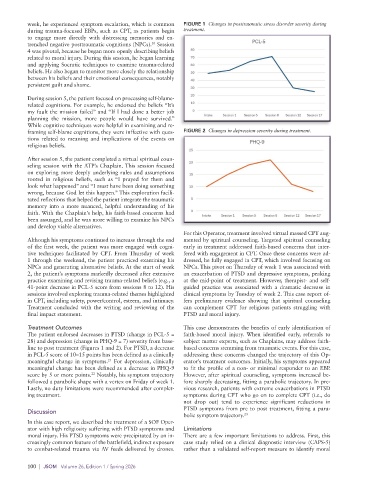
          The patient endorsed decreases in PTSD (change in PCL-5 =   faith-based moral injury.  When identified early, referrals to
          28) and depression (change in PHQ-9 = 7) severity from base-  subject matter experts, such as Chaplains, may address faith-
          line to post treatment (Figures 1 and 2). For PTSD, a decrease   based concerns stemming from traumatic events. For this case,
          in PCL-5 score of 10–15 points has been defined as a clinically   addressing these concerns changed the trajectory of this Op-
          meaningful change in symptoms.  For depression, clinically   erator’s treatment outcomes. Initially, his symptoms appeared
                                    21
          meaningful change has been defined as a decrease in PHQ-9   to fit the profile of a non- or minimal responder to an EBP.
                               22
          score by 5 or more points.  Notably, his symptom trajectory   However, after spiritual counseling, symptoms increased be-
          followed a parabolic shape with a vertex on Friday of week 1.   fore sharply decreasing, fitting a parabolic trajectory. In pre-
          Lastly, no duty limitations were recommended after complet-  vious research, patients with extreme exacerbations in PTSD
          ing treatment.                                     symptoms during CPT who go on to complete CPT (i.e., do
                                                             not drop out) tend to experience significant reductions in
                                                             PTSD symptoms from pre to post treatment, fitting a para-
          Discussion
                                                             bolic symptom trajectory. 23
          In this case report, we described the treatment of a SOF Oper-
          ator with high religiosity suffering with PTSD symptoms and   Limitations
          moral injury. His PTSD symptoms were precipitated by an in-  There are a few important limitations to address. First, this
          creasingly common feature of the battlefield, indirect exposure   case study relied on a clinical diagnostic interview (CAPS-5)
          to combat-related trauma via AV feeds delivered by drones.   rather than a validated self-report measure to identify moral

          100  |  JSOM   Volume 26, Edition 1 / Spring 2026

