


Page 101 - JSOM Spring 2026
P. 101
Case Context                                       phone, tablet, laptop, or desktop computer). Exclusionary cri-
                                                                 teria include unstable housing, non-independent activities of
              This case report describes treatment completed at an acceler-  daily living, suicide attempt within 30 days, untreated psycho-
              ated treatment program (ATP) for PTSD in Chicago, IL. This   sis or mania, or substance use dependence.
              program offers two formats of massed treatments for PTSD: 1)
              an in-person format offering individual sessions and a mixture
              of groups and adjunctive services or 2) a virtual, stand-alone   Case Description and Formulation
              treatment format offered via the Interjurisdictional Practice   The patient is a 40-year-old married White male SOF Officer
              of  Psychology compact (PSYPACT). In this case report, the   with high religiosity. He sought treatment after experiencing
              Servicemember selected the virtual format, which involved 16   an indirect trauma exposure via live-stream drone  AV feed
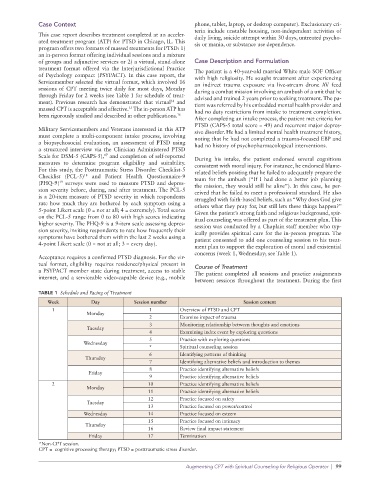
              sessions of CPT meeting twice daily for most days, Monday   during a combat mission involving an ambush of a unit that he
              through Friday for 2 weeks (see Table 1 for schedule of treat-  advised and trained 2 years prior to seeking treatment. The pa-
              ment). Previous research has demonstrated that virtual  and   tient was referred by his embedded mental health provider and
                                                         14
              massed CPT is acceptable and effective.  The in-person ATP has   had no duty restrictions from intake to treatment completion.
                                           15
              been rigorously studied and described in other publications. 16  After completing an intake process, the patient met criteria for
                                                                 PTSD (CAPS-5 total score = 49) and recurrent major depres-
              Military Servicemembers and Veterans interested in this ATP   sive disorder. He had a limited mental health treatment history,
              must complete a multi-component  intake process, involving   noting that he had not completed a trauma-focused EBP and
              a biopsychosocial evaluation, an assessment of PTSD using   had no history of psychopharmacological interventions.
              a structured interview via the Clinician Administered PTSD
              Scale for DSM-5 (CAPS-5),  and completion of self-reported   During his intake, the patient endorsed several cognitions
                                   17
              measures to determine program eligibility and suitability.   consistent with moral injury. For instance, he endorsed blame-
              For this study, the Posttraumatic Stress Disorder Checklist-5   related beliefs positing that he failed to adequately prepare the
              Checklist (PCL-5)  and Patient Health Questionnaire-9   team for the ambush (“If I had done a better job planning
                            18
              (PHQ-9)  surveys were used to measure PTSD and depres-  the mission, they would still be alive”). In this case, he per-
                    19
              sion severity before, during, and after treatment. The PCL-5   ceived that he failed to meet a professional standard. He also
              is a 20-item measure of PTSD severity in which respondents   struggled with faith-based beliefs, such as “Why does God give
              rate how much they are bothered by each symptom using a   others what they pray for, but still lets these things happen?”
              5-point Likert scale (0 = not at all; 4 = extremely). Total scores   Given the patient’s strong faith and religious background, spir-
              on the PCL-5 range from 0 to 80 with high scores indicating   itual counseling was offered as part of the treatment plan. This
              higher severity. The PHQ-9 is a 9-item scale assessing depres-  session was conducted by a Chaplain staff member who typ-
              sion severity, inviting respondents to rate how frequently their   ically provides spiritual care for the in-person program. The
              symptoms have bothered them within the last 2 weeks using a   patient consented to add one counseling session to his treat-
              4-point Likert scale (0 = not at all; 3 = every day).  ment plan to support the exploration of moral and existential
                                                                 concerns (week 1, Wednesday; see Table 1).
              Acceptance requires a confirmed PTSD diagnosis. For the vir-
              tual format, eligibility requires residence/physical present in   Course of Treatment
              a PSYPACT member state during treatment, access to stable   The patient completed all sessions and practice assignments
              internet, and a serviceable video-capable device (e.g., mobile   between sessions throughout the treatment. During the first

              TABLE 1  Schedule and Pacing of Treatment
                 Week          Day           Session number                      Session content
                  1                               1         Overview of PTSD and CPT
                             Monday
                                                  2         Examine impact of trauma
                                                  3         Monitoring relationship between thoughts and emotions
                             Tuesday
                                                  4         Examining index event by exploring questions
                                                  5         Practice with exploring questions
                            Wednesday
                                                  *         Spiritual counseling session
                                                  6         Identifying patterns of thinking
                             Thursday
                                                  7         Identifying alternative beliefs and introduction to themes
                                                  8         Practice identifying alternative beliefs
                              Friday
                                                  9         Practice identifying alternative beliefs
                  2                              10         Practice identifying alternative beliefs
                             Monday
                                                 11         Practice identifying alternative beliefs
                                                 12         Practice focused on safety
                             Tuesday
                                                 13         Practice focused on power/control
                            Wednesday            14         Practice focused on esteem
                                                 15         Practice focused on intimacy
                             Thursday
                                                 16         Review final impact statement
                              Friday             17         Termination
              *Non-CPT session.
              CPT =  cognitive processing therapy; PTSD = posttraumatic stress disorder.

                                                              Augmenting CPT with Spiritual Counseling for Religious Operator  |  99

