


Page 97 - JSOM Winter 2025
P. 97
Introduction to
                                           Tactical Combat Casualty Care

                                                     11 October 2022


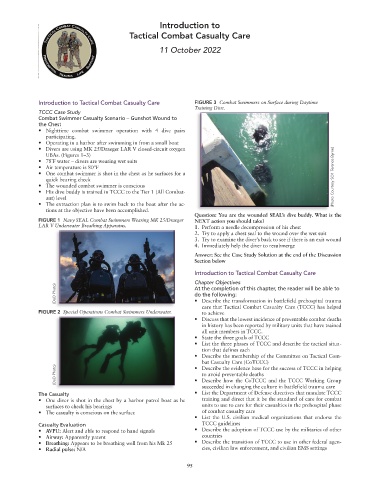
              Introduction to Tactical Combat Casualty Care      FIGURE 3  Combat Swimmers on Surface during Daytime
                                                                 Training Dive.
              TCCC Case Study
              Combat Swimmer Casualty Scenario – Gunshot Wound to
              the Chest
              •  Nighttime combat swimmer operation with  4  dive pairs
                participating.
              •  Operating in a harbor after swimming in from a small boat
              •  Divers are using MK 25/Draeger LAR V closed-circuit oxygen
                UBAs. (Figures 1–3)
                  º
              •  78 F water – divers are wearing wet suits
              •  Air temperature is 80ºF
              •  One combat swimmer is shot in the chest as he surfaces for a
                quick bearing check                                                                           (Photo Courtesy SO1 Terence Byrne)
              •  The wounded combat swimmer is conscious
              •  His dive buddy is trained in TCCC to the Tier 1 (All Combat-
                ant) level
              •  The extraction plan is to swim back to the boat after the ac-
                tions at the objective have been accomplished.
                                                                 Question: You are the wounded SEAL’s dive buddy. What is the
              FIGURE 1  Navy SEAL Combat Swimmers Wearing MK 25/Draeger   NEXT action you should take?
              LAR V Underwater Breathing Apparatus.              1.  Perform a needle decompression of his chest
                                                                 2.  Try to apply a chest seal to the wound over the wet suit
                                                                 3.  Try to examine the diver’s back to see if there is an exit wound
                                                                 4.  Immediately help the diver to resubmerge
                                                                 Answer: See the Case Study Solution at the end of the Discussion
                                                                 Section below

                                                                 Introduction to Tactical Combat Casualty Care
                                                                 Chapter Objectives
                   (DoD Photo)                                   At the completion of this chapter, the reader will be able to
                                                                 do the following:
                                                                 •  Describe the transformation in battlefield prehospital trauma
                                                                   care that Tactical Combat Casualty Care (TCCC) has helped
              FIGURE 2  Special Operations Combat Swimmers Underwater.  to achieve
                                                                 •  Discuss that the lowest incidence of preventable combat deaths
                                                                   in history has been reported by military units that have trained
                                                                   all unit members in TCCC.
                                                                 •  State the three goals of TCCC
                                                                 •  List the three phases of TCCC and describe the tactical situa-
                                                                   tion that defines each
                                                                 •  Describe the membership of the Committee on Tactical Com-
                                                                   bat Casualty Care (CoTCCC)
                   (DoD Photo)                                   •  Describe how the CoTCCC and the TCCC Working Group
                                                                 •  Describe the evidence base for the success of TCCC in helping
                                                                   to avoid preventable deaths
                                                                   succeeded in changing the culture in battlefield trauma care
              The Casualty                                       •  List the Department of Defense directives that mandate TCCC
              •  One diver is shot in the chest by a harbor patrol boat as he   training and direct that it be the standard of care for combat
                surfaces to check his bearings                     units to use to care for their casualties in the prehospital phase
              •  The casualty is conscious on the surface          of combat casualty care
                                                                 •  List the U.S. civilian medical organizations that endorse the
              Casualty Evaluation                                  TCCC guidelines
              •  AVPU: Alert and able to respond to hand signals  •  Describe the adoption of TCCC use by the militaries of other
              •  Airway: Apparently patent                         countries
              •  Breathing: Appears to be breathing well from his Mk 25  •  Describe the transition of TCCC to use in other federal agen-
              •  Radial pulse: N/A                                 cies, civilian law enforcement, and civilian EMS settings

                                                              95

