


Page 92 - JSOM Winter 2025
P. 92
Proposed New Wording in the TCCC Guidelines        evaluating these effects at new MTFs, similar to the data being
          (changes in bolded italics)                        collected from the ongoing conflict in Ukraine.
          9.  Penetrating Eye Trauma
            a.  If a penetrating eye injury is noted or suspected:  Lastly, more studies on the validity and impact of self-reported
               •  Perform a rapid field test of visual acuity and docu-  and charted penicillin allergies at the time of military recruit-
                 ment findings.                              ment and beyond with the ultimate goal of allergy delabeling
               •  Cover the eye with a rigid eye shield (NOT a pressure   can have significant downstream effects on the safety of the
                 patch).                                     warfighter.
               •  Administer ceftriaxone 2g IV or IM (recommended),
                 or cephalexin 500mg or cefadroxil 1g orally as soon   Disclosures
                 as possible.                                The authors have the following disclosures:
          12.  Antibiotics                                   CAPT (Ret) Butler is the President of DSO Medical Associates,
              a.  Antibiotics recommended for all open combat   an LLC that provides medicolegal consultation on diving and
                wounds and invasive procedures               Special Operations medical issues. He is also the first author
              b.  If able to take PO medications:            of “Tell Them Yourself – It’s Not Your Day to Day,” a history
                •  Cefadroxil 1g PO once a day (recommended).  of the origin and evolution of TCCC.
                •  Cephalexin 500mg PO four times daily (alternative).
              c.  If unable to take PO medications (shock,   CAPT (Ret) Maves has received research support paid to his
                unconsciousness):                            institution from AiCuris, Merck, GeoVax, and Biotest. He has
                •  Ceftriaxone 2g IM/IO/IV once a day.       received consultancy fees from Shionogi and GSK. He receives
                                                             travel expenses and honoraria for the American Board of In-
                                                             ternal Medicine for his service as Chair, Critical Care Medicine
          Results of CoTCCC Vote:                            Examination Approval Committee.
          This proposed change was approved by the required 3/4 or
          greater majority of the voting members of the CoTCCC.
                                                             Disclaimer
                                                             The views expressed in this presentation are those of the au-
          Levels of Evidence                                 thors and do not necessarily reflect the official policy or posi-
          Questions 1 and 2 are graded Level A.
          Questions 3 and 4 are graded Level B-NR.           tion of the Department of the Navy, Department of Defense,
                                                             Defense Health Agency, nor the U.S. Government.
          Considerations for Future Research and Development  We are employees of the U.S. Government. This work was pre-
          A promising area of future research is the use of topical an-  pared as part of our official duties. Title 17 U.S.C. §105 pro-
          tibiotics in combat wounds/environments. Several studies are   vides that copyright protection under this title is not available
          currently being conducted primarily in small special forces   for any work of the United States Government. Title 17 U.S.C.
          units which can ideally be applied to the TCCC environment.   §101 defines a United States Government work as a work pre-
          While imperfect, continued research in civilian trauma settings   pared by a military service member or employee of the United
          can continue to inform future avenues for military-focused   States Government as part of that person’s official duties.
          research.
          The long-term impact  of the revised  antibiotic selection on   Publication Clearance
          resistance patterns in higher levels of care will take time to   This document was reviewed by the Chief of the Joint Trauma
          become evident but requires close monitoring.  While some   System and by the Public Affairs Office and the Operational
          practices may already be established at previously utilized   Security Office at the Defense Health Agency. It is approved
          Military Treatment Facilities (MTFs), the emergence of new   for unlimited public release.
          operational theaters presents an opportunity to continue


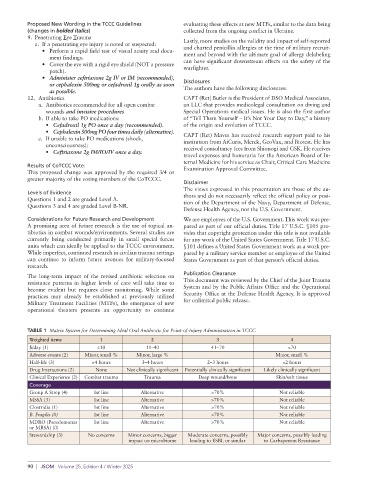
          TABLE 1  Matrix System for Determining Ideal Oral Antibiotic for Point-of-Injury Administration in TCCC
           Weighted items         1               2                     3                       4
           $/day (1)             ≤10             11–40                41–70                    >70
           Adverse events (2)   Minor, small %  Minor, large %                             Major, small %
           Half-life (3)       >4 hours        3–4 hours             2–3 hours               <2 hours
           Drug Interactions (2)   None   Not clinically significant  Potentially clinically significant   Likely clinically significant
           Clinical Experience (2)   Combat trauma  Trauma        Deep wound/bone          Skin/soft tissue
           Coverage
           Group A Strep (4)    1st line       Alternative            >70%                  Not reliable
           MSSA (3)             1st line       Alternative            >70%                  Not reliable
           Clostridia (1)       1st line       Alternative            >70%                  Not reliable
           B. Fragilis (0)      1st line       Alternative            >70%                  Not reliable
           MDRO (Pseudomonas    1st line       Alternative            >70%                  Not reliable
           or MRSA) (0)
           Stewardship (3)    No concerns  Minor concerns, bigger   Moderate concerns, possibly   Major concerns, possibly leading
                                           impact on microbiome  leading to ESBL or similar  to Carbapenem Resistance


          90  |  JSOM   Volume 25, Edition 4 / Winter 2025

