


Page 225 - 2023 SMOG Digital
P. 225
o In pelvic wounds – utilize pelvic binding to limit capacity for hemorrhage (tie
pelvis with sheet/commercial binder).
o For external hemorrhage of the head and neck where the wound edges can
be easily re-approximated, the iTClamp may be used as a primary option for
hemorrhage control. Wounds should be packed with a hemostatic dressing or
XStat, if appropriate, prior to iTClamp application. DO NOT APPLY on or near
the eye or eyelid (within 1cm of the orbit).
The iTClamp does not require additional direct pressure, either when
used alone or in combination with other hemostatic adjuncts.
If the iTClamp is applied to the neck, perform frequent airway
monitoring and evaluate for an expanding hematoma that may
compromise the airway. Consider placing a definitive airway if there is
evidence of an expanding hematoma.
o Administer IVFs as per guideline – use care with internal bleeding so as not to
raise SBP above 80mmHg. MAP should be greater than >60mmHg.
o Consider 2g TXA if significant blood loss.
Document procedure, results, and vital signs.
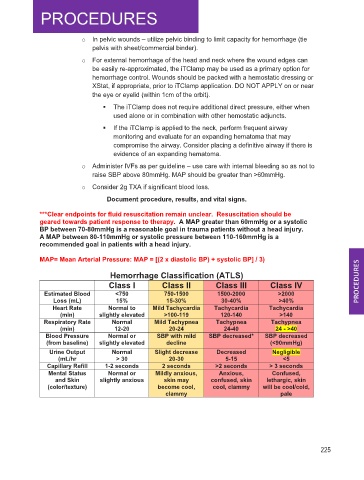
***Clear endpoints for fluid resuscitation remain unclear. Resuscitation should be
geared towards patient response to therapy. A MAP greater than 60mmHg or a systolic
BP between 70-80mmHg is a reasonable goal in trauma patients without a head injury.
A MAP between 80-110mmHg or systolic pressure between 110-160mmHg is a
recommended goal in patients with a head injury.
MAP= Mean Arterial Pressure: MAP = [(2 x diastolic BP) + systolic BP] / 3)
Hemorrhage Classification (ATLS)
Class I Class II Class III Class IV
Estimated Blood <750 750-1500 1500-2000 >2000
Loss (mL) 15% 15-30% 30-40% >40%
Heart Rate Normal to Mild Tachycardia Tachycardia Tachycardia
(min) slightly elevated >100-119 120-140 >140
Respiratory Rate Normal Mild Tachypnea Tachypnea Tachypnea
(min) 12-20 20-24 24-40 24 - >40
Blood Pressure Normal or SBP with mild SBP decreased* SBP decreased
(from baseline) slightly elevated decline (<90mmHg)
Urine Output Normal Slight decrease Decreased Negligible
(mL/hr > 30 20-30 5-15 <5
Capillary Refill 1-2 seconds 2 seconds >2 seconds > 3 seconds
Mental Status Normal or Mildly anxious, Anxious, Confused,
and Skin slightly anxious skin may confused, skin lethargic, skin
(color/texture) become cool, cool, clammy will be cool/cold,
clammy pale
225

