


Page 221 - 2023 SMOG Digital
P. 221
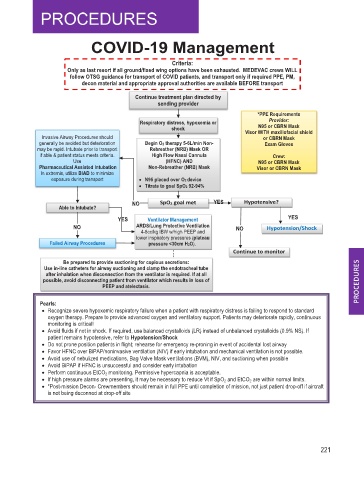
COVID-19 Management


                                      Criteria:


                Only as last resort if all ground/fixed wing options have been exhausted.  MEDEVAC crews WILL
                follow OTSG guidance for transport of COVID patients, and transport only if required PPE, PM,
                   decon material and appropriate approval authorities are available BEFORE transport
                              Continue treatment plan directed by
                                   sending provider
                                                         *PPE Requirements
                               Respiratory distress, hypoxemia or   Provider:
                                                         N95 or CBRN Mask
                                      shock           Visor WITH maxillofacial shield
          Invasive Airway Procedures should               or CBRN Mask
          generally be avoided but deterioration   Begin O2 therapy 5-6L/min Non-  Exam Gloves
         may be rapid. Intubate prior to transport   Rebreather (NRB) Mask OR
          if able & patient status meets criteria.   High Flow Nasal Cannula   Crew:
                 Use                 (HFNC) AND          N95 or CBRN Mask
          Pharmaceutical Assisted Intubation    Non-Rebreather (NRB) Mask   Visor or CBRN Mask
          In extremis, utilize BIAD to minimize
            exposure during transport   • N95 placed over O2 device
                               • Titrate to goal SpO2 92-94%
                              NO    SpO2 goal met   YES   Hypotensive?
              Able to Intubate?
                           YES   Ventilator Management          YES
                 NO            ARDS/Lung Protective Ventilation   NO   Hypotension/Shock
                                4-8cc/kg IBW w/high PEEP and
                               lower inspiratory pressures (plateau
            Failed Airway Procedures   pressure <30cm H2O).
                                                    Continue to monitor
               Be prepared to provide suctioning for copious secretions:
           Use in-line catheters for airway suctioning and clamp the endotracheal tube
           after inhalation when disconnection from the ventilator is required. If at all
          possible, avoid disconnecting patient from ventilator which results in loss of
                       PEEP and atelectasis.
          Pearls:
          • Recognize severe hypoxemic respiratory failure when a patient with respiratory distress is failing to respond to standard
           oxygen therapy. Prepare to provide advanced oxygen and ventilatory support. Patients may deteriorate rapidly, continuous
           monitoring is critical!
          • Avoid fluids if not in shock. If required, use balanced crystalloids (LR) instead of unbalanced crystalloids (0.9% NS). If
           patient remains hypotensive, refer to Hypotension/Shock
          • Do not prone position patients in flight; rehearse for emergency re-proning in event of accidental lost airway
          • Favor HFNC over BiPAP/noninvasive ventilation (NIV) if early intubation and mechanical ventilation is not possible.
          • Avoid use of nebulized medications, Bag Valve Mask ventilations (BVM), NIV, and suctioning when possible
          • Avoid BiPAP if HFNC is unsuccessful and consider early intubation
          • Perform continuous EtCO 2  monitoring. Permissive hypercapnia is acceptable.
          • If high pressure alarms are presenting, it may be necessary to reduce Vt if SpO 2  and EtCO 2  are within normal limits.
          • *Post-mission Decon- Crewmembers should remain in full PPE until completion of mission, not just patient drop-off if aircraft
           is not being deconned at drop-off site


                                                                       221

