


Page 58 - 2022 Ranger Medic Handbook
P. 58
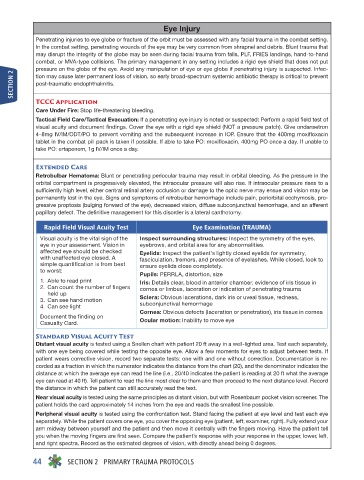
Eye Injury
         Penetrating injuries to eye globe or fracture of the orbit must be assessed with any facial trauma in the combat setting.
         In the combat setting, penetrating wounds of the eye may be very common from shrapnel and debris. Blunt trauma that
         may disrupt the integrity of the globe may be seen during facial trauma from falls, PLF, FRIES landings, hand-to-hand
         combat, or MVA-type collisions. The primary management in any setting includes a rigid eye shield that does not put
         pressure on the globe of the eye. Avoid any manipulation of eye or eye globe if penetrating injury is suspected. Infec-
    SECTION 2  post-traumatic endophthalmitis.
         tion may cause later permanent loss of vision, so early broad-spectrum systemic antibiotic therapy is critical to prevent

         TCCC Application
         Care Under Fire: Stop life-threatening bleeding.
         Tactical Field Care/Tactical Evacuation: If a penetrating eye injury is noted or suspected: Perform a rapid field test of
         visual acuity and document findings. Cover the eye with a rigid eye shield (NOT a pressure patch). Give ondansetron
         4–8mg IV/IM/ODT/PO to prevent vomiting and the subsequent increase in IOP. Ensure that the 400mg moxifloxacin
         tablet in the combat pill pack is taken if possible. If able to take PO: moxifloxacin, 400mg PO once a day. If unable to
         take PO: ertapenem, 1g IV/IM once a day.
         Extended Care
         Retrobulbar Hematoma: Blunt or penetrating periocular trauma may result in orbital bleeding. As the pressure in the
         orbital compartment is progressively elevated, the intraocular pressure will also rise. If intraocular pressure rises to a
         sufficiently high level, either central retinal artery occlusion or damage to the optic nerve may ensue and vision may be
         permanently lost in the eye. Signs and symptoms of retrobulbar hemorrhage include pain, periorbital ecchymosis, pro-
         gressive proptosis (bulging forward of the eye), decreased vision, diffuse subconjunctival hemorrhage, and an afferent
         papillary defect. The definitive management for this disorder is a lateral canthotomy.
           Rapid Field Visual Acuity Test  Eye Examination (TRAUMA)
          Visual acuity is the vital sign of the   Inspect surrounding structures: Inspect the symmetry of the eyes,
          eye in your assessment. Vision in   eyebrows, and orbital area for any abnormalities.
          affected eye should be checked   Eyelids: Inspect the patient’s lightly closed eyelids for symmetry,
          with unaffected eye closed. A   fasciculation, tremors, and presence of eyelashes. While closed, look to
          simple quantification is from best   ensure eyelids close completely.
          to worst:
                               Pupils: PERRLA, distortion, size
          1.  Able to read print  Iris: Details clear, blood in anterior chamber, evidence of iris tissue in
          2.   Can count the number of fingers   cornea or limbus, laceration or indication of penetrating trauma
           held up
          3.  Can see hand motion  Sclera: Obvious lacerations, dark iris or uveal tissue, redness,
          4.  Can see light    subconjunctival hemorrhage
                               Cornea: Obvious defects (laceration or penetration), iris tissue in cornea
          Document the finding on
          Casualty Card.       Ocular motion: Inability to move eye
         Standard Visual Acuity Test
         Distant visual acuity is tested using a Snellen chart with patient 20 ft away in a well-lighted area. Test each separately,
         with one eye being covered while testing the opposite eye. Allow a few moments for eyes to adjust between tests. If
         patient wears corrective vision, record two separate tests: one with and one without correction. Documentation is re-
         corded as a fraction in which the numerator indicates the distance from the chart (20), and the denominator indicates the
         distance at which the average eye can read the line (i.e., 20/40 indicates the patient is reading at 20 ft what the average
         eye can read at 40 ft). Tell patient to read the line most clear to them and then proceed to the next distance level. Record
         the distance in which the patient can still accurately read the text.
         Near visual acuity is tested using the same principles as distant vision, but with Rosenbaum pocket vision screener. The
         patient holds the card approximately 14 inches from the eye and reads the smallest line possible.
         Peripheral visual acuity is tested using the confrontation test. Stand facing the patient at eye level and test each eye
         separately. While the patient covers one eye, you cover the opposing eye (patient, left; examiner, right). Fully extend your
         arm midway between yourself and the patient and then move it centrally with the fingers moving. Have the patient tell
         you when the moving fingers are first seen. Compare the patient’s response with your response in the upper, lower, left,
         and right spectra. Record as the estimated degrees of vision, with directly ahead being 0 degrees.
        44      SECTION 2   PRIMARY TRAUMA PROTOCOLS

