


Page 216 - 2022 Ranger Medic Handbook
P. 216
Antifreeze: Minimum lethal dose of undiluted ethylene glycol (what makes up most antifreeze) in an MPC is about 132mL.
         Clinical signs – within 1 hour of exposure vomiting, polydipsia, polyuria, and neurologic signs such as ataxia, stupor,
         and knuckling can occur. Oliguric (abnormally small amounts of urine). Renal failure occurs between 36 and 72 hours.
         These animals are lethargic, dehydrated, vomit, can have diarrhea, salivate excessively, sometimes have oral ulcers,
         breathe fast, can seizure, or present in a coma.
         Treatment – Generally requires veterinary care facility. If unavailable: Induce vomiting if within 2 hours of ingestion. Acti-
         vated charcoal is ineffective. If the animal is still producing urine and not already oliguric or anuric, then 4-methypryrazole
         (fomepizole – costs $1,000) can be given IV at 20mg/kg (600mg) initially then 15mg/kg (940mg) 12, 24, and 36 hours
         later to block metabolism of ethylene glycol by alcohol dehydrogenase. 5.5mL/kg (165mL) of 20% ethanol (e.g., 40 proof
         “everclear”) in IV fluids can be given over 6 hours for five treatments and then over 8 hours for 4 more treatments. It com-
         petitively inhibits ethylene glycol from getting broken down by the enzyme (alcohol dehydrogenase). The metabolites
         are the problem. Metabolic acidosis likely needs monitored and treated with NaHCO 3  in fluids. Use 0.3 – (0.5 × 30kg) ×
         (24 – plasma HCO 3 ) gives you the mEq of bicarbonate to administer. Give half this dose IV slowly and monitor plasma
         bicarbonate every 4 hours. Fluid therapy to replace dehydration (% dehydrated × bwt in kg × 0.6, so 5% dehydrated
         × 30kg × 0.6 = 0.9L) can be administered over 2–4 hours while simultaneously monitoring urine output (normal urine
         output is 30–60mL/hr). If urine output is less than 15mL/hr the MPC is oliguric. Oliguria and anuria in dogs with ethylene
         glycol toxicity have a poor prognosis. Anuric animals should only have small amounts of fluid given to replace loses from
         respiration, defecation etc. If the animal is not anuric, continue kidney diuresis at maintenance rates of 60mL/kg/day
         (75mL/hr) with LR or Plasma-Lyte, continuing to monitor urine output.
         C6.  Canine CBRNE
         Triage: Take care of yourself and other Rangers first. Move affected Soldiers first. Use the following guide when man-
         power can be spared for an MPC.
         M 4 A 2 R 2 C 2 H 2  In a CBRNE environment terminate the exposure first. Move out of the contaminated area. Dogs do not
         have masks so inhalation is a major concern. Consider what is killing the animal and treat that first. Use the algorithm
         when not sure.
         M 1 ove the MPC out of the affected area (terminate the exposure). M 2 uzzle the MPC. M 3 assive hemorrhage (treat).
    SECTION 6  A 1 ntidote (which antidotes depend on the signs, symptoms and knowledge of the agent(s) being used against you via
         M 4 edicate (consider sedation and pain Medication, again – not needed if there is a loss of consciousness).
         M8 paper or JCAD reading) A 2 irway (check that it is clear – choking agents need intubated early on).
         R 1 apid Decontamination There is not really a spot decon for the dog. A full decontamination can occur while awaiting
         evacuation to the decontamination site. Full decontamination should occur again at the designated decon site – see at
         the end of this section. R 2 espirations If there is no physical wound, wheezing or coughing could be a choking agent or
         nerve agent; hypoventilation could be from an opioid agent; apnea or dyspnea could be from cyanide; tracheal/pulmo-
         nary rales (clicking) could be from mustard exposure.
         C 1 irculation treat hypovolemia as before C 2 ountermeasures (oxygen, ventilation support and albuterol may be required
         for Lewisite/Mustard or choking agents).
         H 1 ypothermia and H 2 ead Trauma: Same as before.
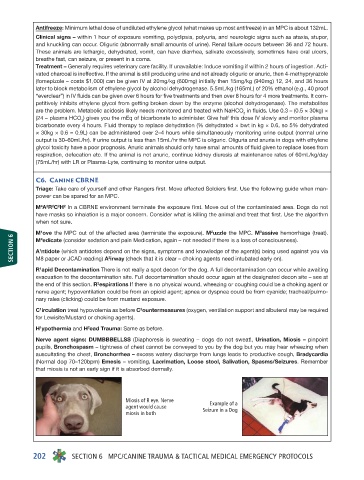
         Nerve agent signs: DUMBBBELLSS (Diaphoresis is sweating – dogs do not sweat!, Urination, Miosis – pinpoint
         pupils, Bronchospasm – tightness of chest cannot be conveyed to you by the dog but you may hear wheezing when
         auscultating the chest, Bronchorrhea – excess watery discharge from lungs leads to productive cough, Bradycardia
         (Normal dog 70–120bpm) Emesis – vomiting, Lacrimation, Loose stool, Salivation, Spasms/Seizures. Remember
         that miosis is not an early sign if it is absorbed dermally.


                            Miosis of R eye. Nerve
                            agent would cause   Example of a
                            miosis in both   Seizure in a Dog


        202      SECTION 6   MPC/CANINE TRAUMA & TACTICAL MEDICAL EMERGENCY PROTOCOLS

