


Page 211 - 2022 Ranger Medic Handbook
P. 211
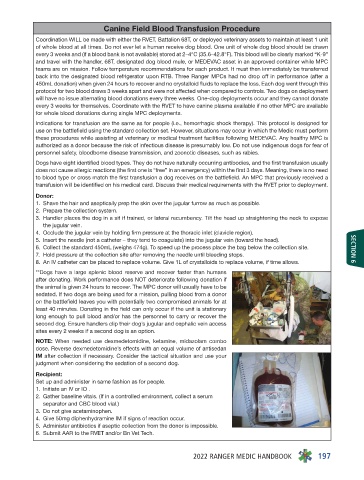
Canine Field Blood Transfusion Procedure
         Coordination WILL be made with either the RVET, Battalion 68T, or deployed veterinary assets to maintain at least 1 unit
         of whole blood at all times. Do not ever let a human receive dog blood. One unit of whole dog blood should be drawn
         every 3 weeks and (if a blood bank is not available) stored at 2–4°C (35.6–42.8°F). This blood will be clearly marked “K-9”
         and travel with the handler, 68T, designated dog blood mule, or MEDEVAC asset in an approved container while MPC
         teams are on mission. Follow temperature recommendations for each product. It must then immediately be transferred
         back into the designated blood refrigerator upon RTB. Three Ranger MPCs had no drop off in performance (after a
         450mL donation) when given 24 hours to recover and no crystalloid fluids to replace the loss. Each dog went through this
         protocol for two blood draws 3 weeks apart and were not affected when compared to controls. Two dogs on deployment
         will have no issue alternating blood donations every three weeks. One-dog deployments occur and they cannot donate
         every 3 weeks for themselves. Coordinate with the RVET to have canine plasma available if no other MPC are available
         for whole blood donations during single MPC deployments.
         Indications for transfusion are the same as for people (i.e., hemorrhagic shock therapy). This protocol is designed for
         use on the battlefield using the standard collection set. However, situations may occur in which the Medic must perform
         these procedures while assisting at veterinary or medical treatment facilities following MEDEVAC. Any healthy MPC is
         authorized as a donor because the risk of infectious disease is presumably low. Do not use indigenous dogs for fear of
         personnel safety, bloodborne disease transmission, and zoonotic diseases, such as rabies.
         Dogs have eight identified blood types. They do not have naturally occurring antibodies, and the first transfusion usually
         does not cause allergic reactions (the first one is “free” in an emergency) within the first 3 days. Meaning, there is no need
         to blood type or cross match the first transfusion a dog receives on the battlefield. An MPC that previously received a
         transfusion will be identified on his medical card. Discuss their medical requirements with the RVET prior to deployment.
         Donor:
         1.  Shave the hair and aseptically prep the skin over the jugular furrow as much as possible.
         2.  Prepare the collection system.
         3.  Handler places the dog in a sit if trained, or lateral recumbency. Tilt the head up straightening the neck to expose
          the jugular vein.
         4.  Occlude the jugular vein by holding firm pressure at the thoracic inlet (clavicle region).
         5.  Insert the needle (not a catheter – they tend to coagulate) into the jugular vein (toward the head).
         6.  Collect the standard 450mL (weighs 474g). To speed up the process place the bag below the collection site.  SECTION 6
         7.  Hold pressure at the collection site after removing the needle until bleeding stops.
         8.  An IV catheter can be placed to replace volume. Give 1L of crystalloids to replace volume, if time allows.
         **Dogs have a large splenic blood reserve and recover faster than humans
         after donating. Work performance does NOT deteriorate following donation if
         the animal is given 24 hours to recover. The MPC donor will usually have to be
         sedated. If two dogs are being used for a mission, pulling blood from a donor
         on the battlefield leaves you with potentially two compromised animals for at
         least 40 minutes. Donating in the field can only occur if the unit is stationary
         long enough to pull blood and/or has the personnel to carry or recover the
         second dog. Ensure handlers clip their dog’s jugular and cephalic vein access
         sites every 2 weeks if a second dog is an option.
         NOTE:  When needed use dexmedetomidine, ketamine, midazolam combo
         dose. Reverse dexmedetomidine’s effects with an equal volume of antisedan
         IM after collection if necessary. Consider the tactical situation and use your
         judgment when considering the sedation of a second dog.
         Recipient:
         Set up and administer in same fashion as for people.
         1.  Initiate an IV or IO .
         2.  Gather baseline vitals. (If in a controlled environment, collect a serum
          separator and CBC blood vial.)
         3.  Do not give acetaminophen.
         4.  Give 50mg diphenhydramine IM if signs of reaction occur.
         5.  Administer antibiotics if aseptic collection from the donor is impossible.
         6.  Submit AAR to the RVET and/or Bn Vet Tech.


                                           2022 RANGER MEDIC HANDBOOK  197

