


Page 188 - 2022 Ranger Medic Handbook
P. 188
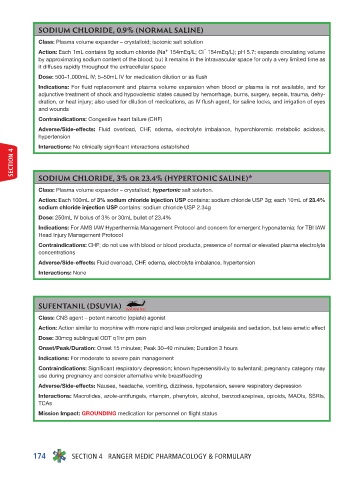
SODIUM CHLORIDE, 0.9% (NORMAL SALINE)
         Class: Plasma volume expander – crystalloid; isotonic salt solution
                                             –
                                     +
         Action: Each 1mL contains 9g sodium chloride (Na  154mEq/L; Cl  154mEq/L); pH 5.7; expands circulating volume
         by approximating sodium content of the blood; but it remains in the intravascular space for only a very limited time as
         it diffuses rapidly throughout the extracellular space
         Dose: 500–1,000mL IV; 5–50mL IV for medication dilution or as flush
         Indications: For fluid replacement and plasma volume expansion when blood or plasma is not available, and for
         adjunctive treatment of shock and hypovolemic states caused by hemorrhage, burns, surgery, sepsis, trauma, dehy-
         dration, or heat injury; also used for dilution of medications, as IV flush agent, for saline locks, and irrigation of eyes
         and wounds
         Contraindications: Congestive heart failure (CHF)
         Adverse/Side-effects:  Fluid  overload,  CHF, edema,  electrolyte  imbalance,  hyperchloremic  metabolic  acidosis,
         hypertension
         Interactions: No clinically significant interactions established
    SECTION 4

         SODIUM CHLORIDE, 3% or 23.4% (HYPERTONIC SALINE) *
         Class: Plasma volume expander – crystalloid; hypertonic salt solution.
         Action: Each 100mL of 3% sodium chloride injection USP contains: sodium chloride USP 3g; each 10mL of 23.4%
         sodium chloride injection USP contains: sodium chloride USP 2.34g
         Dose: 250mL IV bolus of 3% or 30mL bullet of 23.4%
         Indications: For AMS IAW Hyperthermia Management Protocol and concern for emergent hyponatemia; for TBI IAW
         Head Injury Management Protocol
         Contraindications: CHF; do not use with blood or blood products, presence of normal or elevated plasma electrolyte
         concentrations
         Adverse/Side-effects: Fluid overload, CHF, edema, electrolyte imbalance, hypertension
         Interactions: None


         SUFENTANIL (DSUVIA)
         Class: CNS agent – potent narcotic (opiate) agonist
         Action: Action similar to morphine with more rapid and less prolonged analgesia and sedation, but less emetic effect
         Dose: 30mcg sublingual ODT q1hr prn pain
         Onset/Peak/Duration: Onset 15 minutes; Peak 30–40 minutes; Duration 3 hours
         Indications: For moderate to severe pain management
         Contraindications: Significant respiratory depression; known hypersensitivity to sufentanil; pregnancy category may
         use during pregnancy and consider alternative while breastfeeding
         Adverse/Side-effects: Nausea, headache, vomiting, dizziness, hypotension, severe respiratory depression
         Interactions: Macrolides, azole-antifungals, rifampin, phenytoin, alcohol, benzodiazepines, opioids, MAOIs, SSRIs,
         TCAs
         Mission Impact: GROUNDING medication for personnel on flight status


        174      SECTION 4   RANGER MEDIC PHARMACOLOGY & FORMULARY

