


Page 173 - 2022 Ranger Medic Handbook
P. 173
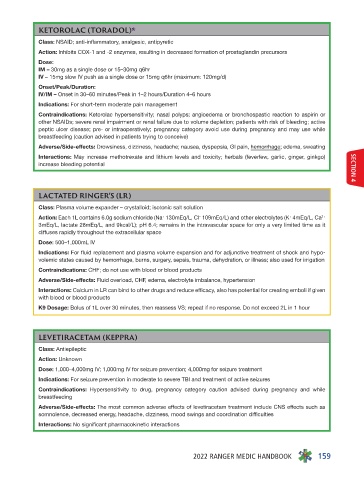
KETOROLAC (TORADOL)  *
         Class: NSAID; anti-inflammatory, analgesic, antipyretic
         Action: Inhibits COX-1 and -2 enzymes, resulting in decreased formation of prostaglandin precursors
         Dose:
         IM – 30mg as a single dose or 15–30mg q6hr
         IV – 15mg slow IV push as a single dose or 15mg q6hr (maximum: 120mg/d)
         Onset/Peak/Duration:
         IV/IM – Onset in 30–60 minutes/Peak in 1–2 hours/Duration 4–6 hours
         Indications: For short-term moderate pain management
         Contraindications: Ketorolac hypersensitivity; nasal polyps; angioedema or bronchospastic reaction to aspirin or
         other NSAIDs; severe renal impairment or renal failure due to volume depletion; patients with risk of bleeding; active
         peptic ulcer disease; pre- or intraoperatively; pregnancy category avoid use during pregnancy and may use while
         breastfeeding (caution advised in patients trying to conceive)
         Adverse/Side-effects: Drowsiness, dizziness, headache; nausea, dyspepsia, GI pain, hemorrhage; edema, sweating
         Interactions:  May increase methotrexate and lithium levels and toxicity; herbals (fever few, garlic, ginger, ginkgo)
         increase bleeding potential                                         SECTION 4


         LACTATED RINGER’S (LR)
         Class: Plasma volume expander – crystalloid; isotonic salt solution
         Action: Each 1L contains 6.0g sodium chloride (Na +  130mEq/L, Cl –  109mEq/L) and other electrolytes (K +  4mEq/L, Ca 2+
         3mEq/L, lactate 28mEq/L, and 9kcal/L); pH 6.4; remains in the intravascular space for only a very limited time as it
         diffuses rapidly throughout the extracellular space
         Dose: 500–1,000mL IV
         Indications: For fluid replacement and plasma volume expansion and for adjunctive treatment of shock and hypo-
         volemic states caused by hemorrhage, burns, surgery, sepsis, trauma, dehydration, or illness; also used for irrigation
         Contraindications: CHF; do not use with blood or blood products
         Adverse/Side-effects: Fluid overload, CHF, edema, electrolyte imbalance, hypertension
         Interactions: Calcium in LR can bind to other drugs and reduce efficacy, also has potential for creating emboli if given
         with blood or blood products
         K9 Dosage: Bolus of 1L over 30 minutes, then reassess VS; repeat if no response. Do not exceed 2L in 1 hour


         LEVETIRACETAM (KEPPRA)
         Class: Antiepileptic
         Action: Unknown
         Dose: 1,000–4,000mg IV; 1,000mg IV for seizure prevention; 4,000mg for seizure treatment
         Indications: For seizure prevention in moderate to severe TBI and treatment of active seizures
         Contraindications:  Hypersensitivity to drug, pregnancy category caution advised during pregnancy and while
         breastfeeding
         Adverse/Side-effects: The most common adverse effects of levetiracetam treatment include CNS effects such as
         somnolence, decreased energy, headache, dizziness, mood swings and coordination difficulties
         Interactions: No significant pharmacokinetic interactions


                                           2022 RANGER MEDIC HANDBOOK  159

