


Page 172 - 2022 Ranger Medic Handbook
P. 172
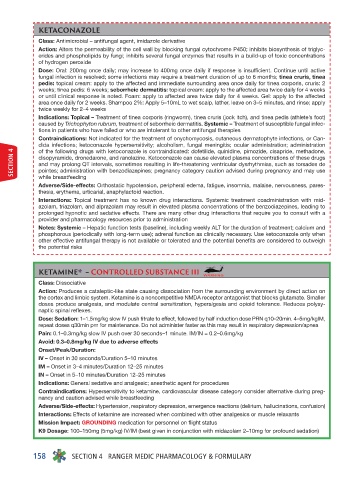
KETACONAZOLE
         Class: Antimicrobial – antifungal agent, imidazole derivative
         Action: Alters the permeability of the cell wall by blocking fungal cytochrome P450; inhibits biosynthesis of triglyc-
         erides and phospholipids by fungi; inhibits several fungal enzymes that results in a build-up of toxic concentrations
         of hydrogen peroxide
         Dose: Oral: 200mg once daily; may increase to 400mg once daily if response is insufficient. Continue until active
         fungal infection is resolved; some infections may require a treatment duration of up to 6 months; tinea cruris, tinea
         pedis: topical cream: apply to the affected and immediate surrounding area once daily for tinea corporis, cruris: 2
         weeks; tinea pedis: 6 weeks; seborrheic dermatitis: topical cream: apply to the affected area twice daily for 4 weeks
         or until clinical response is noted. Foam: apply to affected area twice daily for 4 weeks. Gel: apply to the affected
         area once daily for 2 weeks. Shampoo 2%: Apply 5–10mL to wet scalp, lather, leave on 3–5 minutes, and rinse; apply
         twice weekly for 2–4 weeks
         Indications: Topical – Treatment of tinea corporis (ringworm), tinea cruris (jock itch), and tinea pedis (athlete’s foot)
         caused by Trichophyton rubrum, treatment of seborrheic dermatitis. Systemic – Treatment of susceptible fungal infec-
         tions in patients who have failed or who are intolerant to other antifungal therapies
         Contraindications: Not indicated for the treatment of onychomycosis, cutaneous dermatophyte infections, or Can-
         dida infections; ketoconazole hypersensitivity;  alcoholism, fungal meningitis; ocular administration; administration
         of the following drugs with ketoconazole is contraindicated: dofetilide, quinidine, pimozide, cisapride, methadone,
    SECTION 4  disopyramide, dronedarone, and ranolazine. Ketoconazole can cause elevated plasma concentrations of these drugs
         and may prolong QT intervals, sometimes resulting in life-threatening ventricular dysrhythmias, such as torsades de
         pointes; administration with benzodiazepines; pregnancy category caution advised during pregnancy and may use
         while breastfeeding
         Adverse/Side-effects: Orthostatic hypotension, peripheral edema, fatigue, insomnia, malaise, nervousness, pares-
         thesia, erythema, urticarial, anaphylactoid reaction.
         Interactions:  Topical  treatment  has  no known drug  interactions. Systemic  treatment  coadministration with  mid-
         azolam, triazolam, and alprazolam may result in elevated plasma concentrations of the benzodiazepines, leading to
         prolonged hypnotic and sedative effects. There are many other drug interactions that require you to consult with a
         provider and pharmacology resources prior to administration
         Notes: Systemic – Hepatic function tests (baseline), including weekly ALT for the duration of treatment; calcium and
         phosphorous (periodically with long-term use); adrenal function as clinically necessary. Use ketoconazole only when
         other effective antifungal therapy is not available or tolerated and the potential benefits are considered to outweigh
         the potential risks
         KETAMINE *  – CONTROLLED SUBSTANCE III
         Class: Dissociative
         Action: Produces a cataleptic-like state causing dissociation from the surrounding environment by direct action on
         the cortex and limbic system. Ketamine is a noncompetitive NMDA receptor antagonist that blocks glutamate. Smaller
         doses produce analgesia, and modulate central sensitization, hyperalgesia and opioid tolerance. Reduces polysy-
         naptic spinal reflexes.
         Dose: Sedation: 1–1.5mg/kg slow IV push titrate to effect, followed by half induction dose PRN q10–20min. 4–5mg/kgIM,
         repeat doses q30min prn for maintenance. Do not administer faster as this may result in respiratory depression/apnea
         Pain: 0.1–0.3mg/kg slow IV push over 30 seconds–1 minute. IM/IN = 0.2–0.6mg/kg
         Avoid: 0.3–0.8mg/kg IV due to adverse effects
         Onset/Peak/Duration:
         IV – Onset in 30 seconds/Duration 5–10 minutes
         IM – Onset in 3–4 minutes/Duration 12–25 minutes
         IN – Onset in 5–10 minutes/Duration 12–25 minutes
         Indications: General sedative and analgesic; anesthetic agent for procedures
         Contraindications: Hypersensitivity to ketamine, cardiovascular disease category consider alternative during preg-
         nancy and caution advised while breastfeeding
         Adverse/Side-effects: Hypertension, respiratory depression, emergence reactions (delirium, hallucinations, confusion)
         Interactions: Effects of ketamine are increased when combined with other analgesics or muscle relaxants
         Mission Impact: GROUNDING medication for personnel on flight status
         K9 Dosage: 100–150mg (5mg/kg) IV/IM (best given in conjunction with midazolam 2–10mg for profound sedation)

        158      SECTION 4   RANGER MEDIC PHARMACOLOGY & FORMULARY

