


Page 25 - JSOM Fall 2025
P. 25
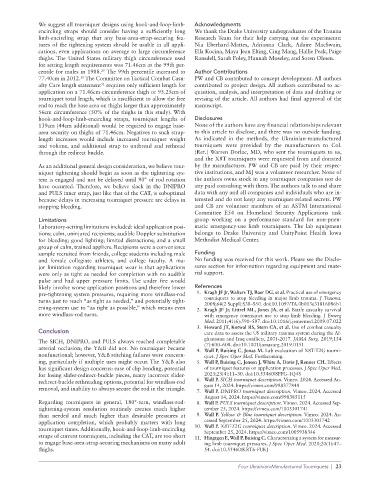
TABLE 4  Cont.
           Tourniquet                 Liked                                     Considerations
           PULS     Limb-encircling strap:                    Limb-encircling strap:
                      – hook-and-loop adhered equivalently for all 30     – consider making strap longer so it can still be secured under the
                     applications                              time strap across the top of the top-opening bracket when on
                                                               medium to large thighs*
                    Inner strap:                              Inner strap:
                      – see considerations                      – unnecessary slack, delays start of tightening until approximately
                                                               90° of rod rotation †
                    Base area/strap connection:               Base area/strap connection:
                      – relationship of base plate and strap remains consistent     – no considerations
                     over multiple uses (30 lab uses)
                    Base area:                                Base area:
                      – edges rounded for least skin discomfort    – a few exposed hooks of hook-and-loop pushing into skin
                      – strong attempt at no exposed hooks of hook-and-loop
                     pushing into skin
                      – 9cm-long base plate more flexible than DNIPRO,
                     can tighten secure strap and use tightening system on
                     14.0cm-circumference cylinder
                    Redirect buckle (simple):                 Redirect buckle (simple):
                      – simple redirect for easy development of strap pull     – could consider smoothing and rounding the strap-engaged edge
                     tension                                   (for lower friction when pulling the redirected strap tight around
                      – simple redirect for limited threading choices  the limb)
                      – easy threading (good-sized opening)
                    Windlass rod:                             Windlass rod:
                      – strap through rod with rounded slot edges    – no considerations
                      – remained a securable distance from securing bracket
                     with up to 3.5 total turns of 180° each
                    Top-opening bracket rod- and strap-securing system:  Top-opening bracket rod- and strap-securing system:
                      – easy to place rod into (in lab)         – some interference with rod turning
           Y&B      Limb-encircling strap:                    Limb-encircling strap:
                      – no unnecessary slack so tightening starts when rod     – sewing of loop around windlass rod can start failing with
                     rotation starts                           multiple uses
                                                                – attachment between limb-encircling strap part and windlass-rod-
                                                               encircling strap part develops a mangled plate, failing stitches,
                                                               and exposure of corners of the plate with multiple windlass-rod
                                                               turns in multiple uses
                                                                – strap sewn around rod can be slid completely off rod, as can rod
                                                               “grips” (Major Problem)
                    Base area:                                Base area:
                      – more flexible than DNIPRO, can secure strap and use     – no considerations
                     tightening system on 16.5cm-circumference cylinder
                      – no sharp edges pushing into skin
                    Redirect buckle (slider):                 Redirect buckle (slider):
                      – self-securing                           – difficult to develop good strap pull tension, results in more
                                                               windlass rod turns needed than a simple redirect
                                                                – can be unthreaded and has many rethreading possibilities with
                                                               correct rethreading not obvious (Major Problem)
                                                                – when unthreaded, becomes two separate pieces for easy loss of
                                                               parts (Major Problem)
                    Clip of redirect buckle:                  Clip of redirect buckle:
                      – clip option to avoid need for unthreading    – not very robust as opened more during lab uses (concern that
                      – clip obvious and easy to use           might therefore easily be compressed closed)
                    Windlass rod:                             Windlass rod:
                      – metal, seems robust                     – slide-on grips on each side of the rod are easy to slide off, which
                                                               allows easy movement of the rod completely out of the sewn
                                                               loop of strap, resulting in no tightening system (Major Problem)
                                                                – did not remain a securable distance from securing triangle with
                                                               4.5 or more turns of 180° each (Major Problem)
                    Top-opening bracket for temporary holding of windlass   Top-opening bracket for temporary holding of windlass rod:
                    rod:                                        – not functional in lab use (Radius of limbs precluded use of
                      – see considerations                     bracket with use of triangle, and triangle provides better rod
                                                               security. Recommend removing bracket or replacing with a
                                                               second triangle option.)
                    Triangle rod-securing system:             Triangle rod-securing system:
                      – see considerations                      – rod migration during turns can preclude rod securing in triangle
                                                               (Major Problem) ‡
          *We suggest all tourniquets using hook-and-loop as part of limb-encircling strap security should consider a sufficiently long strap that any strap-securing features of
          the base area should be usable even on limb circumferences>56cm.
          † We suggest that having slack in the inner strap such that no limb-encircling strap tightening begins until after 90° of rod rotation have occurred is suboptimal because
          delays in increasing tourniquet pressure are delays in stopping bleeding.
          ‡ We did not try to slide the grips and then the rod within the sewn strap loop.
          SICH = SICH tourniquet; DNIPRO = DNIPRO tourniquet; PULS = PULS tourniquet; Y&B = Yellow & Blue tourniquet.

          22  |  JSOM   Volume 25, Edition 3 / Fall 2025

