


Page 21 - JSOM Fall 2025
P. 21
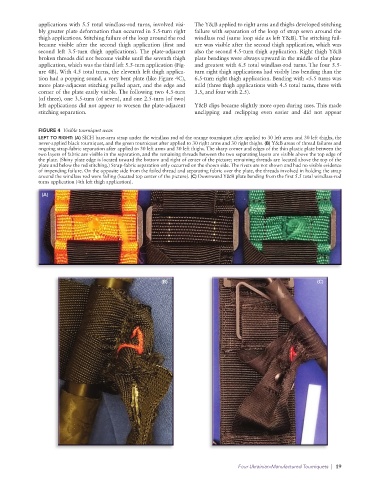
applications with 5.5 total windlass-rod turns, involved visi-  The Y&B applied to right arms and thighs developed stitching
              bly greater plate deformation than occurred in 5.5-turn right   failure with separation of the loop of strap sewn around the
              thigh applications. Stitching failure of the loop around the rod   windlass rod (same loop side as left Y&B). The stitching fail-
              became visible after the second thigh application (first and   ure was visible after the second thigh application, which was
              second left 3.5-turn thigh applications).  The plate-adjacent   also the second 4.5-turn thigh application. Right thigh Y&B
              broken threads did not become visible until the seventh thigh   plate bendings were always upward in the middle of the plate
              application, which was the third left 5.5-turn application (Fig-  and greatest with 6.5 total windlass-rod turns. The four 5.5-
              ure 4B). With 4.5 total turns, the eleventh left thigh applica-  turn right thigh applications had visibly less bending than the
              tion had a popping sound, a very bent plate (like Figure 4C),   6.5-turn right thigh application. Bending with <5.5 turns was
              more plate-adjacent stitching pulled apart, and the edge and   mild (three thigh applications with 4.5 total turns, three with
              corner of the plate easily visible. The following two 4.5-turn   3.5, and four with 2.5).
              (of three), one 3.5-turn (of seven), and one 2.5-turn (of two)
              left applications did not appear to worsen the plate-adjacent   Y&B clips became slightly more open during uses. This made
              stitching separation.                              unclipping and reclipping even easier and did not appear


              FIGURE 4  Visible tourniquet wear.
              LEFT TO RIGHT: (A) SICH base-area strap under the windlass rod of the orange tourniquet after applied to 30 left arms and 30 left thighs, the
              never-applied black tourniquet, and the green tourniquet after applied to 30 right arms and 30 right thighs. (B) Y&B areas of thread failures and
              ongoing strap-fabric separation after applied to 30 left arms and 30 left thighs. The sharp corner and edges of the thin plastic plate between the
              two layers of fabric are visible in the separation, and the remaining threads between the two separating layers are visible above the top edge of
              the plate. (Shiny plate edge is located toward the bottom and right of center of the picture; remaining threads are located above the top of the
              plate and below the red stitching.) Strap-fabric separation only occurred on the shown side. The rivets are not shown and had no visible evidence
              of impending failure. On the opposite side from the failed thread and separating fabric over the plate, the threads involved in holding the strap
              around the windlass rod were failing (located top center of the picture). (C) Downward Y&B plate bending from the first 5.5 total windlass-rod
              turns application (4th left thigh application).

               (A)


                                                      (B)                                                (C)


                                                                               Four Ukrainian-Manufactured Tourniquets  |  19

