


Page 18 - JSOM Fall 2025
P. 18
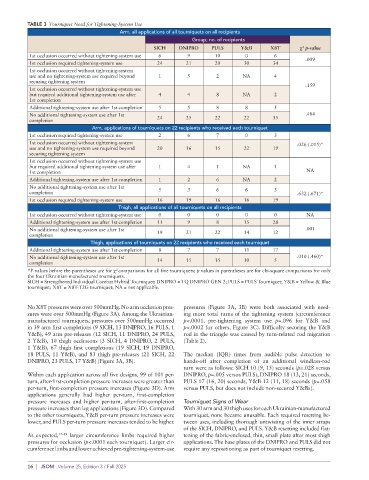
TABLE 1  Tourniquet Recipient Information
                                                                Group; median
                                                  (minimum, 25th percentile, 75th percentile, maximum)
                                        All 4
                                       Ukrainian
                             Any      tourniquets
                           tourniquet;   and X8T;            DNIPRO;                                     X8T only;
                             n=44       n=22     SICH; n=30    n=30     PULS; n=30  Y&B; n=30  X8T; n=40   n=2
              Sex; F; M    31 F; 13 M  15 F; 7 M  21 F; 9 M   21 F; 9 M  21 F; 9 M  20 F; 10 M  27 F; 13 M  1 F; 1 M
              Age, yr         20         20         20          20         20         20          20      19; 20
                          (19, 20, 22, 68) (19, 20, 22, 68) (19, 20, 22, 68) (19, 20, 22, 68) (19, 20, 22, 68) (19, 20, 22, 68) (19, 20, 22, 68)
              Height, cm     169         168        168        168         168        169        170      163; 191
                           (152, 163,    (152, 159,    (152, 163,    (152, 160,    (152, 160,    (152, 162,    (152, 163,
                            180, 193)  180, 193)  180, 193)   180, 193)  180, 193)  181, 193)  180, 193)
              Weight, kg     69.2        71.4       70.3       69.2       69.2        72.6       71.4    62.1; 81.6
                           (47.2, 62.3,   (47.2, 61.1,   (47.2, 62.6,   (47.2, 58.4,   (47.2, 58.4,   (47.2, 63.3,   (47.2, 62.8,
                           94.1, 133.8)  95.3, 133.8)  95.3, 133.8)  95.3, 133.8)  95.3, 133.8)  95.8, 133.8)  95.3, 133.8)
              Systolic blood   124       124        122        124         124        124        124      126; 130
              pressure,     (91, 113,    (104, 112,    (104, 112,    (99, 114,    (99, 114,    (91, 114,    (91, 113,
              mmHg          131, 165)  130, 145)  130, 145)   130, 165)  130, 165)  132, 165)  124, 131, 165)
              Arm            30.5        32.4       31.8       31.8       31.8        32.4       31.3    27.3; 31.0
              circumference,   (23.1, 26.0,   (23.1, 27.0,   (23.1, 26.6,   (23.1, 25.9,   (23.1, 25.9,   (23.1, 27.0,   (23.1, 26.7,
              cm           35.2, 40.5)  35.1, 40.5)  35.1, 40.5)  35.1, 40.5)  35.1, 40.5)  35.5, 40.5)  35.4, 40.5)*
              Thigh          55.8        57.3       56.0       56.0       56.0        57.8       56.1    53.3; 56.5
              circumference,   (43.7, 51.7,   (43.7, 52.2,   (43.7, 52.0,   (43.7, 51.1,   (43.7, 51.1,   (43.7, 52.9,   (43.7, 52.5,
              cm           61.0, 75.5)  61.8, 75.5)  61.3, 75.5)  61.3, 75.5)  61.3, 75.5)  61.8, 75.5)  61.5, 75.5)
              Note: Data are for the day and limb on which recipients received the X8T for 40 recipients and the DNIPRO for the 4 recipients who did not
              receive the X8T.
              *n=19 arm X8T pressures group 35.4 (32.0, 32.9, 37.0, 40.5).
              F = female; M = male; SICH = Strengthened Individual Combat Hybrid Tourniquet; DNIPRO = TQ DNIPRO GEN 2; PULS = PULS Tourniquet;
              Y&B = Yellow & Blue tourniquet; X8T = X8T-T2G tourniquet.


              TABLE 2  Tourniquet Occlusion and Application Completion
                                                        SICH         DNIPRO            PULS            Y&B
              Reached occlusion                        30 arm,        30 arm,         30 arm,         30 arm,
                                                       30 thigh       30 thigh        30 thigh        30 thigh
              Secured windlass rod with occlusion (achieved first   29 arm,  30 arm,  30 arm,         30 arm,
              completion)                              30 thigh       30 thigh        30 thigh        29 thigh
              Never secured windlass rod for crossing pressure   1 arm (1.5 turns),  0 arm,  0 arm,   0 arm,
              threshold (physically securable, could have achieved   0 thigh  0 thigh  0 thigh        0 thigh
              first completion)
              Never secured windlass rod because physically   0 arm,  0 arm,          0 arm,          0 arm,
              unsecurable (could not achieve first completion)  0 thigh  0 thigh      0 thigh     1 thigh (could not
                                                                                                  secure at 5.5 turns
                                                                                                 and needed 6.5 turns
                                                                                                    for occlusion)
              Pulse return, restored occlusion but released for   0 arm,  0 arm,      0 arm,          0 arm,
              time limit before re-securing (physically securable,   0 thigh  0 thigh  0 thigh        0 thigh
              could have achieved second completion)
              Pulse return, restored occlusion but then released   1 arm (1.5 turns),  0 arm (1 arm with   7 arm (2 arm each   0 arm,
              for pressure threshold (all physically securable,   0 thigh  1.5 turns should   with 1.5 turns should   0 thigh
              could have achieved second completion)              have been released   have been released
                                                                  early for threshold   early for threshold
                                                                    but was not),   but were not),
                                                                      0 thigh         0 thigh
              Pulse return and did not manage to re-secure rod   0 arm,  0 arm,       0 arm,          0 arm,
              before release time limit because physically difficult,   0 thigh  0 thigh  0 thigh  1 thigh (4.5 turns)
              unknown if rod physically securable (unknown if
              could have achieved second completion)
              Pulse return and physically could not re-secure rod   0 arm,  0 arm,    0 arm,          0 arm,
              with additional turn (could not achieve second   0 thigh  0 thigh       0 thigh     1 thigh (5.5 turns)
              completion)
              Lost hold of rod trying to secure (did not achieve   0 arm,  0 arm,     0 arm,          0 arm,
              second completion)                       0 thigh        0 thigh         0 thigh     1 thigh (5.5 turns)
              Note: Turns refers to 180° tightening-system rotations starting from the beginning position of the windlass rod (perpendicular to the limb-
              encircling strap).
              SICH = Strengthened Individual Combat Hybrid Tourniquet; DNIPRO = TQ DNIPRO GEN 2; PULS = PULS Tourniquet; Y&B = Yellow & Blue
              tourniquet; X8T = X8T-T2G tourniquet.


                                                                               Four Ukrainian-Manufactured Tourniquets  |  15

