


Page 15 - JSOM Fall 2025
P. 15
planned to compare Ukrainian-manufactured tourniquet pres-  Pressure Measurements
          sures and tightening-system use obtained with the same ap-  Pressures  were  measured  using  a No. 1  neonatal-blood-
          pliers and most of the same recipients to those obtained with   pressure-cuff bladder inflated to 18mmHg above atmospheric
          the X8T.                                           pressure (baseline), secured beneath the limb-encircling strap
                                                             on the medial aspect of the limb, and connected to a Vernier
                                                             Pressure Sensor 400, Vernier LabPro interface, and Logger Pro
          Methods
                                                             3.16.2 Software (Vernier Science Education, Beaverton, OR).
                                                                                                            11
          The Drake University Institutional Review Board approved   Pressures were recorded every second.  The system was not
          this prospective study (#2023-24012), which took place Au-  used in X8T applications on arm circumferences <31.3cm (too
          gust 2024 through April 2024.                      small to accomodate the bladder under only strap). 4
          Tourniquets                                        Applications
          We had four of each tourniquet model: one for visual compar-  Application side was block randomized in sets of 10 per tour-
          isons (never applied), one for practicing, one for right limbs,   niquet (SICH, DNIPRO, PULS, Y&B, X8T). Tourniquets were
          one for left limbs. We placed a little white mark on one end of   applied over thin scrubs material (Ukrainian- manufactured
          each windlass rod as a possible aid in turn counting.  tourniquets because the edge of the SICH-limb-encricling
                                                             strap caused a “paper cut” on the first recipient during strap
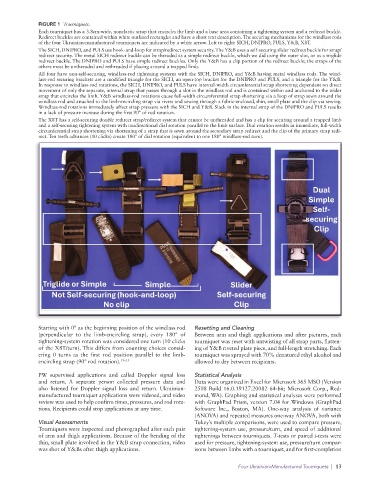
          Four Ukrainian manufacturers provided tourniquets (Figure 1)     securing through the modified triangle) or skin (X8T) on the
          to Col. (Ret.) Warren Dorlac, MD, who sent the tourniquets to   mid-arm then same-side mid-thigh of seated recipients with
          us. The tourniquets are abbreviated as:            the arm resting palm up on a table and knee flexed approx-
                                                             imately 90° with feet on the floor or elevated surface. Distal
          •  SICH (Strengthened Individual Combat Hybrid  Tourni-  arterial  flow  (radial  artery,  dorsal  pedal  artery,  or  posterior
            quet; SICH Ukraine, LLC, Kyiv; Lot GS-III2023, manufac-  tibial artery) was monitored with audible Doppler (Ultrasonic
            tured 9/2023);                                   Doppler Flow Detector Model 811 with 9.5MHz adult flat
          •  DNIPRO (TQ DNIPRO GEN 2;  TQ DNIPRO, Dnipro,    probe; Parks Medical Electronics, Aloha, OR). Arterial occlu-
            Ukraine; Lot DNT2/23-17R 2023-09);               sion was defined as loss of audible Doppler pulse. Arterial flow
          •  PULS  (PULS Tourniquet;  PULS Tourniquet, Ternopil;   return was defined as return of audible Doppler pulse.
            G1D1023B, manufactured 10/20/2023); and
          •  Y&B (Yellow & Blue tourniquet; Yellow & Blue, Dnipro,   After tourniquet placement around the limb with the redirect
            Ukraine; Gen 5 manufactured 2/1/2023).           buckle positioned laterally for downward strap pulling,  the
                                                                                                         12
                                                             applier pulled and secured the strap as tight as possible and
          See reference 5 for tourniquet parts and references 6–9 for   removed both hands from the tourniquet for pre-tightening-
          video tourniquet descriptions.  The strap of the SICH was   system-use pressure (Figure 2). Tightening-system use began.
          simple-threaded through the outer slot of the redirect. All use   For the Ukrainian-manufactured tourniquets, rod rotation
          windlass-rod tightening systems. Windlass-rod rotations im-  was paused at first arterial occlusion (Figure 2), and the rod
          mediately affect SICH and Y&B strap pressure. Built-in slack   was secured as soon thereafter as allowed hands-off first com-
          in the DNIPRO and PULS internal strap cause a lack of pres-  pletion with no audible pulse (Figure 2).
          sure increase during the first 90° of rod rotation.
                                                             Rod securing and application completion involved rod place-
          The X8Ts (Figure 1) were requested from and donated by   ment in the rod-holding part of the tourniquet and comple-
          the manufacturer (manufactured  04/25/2022). X8Ts have a   tion of additional application securing maneuvers: SICH–rod
          self-securing-double-redirect strap/redirect system that can-  end in top of modified triangle and any available portion of
          not be unthreaded, a clip for securing around a trapped limb,   limb-encircling strap threaded through a slot in the modified
          and a self-securing tightening system with unidirectional dial   triangle;  DNIPRO and PULS–rod end in one side of open-
                                                                   6
          rotation parallel to the limb surface (see Reference 10 for   top bracket with any available portion of limb-encircling
          X8T video description). Dial rotation results in immediate,   strap placed over rod in bracket and time strap secured across
          full-width circumferential strap shortening via shortening of   bracket opening;  Y&B–rod end in triangle. 9
                                                                          7,8
          a strap that is sewn around the secondary strap redirect and
          the clip of the primary strap redirect. Ten teeth advances (10   Returns of arterial flow before 100 seconds from first com-
          clicks) create 180° of dial rotation (equivalent to one 180°   pletion resulted in an additional 180° rod rotation and an
          windlass-rod turn).                                additional completion. Pressure thresholds for early applica-
                                                             tion release were set at rod-secured pressures of 800mmHg
          Appliers                                           for arms and 1500mmHg for thighs. Pre-release pressure was
          Following practice, eight researchers were chosen as tourniquet   taken 100 seconds from first completion or sooner if early
          appliers based on ability to frequently achieve pre-tightening-   release; then the rod was unsecured and slowly unrotated to
          system-use pressures >100mmHg with the X8T.  Availability   capture return-of-arterial-flow pressure prior to tourniquet
          determined which applier did each application.     removal.

          Recipients                                         X8T application differences were as follows: a hands-off first
          Volunteers were ≥18 years and had no known bleeding or   arterial occlusion pressure, first completion pressure one-click-
          clotting abnormalities, circulation problems, pain syndromes,   and-hands-off past first occlusion, returns of arterial flow
          peripheral neuropathies, connective tissue disorders, or condi-  before 100 seconds from first completion resulted in one addi-
          tions that would contraindicate tourniquet application (e.g.,   tional tightening click, and no collection of return-of- arterial-
          current forearm or thigh injuries).                flow pressure during removal process.

          12  |  JSOM   Volume 25, Edition 3 / Fall 2025

