


Page 11 - JSOM Fall 2025
P. 11
FEATURE ARTICLES                                   first-encounter CAT7/OMT applications, and second- versus first-
          Lab Evaluation of Four Ukrainian-Manufactured Tourniquets:   encounter SOFTTW3/SOFTTW5 applications. Occlusion at “Done”
          With a cohort of 30 participants, Wall and colleagues analyzed four   was more frequent with experienced appliers and did not show first-
          Ukrainian-Manufactured  Tourniquets—the Strengthened Individual   use learning across all tourniquets in no-experience appliers. Occlusion
          Combat Hybrid Tourniquet (SICH), TQ DNIPRO GEN 2 (DNIPRO),   at “Done” indicated possible first-use learning with ratcheting-buckle
          PULS tourniquet (PULS), and Yellow&Blue tourniquet (Y&B)—for   versus windlass-rod tightening systems. Hook-and-loop strap security,
          arterial occlusiveness, 180° turns, pressures, and reuse wear. They also   which provides no inherent knowledge-of-results, showed no learn-
          evaluated the design features of each device. The SICH, DNIPRO, and   ing in experienced or no-experience appliers. These finding show that
          PULS always reached completable arterial occlusion, while the Y&B   while knowledge-of-results is critical for first-use learning, it does not
          did not and had design concerns. The authors conclude that in general,   guarantee it in this context. The existence of first-use learning can al-
          180°-turn, windlass-rod-tightening-system resolution routinely creates   low limited experience with one tourniquet to improve performance
          much higher than needed and much higher than desirable pressures   with a different tourniquet with shared-design features.  Therefore,
          at application completion, which likely matters with long tourniquet   exposure to different designs may have value, and providing tourni-
          times. Additionally, hook-and-loop-limb-encircling straps of current   quet-training knowledge-of-results is important.
          tourniquets, including the CAT, are too short to engage base-area-   Accuracy of 6.5" Beaded Cable Tie, 10" Paracord, and Opera-
          strap-securing mechanisms on many adult thighs.    tor Gestalt in Prehospital Whole Blood Collection Techniques in
                                                             Filling Donor Blood Bags to Target Volume: With two groups of
          Mitigating Heat Loss in IV Tubing During Austere Blood Transfu-
          sions: Foust and Homan sought to determine the amount of heat lost   experts (n=10) and novices (n=65), Carlton and colleagues compared
          through IV tubing during blood transfusions in cold austere environ-  the bag-fill accuracy of three prehospital whole blood collection tech-
          ments. Using an incrementally cooled (by 3°C) environmental cham-  niques: 6.5" beaded cable tie (BC), 10" paracord (PC), and operator
          ber, the researchers conducted experiments, from a first collection at   gestalt (OG). For novices, OG achieved the highest rate of correct fills,
          20°C to a final collection at –39°C. They found that significant heat   while PC had the highest rate of correct fills for experts, though it was
          loss occurs through IV tubing during blood transfusions in these envi-  not significantly different from the other techniques. BC performed
          ronments (40.9 [SD 3.4] W lost, even at 20°C) and propose insulation   poorly on all assessments, and the authors state it should be avoided.
          as a primary mitigation strategy. However, thermal analysis indicates   OG was generally superior to BC and PC, but was still suboptimal,
          that insulation alone is not enough to maintain adequate fluid tem-  with ~30% incorrect fills study wide, signalling the need for better
          peratures in extreme cold conditions.              methods for determining donor blood bag fill volume to preserve the
                                                             life of the wounded in walking blood bank settings.


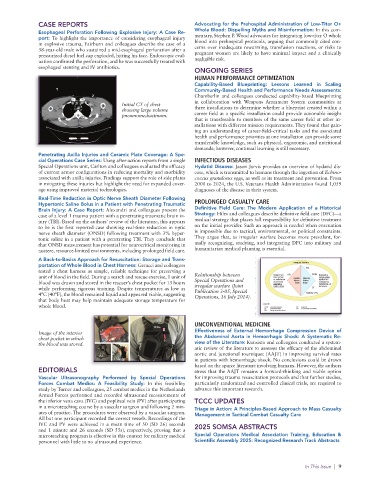
                                                             Equipment included
                                                             in the Valkyrie Low-
                                                             Titer O Whole Blood
                                                             administration set.


          Testing apparatus.
          In-Theater Assessment of Resuscitative Balloon Occlusion of the
          Aorta (REBOA) Capabilities and Training: Koo and colleagues eval-  Antibiotic  Concentrations  After  Massive  Transfusion  (ACME)
                                                             Study: A Review of the Literature on Antibiotic Dosing During
          uated in-theatre resuscitative endovascular balloon occlusion of the
          aorta (REBOA) capabilities at four medical treatment locations in Iraq   Transfusion and Study Protocol:  Huaman and colleagues present
                                                             their protocol for a prospective, multicenter study that will enroll
          and Kuwait during the spring of 2019. Three of the four sites were
          found to have had the minimum training and equipment to complete   trauma patients from two large trauma centers: Brooke Army Medical
                                                             Center and the University of Colorado Hospital. The study group will
          the procedure. However, the authors recommend improvements in
          predeployment  training  of  select  medical  personnel  in  REBOA  and   include participants receiving antibiotics for wound prophylaxis and
                                                             three or more units of blood products. The researchers hypothesize
          arterial blood pressure monitoring to ensure adequate resourcing and
          redundancy in training.                            that antibiotic concentrations decrease in proportion to the volume
                                                             of blood transfused, potentially leading to insufficient antibiotic con-
          Search and Rescue Missions Conducted by the French Army Be-  centrations, placing injured patients at increased risk of infection. This
          tween 2015 and 2019: Gines and Thabouillot analyzed 175 search   study’s results could help fill an important gap in trauma care by ex-
          and rescue (SAR) mission reports from seven French metropolitan   amining how transfusions affect the pharmacokinetics of antibiotic
          bases between 2015 and 2019 to determine how many lives were   levels.
          saved. According to their estimates, 61 patients were in life- threatening   Alternative Plasma Thawers for Austere Resuscitative Surgical
          danger upon arrival of the SAR medical teams, accounting for more
          than one-third of the patients rescued during the study period. This   Teams: Literature Review: Filip and colleagues reviewed the litera-
                                                             ture to identify optimal alternative plasma thawing devices for Austere
          analysis confirms the need for a deployable medical team competent
          in emergency medicine, trained to work together, and aware of the   Resuscitative and Surgical Care (ARSC) teams operating in far forward
                                                             settings, based on the devices’ power consumption, weight, durability,
          difficulties of helicopter-based emergency care.
                                                             portability, post-thaw coagulation preservation, and thaw kinetics.
          Across Tourniquet Designs First-Use Learning: Wall and colleagues   The  authors recommend  that ARSC  teams use  whole blood, liquid
          observed  a  subset  of  10  experienced  and  33  no-experience  tourni-  plasma, and FDA-approved thawing devices whenever available; how-
          quet appliers from a previous study. The authors hypothesized that   ever, alternative methods, such as sous vide warming, demonstrated
                                                                                                        ™
          shared-design tourniquet features have useful first-use learning when   potential. Dry-based thawing systems, such as the ZipThaw , may
          knowledge-of-results occurs. Among no-experience appliers, first-use   also offer advantages by conserving resources like water and electric-
          learning was supported by faster “Go” to “strap secured” times for   ity; however, further research is needed to validate their effectiveness
          combined seventh and eighth versus first applications, second- versus   in forward operating environments.
                                                           8

