


Page 104 - JSOM Spring 2025
P. 104
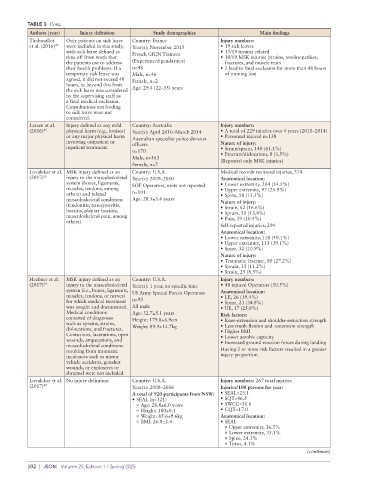
TABLE 3  Cont.
           Authors (year)   Injury definition      Study demographics                 Main findings
           Thabouillot    Only patients on sick leave   Country: France  Injury numbers:
           et al. (2016) 47  were included in this study,   Year(s): November 2015  • 19 sick leaves
                       with sick leave defined as   French GIGN Trainees  • 15/19 trauma related
                       time off from work that                           • 10/19 MSK injuries (strains, tendinopathies,
                       the patients use to address   (Experienced gendarmes)  fractures, and muscle tears
                       their health problems. If a   n=48                • 2 lead to final exclusion for more than 48 hours
                       temporary sick leave was   Male, n=46              of training lost
                       agreed, it did not exceed 48   Female, n=2
                       hours, as beyond this limit
                       the sick leave was considered   Age: 29.4 (22–35) years
                       by the supervising staff as
                       a final medical exclusion.
                       Consultations not leading
                       to sick leave were not
                       considered.
           Larsen et al.   Injury defined as any mild   Country: Australia  Injury numbers:
           (2016) 45   physical harm (e.g., bruises)   Year(s): April 2010–March 2014  • A total of 229 injuries over 4 years (2010–2014)
                       or any major physical harm   Australian specialist police division   • Personnel injured n=138
                       involving outpatient or   officers                Nature of injury:
                       inpatient treatment.                              • Strain/sprain, 140 (61.1%)
                                            n=170                        • Fracture/dislocation, 8 (3.5%)
                                            Male, n=163                  (Reported only MSK injuries)
                                            Female, n=7
           Lovalekar et al.  MSK injury defined as an   Country: U.S.A.  Medical records reviewed injuries, 374
           (2017) 38   injury to the musculoskeletal   Year(s): 2009–2010  Anatomical location:
                       system (bones, ligaments,   SOF Operators, units not reported  • Lower extremity, 204 (54.5%)
                       muscles, tendons, among                           • Upper extremity, 97 (25.9%)
                       others) and related   n=101                       • Spine, 58 (15.5%)
                       musculoskeletal conditions   Age: 28.5±5.6 years  Nature of injury:
                       (tendonitis, tenosynovitis,                       • Strain, 62 (16.6%)
                       bursitis, plantar fasciitis,                      • Sprain, 50 (13.4%)
                       musculoskeletal pain, among                       • Pain, 39 (10.4%)
                       others).
                                                                         Self-reported injuries, 294
                                                                         Anatomical location:
                                                                         • Lower extremity, 118 (40.1%)
                                                                         • Upper extremity, 115 (39.1%)
                                                                         • Spine, 32 (10.9%)
                                                                         Nature of injury:
                                                                         • Traumatic fracture, 80 (27.2%)
                                                                         • Sprain, 33 (11.2%)
                                                                         • Strain, 25 (8.5%)
           Heebner et al.   MSK injury defined as an   Country: U.S.A.   Injury numbers:
           (2017) 39   injury to the musculoskeletal   Year(s): 1 year, no specific time  • 48 injured Operators (50.5%)
                       system (i.e., bones, ligaments,   US Army Special Forces Operators  Anatomical location:
                       muscles, tendons, or nerves)                      • LE, 26 (39.4%)
                       for which medical treatment   n=95                • Spine, 23 (34.8%)
                       was sought and documented.  All male              • UE, 17 (25.8%)
                       Medical conditions   Age: 32.7±5.1 years          Risk factors:
                       consisted of diagnoses   Height: 179.8±6.9cm      • Knee-extension and shoulder-retraction strength
                       such as sprains, strains,                         • Less trunk-flexion and -extension strength
                       dislocations, and fractures.   Weight: 89.9±12.7kg  • Higher BMI
                       Contusions, lacerations, open                     • Lower aerobic capacity
                       wounds, amputations, and                          • Increased ground reaction forces during landing
                       musculoskeletal conditions
                       resulting from traumatic                          Having 2 or more risk factors resulted in a greater
                       incidences such as motor                          injury proportion.
                       vehicle accidents, gunshot
                       wounds, or explosives or
                       shrapnel were not included.
           Lovalekar et al.  No injury definition  Country: U.S.A.       Injury numbers: 267 total injuries
           (2017) 40                        Year(s): 2008–2016           Injuries/100 persons for year:
                                            A total of 920 participants from NSW:  • SEAL=23.1
                                            • SEAL (n=321)               • SQT=46.5
                                                ο Age: 28.8±6.0 years    • SWCC=31.6
                                                ο Height: 180±0.1        • CQT=17.0
                                                ο Weight: 85.6±9.6kg     Anatomical location:
                                                ο BMI: 26.8±2.4          • SEAL
                                                                             ο Upper extremity, 36.5%
                                                                             ο Lower extremity, 35.1%
                                                                             ο Spine, 24.3%
                                                                             ο Torso, 4.1%
                                                                                                     (continues)

          102  |  JSOM   Volume 25, Edition 1 / Spring 2025

