


Page 103 - JSOM Spring 2025
P. 103
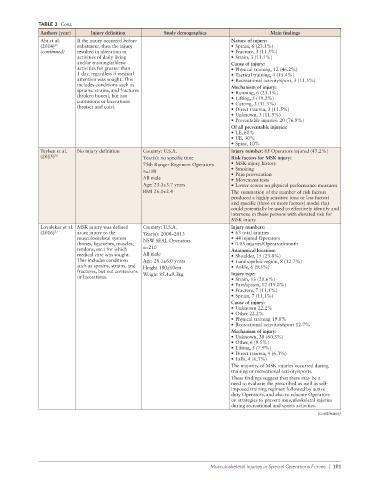
TABLE 3  Cont.
              Authors (year)   Injury definition       Study demographics                Main findings
              Abt et al.   If the injury occurred before                     Nature of injury:
              (2014) 35   enlistment, then the injury                        • Sprain, 6 (23.1%)
              (continued)  resulted in alteration in                         • Fracture, 3 (11.5%)
                          activities of daily living                         • Strain, 3 (11.5%)
                          and/or training/athletic                           Cause of injury:
                          activities for greater than                        • Physical training, 12 (46.2%)
                          1 day, regardless if medical                       • Tactical training, 4 (15.4%)
                          attention was sought. This                         • Recreational activity/sport, 3 (11.5%)
                          includes conditions such as                        Mechanism of injury:
                          sprains, strains, and fractures                    • Running, 6 (23.1%)
                          (broken bones), but not                            • Lifting, 5 (19.2%)
                          contusions or lacerations                          • Cutting, 3 (11.5%)
                          (bruises and cuts).                                • Direct trauma, 3 (11.5%)
                                                                             • Unknown, 3 (11.5%)
                                                                             • Preventable injuries: 20 (76.9%)
                                                                             Of all preventable injuries:
                                                                             • LE, 60%
                                                                             • UE, 30%
                                                                             • Spine, 10%
              Teyhen et al.   No injury definition  Country: U.S.A.          Injury number: 85 Operators injured (45.2%)
              (2015) 36                         Year(s): no specific time    Risk factors for MSK injury:
                                                75th Ranger Regiment Operators  • MSK injury history
                                                n=188                        • Smoking
                                                                             • Pain provocation
                                                All male                     • Movement tests
                                                Age: 23.3±3.7 years          • Lower scores on physical performance measures
                                                BMI 26.0±2.4                 The summation of the number of risk factors
                                                                             produced a highly sensitive (one or less factor)
                                                                             and specific (three or more factors) model that
                                                                             could potentially be used to effectively identify and
                                                                             intervene in those persons with elevated risk for
                                                                             MSK injury
              Lovalekar et al.  MSK injury was defined   Country: U.S.A.     Injury numbers:
              (2016) 37   as an injury to the   Year(s): 2008–2013           • 63 total injuries
                          musculoskeletal system   NSW SEAL Operators        • 44 injured Operators
                          (bones, ligaments, muscles,                        • 0.03 injuries/Operator/month
                          tendons, etc.) for which   n=210                   Anatomical location:
                          medical care was sought.   All male                • Shoulder, 15 (23.8%)
                          This includes conditions   Age: 28.1±6.0 years     • Lumbopelvic region, 8 (12.7%)
                          such as sprains, strains, and   Height 180±10cm    • Ankle, 6 (9.5%)
                          fractures, but not contusions                      Injury type:
                          or lacerations.       Weight 85.4±9.3kg
                                                                             • Strain, 13 (20.6%)
                                                                             • Pain/spasm, 12 (19.0%)
                                                                             • Fracture, 7 (11.1%)
                                                                             • Sprain, 7 (11.1%)
                                                                             Cause of injury:
                                                                             • Unknown 22.2%
                                                                             • Other 22.2%
                                                                             • Physical training 19.0%
                                                                             • Recreational activities/sport 12.7%
                                                                             Mechanism of injury:
                                                                             • Unknown, 38 (60.3%)
                                                                             • Other, 6 (9.5%)
                                                                             • Lifting, 5 (7.9%)
                                                                             • Direct trauma, 4 (6.3%)
                                                                             • Falls, 4 (6.3%)
                                                                             The majority of MSK injuries occurred during
                                                                             training or recreational activity/sports.
                                                                             These findings suggest that there may be a
                                                                             need to evaluate the prescribed as well as self-
                                                                             imposed training regimen followed by active
                                                                             duty Operators, and also to educate Operators
                                                                             on strategies to prevent musculoskeletal injuries
                                                                             during recreational and sports activities.
                                                                                                         (continues)


                                                                      Musculoskeletal Injuries in Special Operations Forces  |  101

