


Page 101 - JSOM Spring 2025
P. 101
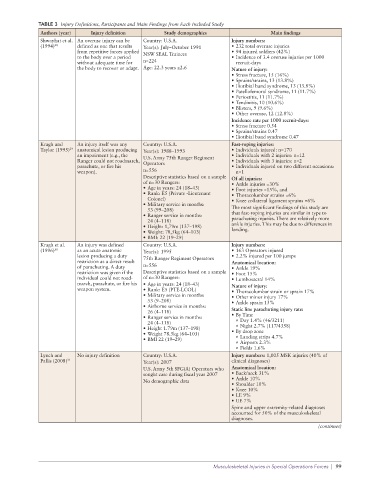
TABLE 3  Injury Definitions, Participants and Main Findings from Each Included Study
              Authors (year)   Injury definition       Study demographics                 Main findings
              Shwayhat et al.  An overuse injury can be   Country: U.S.A.    Injury numbers:
              (1994) 28   defined as one that results   Year(s): July–October 1991  • 232 total overuse injuries
                          from repetitive forces applied   NSW SEAL Trainees  • 94 injured soldiers (42%)
                          to the body over a period                          • Incidence of 3.4 overuse injuries per 1000
                          without adequate time for   n=224                   recruit-days
                          the body to recover or adapt. Age: 22.3 years ±2.6  Nature of injury:
                                                                             • Stress fracture, 15 (16%)
                                                                             • Sprains/strains, 13 (13.8%)
                                                                             • Iliotibial band syndrome, 13 (13.8%)
                                                                             • Patellofemoral syndrome, 11 (11.7%)
                                                                             • Periostitis, 11 (11.7%)
                                                                             • Tendinitis, 10 (10.6%)
                                                                             • Blisters, 9 (9.6%)
                                                                             • Other overuse, 12 (12.8%)
                                                                             Incidence rate per 1000 recruit-days:
                                                                             • Stress fracture 0.54
                                                                             • Sprains/strains 0.47
                                                                             • Iliotibial band syndrome 0.47
              Kragh and   An injury itself was any   Country: U.S.A.         Fast-roping injuries:
              Taylor (1995) 29  anatomical lesion producing   Year(s): 1988–1993  • Individuals injured: n=170
                          an impairment (e.g., the   U.S. Army 75th Ranger Regiment   • Individuals with 2 injuries: n=12
                          Ranger could not roadmarch,   Operators            • Individuals with 3 injuries: n=2
                          parachute, or fire his                             • Individuals injured on two different occasions:
                          weapon).              n=556                         n=1
                                                Descriptive statistics based on a sample   Of all injuries:
                                                of n=30 Rangers:             • Ankle injuries =30%
                                                • Age in years: 24 (18–43)   • Foot injuries =15%, and
                                                • Rank: E5 (Private -Lieutenant   • Thoracolumbar strains =6%
                                                 Colonel)                    • Knee collateral ligament sprains =6%
                                                • Military service in months:
                                                 53 (99–208)                 The most significant findings of this study are
                                                • Ranger service in months:    that fast-roping injuries are similar in type to
                                                 24 (4–118)                  parachuting injuries. There are relatively more
                                                • Height: 1,79m (137–198)    ankle injuries. This may be due to differences in
                                                • Weight: 78,5kg (64–103)    landing.
                                                • BMI: 22 (19–29)
              Kragh et al.   An injury was defined   Country: U.S.A.         Injury numbers:
              (1996) 30   as an acute anatomic   Year(s): 1995               • 163 Operators injured
                          lesion producing a duty   75th Ranger Regiment Operators  • 2.2% injured per 100 jumps
                          restriction as a direct result                     Anatomical location:
                          of parachuting. A duty   n=556                     • Ankle 19%
                          restriction was given if the   Descriptive statistics based on a sample   • Foot 15%
                          individual could not road-  of n=30 Rangers:       • Lumbosacral 14%
                          march, parachute, or fire his   • Age in years: 24 (18–43)  Nature of injury:
                          weapon system.        • Rank: E5 (PTE-LCOL)        • Thoracolumbar strain or sprain 17%
                                                • Military service in months:    • Other minor injury 17%
                                                 53 (9–208)                  • Ankle sprain 13%
                                                • Airborne service in months:    Static line parachuting injury rate:
                                                 26 (4–118)
                                                • Ranger service in months:    • By Time
                                                                                 ο Day 1.4% (46/3211)
                                                 24 (4–118)                      ο Night 2.7% (117/4358)
                                                • Height 1.79m (137–198)
                                                • Weight 78.5kg (64–103)     • By drop zone
                                                                                 ο Landing strips 4.7%
                                                • BMI 22 (19–29)
                                                                                 ο Airports 2.3%
                                                                                 ο Fields 1.6%
              Lynch and   No injury definition  Country: U.S.A.              Injury numbers: 1,005 MSK injuries (40% of
              Pallis (2008) 31                  Year(s): 2007                clinical diagnoses)
                                                U.S. Army 5th SFG(A) Operators who   Anatomical location:
                                                sought care during fiscal year 2007  • Back/neck 31%
                                                No demographic data          • Ankle 10%
                                                                             • Shoulder 10%
                                                                             • Knee 10%
                                                                             • LE 9%
                                                                             • UE 7%
                                                                             Spine and upper extremity-related diagnoses
                                                                             accounted for 50% of the musculoskeletal
                                                                             diagnoses.
                                                                                                         (continues)


                                                                       Musculoskeletal Injuries in Special Operations Forces  |  99

