


Page 61 - JSOM Winter 2024
P. 61
positive pressure ventilated patients, elevated peak inspiratory   thoracostomy, a collapsed lung (“lung down”) can be palpated.
              pressures also suggest the presence of tension pneumothorax.   If the provider has experience and is aware of how an expanded
                                                                 lung feels on palpation, then it is easy to identify the collapsed
              In their article “Tension pneumothorax—time for a re-think?”    lung. It is the absence of the lung that is palpated. This is com-
              Leigh-Smith et al. distinguished between awake (spontaneously   mon practice and terminology in finger thoracostomy.
                                                      5
              breathing) and (positive pressure ventilated) patients.  The au-
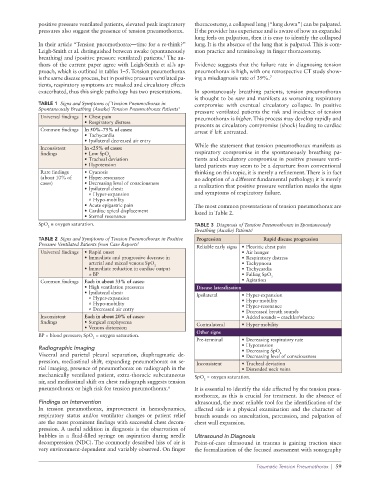
              thors of the current paper agree with Leigh-Smith et al.’s ap-  Evidence suggests that the failure rate in diagnosing tension
              proach, which is outlined in tables 1–5. Tension pneumothorax   pneumothorax is high, with one retrospective CT study show-
              is the same disease process, but in positive pressure ventilated pa-  ing a misdiagnosis rate of 39%. 7
              tients, respiratory symptoms are masked and circulatory effects
              exacerbated, thus this single pathology has two presentations.  In spontaneously breathing patients, tension pneumothorax
                                                                 is thought to be rare and manifests as worsening respiratory
              TABLE 1  Signs and Symptoms of Tension Pneumothorax in   compromise with eventual circulatory collapse. In positive
              Spontaneously Breathing (Awake) Tension Pneumothorax Patients 5  pressure ventilated patients the risk and incidence of tension
              Universal findings  • Chest pain                   pneumothorax is higher. This process may develop rapidly and
                             • Respiratory distress              presents as circulatory compromise (shock) leading to cardiac
              Common findings  In 50%–75% of cases:              arrest if left untreated.
                             • Tachycardia
                             • Ipsilateral decreased air entry
              Inconsistent   In <25% of cases:                   While the statement that tension pneumothorax manifests as
              findings       • Low SpO 2                         respiratory compromise in the spontaneously breathing pa-
                             • Tracheal deviation                tients and circulatory compromise in positive pressure venti-
                             • Hypotension                       lated patients may seem to be a departure from conventional
              Rare findings    • Cyanosis                        thinking on this topic, it is merely a refinement. There is in fact
              (about 10% of   • Hyper-resonance                  no adoption of a different fundamental pathology; it is merely
              cases)         • Decreasing level of consciousness  a realization that positive pressure ventilation masks the signs
                             • Ipsilateral chest:
                                 ο Hyper-expansion               and symptoms of respiratory failure.
                                 ο Hypo-mobility
                             • Acute epigastric pain             The most common presentations of tension pneumothorax are
                             • Cardiac apical displacement       listed in Table 2.
                             • Sternal resonance
              SpO  = oxygen saturation.                          TABLE 3  Diagnosis of Tension Pneumothorax in Spontaneously
                 2
                                                                 Breathing (Awake) Patients 5
              TABLE 2  Signs and Symptoms of Tension Pneumothorax in Positive   Progression   Rapid disease progression
              Pressure Ventilated Patients from Case Reports 5
                                                                 Reliable early signs • Pleuritic chest pain
              Universal findings  • Rapid onset                                 • Air hunger
                             • Immediate and progressive decrease in            • Respiratory distress
                              arterial and mixed venous SpO 2                   • Tachypnoea
                             • Immediate reduction in cardiac output            • Tachycardia
                              ± BP                                              • Falling SpO 2
              Common findings  Each in about 33% of cases:                      • Agitation
                             • High ventilation pressures        Disease lateralization
                             • Ipsilateral chest:                Ipsilateral    • Hyper-expansion
                                 ο Hyper-expansion                              • Hypo-mobility
                                 ο Hypo-mobility                                • Hyper-resonance
                                 ο Decreased air entry                          • Decreased breath sounds
              Inconsistent   Each in about 20% of cases:                        • Added sounds – crackles/wheeze
              findings       • Surgical emphysema                Contralateral   • Hyper-mobility
                             • Venous distension
              BP = blood pressure; SpO  = oxygen saturation.     Other signs
                               2
                                                                 Pre-terminal   • Decreasing respiratory rate
              Radiographic Imaging                                              • Hypotension
                                                                                • Decreasing SpO
              Visceral and parietal pleural separation, diaphragmatic de-       • Decreasing level of consciousness
                                                                                            2
              pression,  mediastinal  shift,  expanding  pneumothorax  on  se-  Inconsistent  • Tracheal deviation
              rial imaging, presence of pneumothorax on radiograph in the       • Distended neck veins
              mechanically ventilated patient, extra-thoracic subcutaneous   SpO  = oxygen saturation.
              air, and mediastinal shift on chest radiograph suggests tension   2
              pneumothorax or high risk for tension pneumothorax. 6  It is essential to identify the side affected by the tension pneu-
                                                                 mothorax, as this is crucial for treatment. In the absence of
              Findings on Intervention                           ultrasound, the most reliable tool for the identification of the
              In tension pneumothorax, improvement in  hemodynamics,   affected side is a physical examination and the character of
              respiratory status and/or ventilator changes or patient relief   breath sounds on auscultation, percussion, and palpation of
              are the most prominent findings with successful chest decom-  chest wall expansion.
              pression. A useful addition in diagnosis is the observation of
              bubbles in a fluid-filled syringe on aspiration during needle   Ultrasound in Diagnosis
              decompression (NDC). The commonly described hiss of air is   Point-of-care ultrasound in trauma is gaining traction since
              very environment-dependent and variably observed. On finger   the formalization of the focused assessment with sonography

                                                                                     Traumatic Tension Pneumothorax  |  59

