


Page 56 - JSOM Winter 2024
P. 56
– (1) Bougie-aided open surgical technique using a curved   Disclaimers
               shaped, flanged and cuffed airway cannula of less than   The opinions or assertions contained herein are the private
               10mm outer diameter, 6–7mm internal diameter, and   views of the authors and are not to be construed as official or
               5–8cm of intra-tracheal length (Preferred option) -or-  as reflecting the views of the Department of the Department
               – (2) Standard open surgical technique using a  curved   of Defense. The recommendations contained in this paper are
               shaped, flanged and cuffed airway cannula of less than   intended to be guidelines only and are not a substitute for clin-
               10mm outer diameter, 6–7 mm internal diameter, and   ical judgment.
               5–8cm of intratracheal length
               – Verify placement by EtCO  digital capnography  Disclosures
                                   2
               – Use lidocaine if the casualty is conscious.  The authors have no disclosures.
               – Frequently reassess SpO , EtCO  and airway patency as
                                  2
                                        2
               airway status may change over time.           Release
                                                             This  document  was reviewed  by  the  Director  of the  Joint
          Tactical Field Care (Respiration/Breathing)        Trauma System and by the Public Affairs Office and the Op-
          (Add to bottom of section)                         erational Security Office at the Defense Health Agency. It is
          •  If the patient has impaired ventilation and uncorrectable   approved for unlimited public release.
            hypoxia  with  a  desaturating  SpO   below  90%,  consider
                                       2
            insertion of a properly sized nasopharyngeal airway, and   References
            ventilate using a 1,000-mL resuscitator bag valve mask.  1.  Butler FK Jr, Hagmann J, Butler EG. Tactical combat casualty
          •  Use EtCO  and SpO  monitoring to help assess airway   care in special operations. Mil Med. 1996;161 Suppl:3-16. doi:
                             2
                     2
            patency.                                            10.1007/978-3-319-56780-8_1
                                                              2.  Dickey N. Supraglottic airway use in tactical evacuation. Defense
                                                                Health Board Memo 2012-6. September 17, 2012.
          Results of CoTCCC Vote:                             3.  Mabry RL, Frankfurt A, Kharod C, Butler FK Jr. Emergency cri-
          These changes were approved by the required 75% or greater   cothyroidotomy in Tactical Combat Casualty Care. J Spec Oper
          majority of the voting members of the CoTCCC.         Med. 2015;15(3):11–19. doi:10.55460/KYGI-F0VF
                                                              4.  Mabry RL, Edens JW, Pearse L, Kelly JF, Harke H. Fatal air-
          Levels of Evidence for the Recommendations            way injuries during Operation Enduring Freedom and Opera-
          The Committee on TCCC and TCCC guidelines utilize the   tion Iraqi Freedom. Prehosp Emerg Care. 2010;14(2):272–277.
                                                                doi:10.3109/10903120903537205
          ACC/AHA (American College of Cardiology/American Heart   5.  Eastridge BJ, Mabry RL, Seguin P, et al. Pre-hospital death on the
                                            88
          Association) evidence classification system  to ensure that   battlefield: implications for the future of Combat Casualty Care.
          recommendations are based on the highest quality of evi-  J Trauma Acute Care Surg. 2012;73:S431–S437. doi:10.1097/TA.
          dence available, adapted to the unique challenges of combat   0b013e3182755dcc
          medicine.                                           6.  Sebesta J. Special lessons learned from Iraq. Surg Clin North Am.
                                                                2006;86(3):711–726.
                                                              7.  Schauer SG, Naylor JF, Maddry JK, Kobylarz FC,  April MD.
          The overall Level of Evidence for this change proposal ranges   Outcomes of casualties without airway trauma undergoing pre-
          from B-NR to C-LD (Table 2), depending on the specific inter-  hospital airway interventions: a Department of Defense Trauma
          vention, with the majority of the recommendations supported   Registry Study. Mil Med. 2020;185(3-4):e352–e357. doi:10.1093/
          by nonrandomized studies and expert opinions relevant to   milmed/usz349
          military medicine.                                  8.  Adams BD, Cuniowski PA, Muck A, De Lorenzo RA. Registry of
                                                                emergency airways arriving at combat hospitals. J Trauma. 2008;
                                                                64(6):1548–1554.
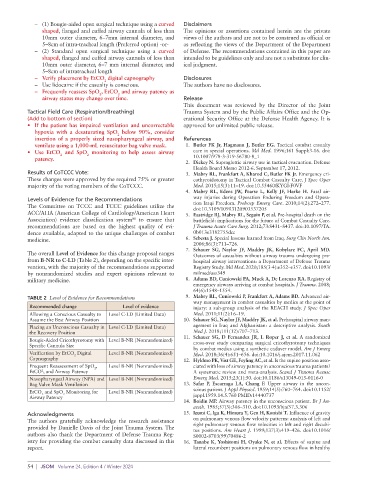
          TABLE 2  Level of Evidence for Recommendations      9.  Mabry RL, Cuniowski P, Frankfurt A, Adams BD. Advanced air-
                                                                way management in combat casualties by medics at the point of
           Recommended change            Level of evidence      injury: a sub-group analysis of the REACH study. J Spec Oper
           Allowing a Conscious Casualty to   Level C-LD (Limited Data)  Med. 2011;11(2):16–19.
           Assume the Best Airway Position                   10.  Schauer SG, Naylor JF, Maddry JK, et al. Prehospital airway man-
           Placing an Unconscious Casualty in  Level C-LD (Limited Data)  agement in Iraq and Afghanistan: a descriptive analysis.  South
           the Recovery Position                                Med J. 2018;111(12):707–713.
                                                             11.  Schauer SG, D Fernandez JR, L Roper J, et al. A  randomized
           Bougie-Aided Cricothyrotomy with  Level B-NR (Nonrandomized)  cross-over study comparing surgical cricothyrotomy techniques
           Specific Cannula Size
                                                                by combat medics using a synthetic cadaver model. Am J Emerg
           Verification by EtCO  Digital   Level B-NR (Nonrandomized)  Med. 2018;36(4):651–656. doi:10.1016/j.ajem.2017.11.062
                         2
           Capnography                                       12.  Hyldmo PK, Vist GE, Feyling AC, et al. Is the supine position asso-
           Frequent Reassessment of SpO ,   Level B-NR (Nonrandomized)  ciated with loss of airway patency in unconscious trauma patients?
                                2
               2
           EtCO , and Airway Patency                            A systematic review and meta-analysis. Scand J Trauma Resusc
           Nasopharyngeal Airway (NPA) and  Level B-NR (Nonrandomized)  Emerg Med. 2015;23(1):50. doi:10.1186/s13049-015-0116-0
           Bag Valve Mask Ventilation                        13.  Safar P, Escarraga LA, Chang F.  Upper airway in the uncon-
           EtCO  and SpO  Monitoring for   Level B-NR (Nonrandomized)  scious patient. J Appl Physiol. 1959;14(5):760–764. doi:10.1152/
               2
                      2
           Airway Patency                                       jappl.1959.14.5.760 PMID:14440737
                                                             14.  Boidin MP. Airway patency in the unconscious patient. Br J An-
                                                                aesth. 1985;57(3):306–310. doi:10.1093/bja/57.3.306
          Acknowledgments                                    15.  Izumi C, Iga K, Himura Y, Gen H, Konishi T. Influence of gravity
          The  authors  gratefully  acknowledge  the  research  assistance   on pulmonary venous flow velocity patterns: analysis of left and
          provided by Danielle Davis of the Joint Trauma System. The   right pulmonary venous flow velocities in left and right decubi-
                                                                tus positions.  Am Heart J. 1999;137(3):419–426.  doi:10.1016/
          authors also thank the Department of Defense Trauma Reg-  S0002-8703(99)70486-2
          istry for providing the combat casualty data discussed in this   16.  Tanabe K, Yoshitomi H, Oyake N, et al. Effects of supine and
          report.                                               lateral recumbent positions on pulmonary venous flow in healthy
          54  |  JSOM   Volume 24, Edition 4 / Winter 2024

