


Page 47 - JSOM Winter 2023
P. 47
signed-ranks nonparametric tests to compare the pre- and   Time in Seconds
              post- assessment scores of each student. 9         The tourniquet application time was measured in seconds,
                                                                 from when the student first touched the tourniquet to when
                                                                 they finished the application and verbally reported that it was
              Results
                                                                 secured.  The seconds  taken to complete the tourniquet ap-
              Performance Ratings                                plication were not normally distributed (p<.001), so we con-
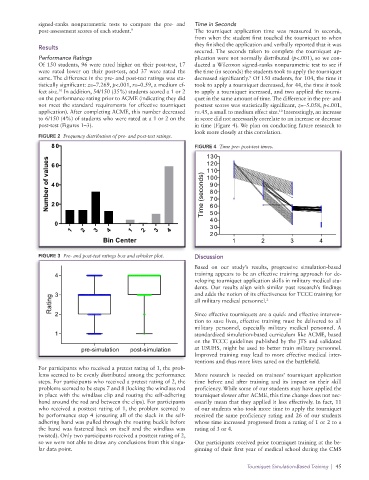
              Of 150 students, 96 were rated higher on their post-test, 17   ducted a Wilcoxon signed-ranks nonparametric test to see if
              were rated lower on their post-test, and 37 were rated the   the time (in seconds) the students took to apply the tourniquet
              same. The difference in the pre- and post-test ratings was sta-  decreased significantly.  Of 150 students, for 104, the time it
                                                                                  9
              tistically significant: z=–7.269, p<.001, r=–0.59, a medium ef-  took to apply a tourniquet decreased, for 44, the time it took
                    10
              fect size.  In addition, 54/150 (35%) students scored a 1 or 2   to apply a tourniquet increased, and two applied the tourni-
              on the performance rating prior to ACME (indicating they did   quet in the same amount of time. The difference in the pre- and
              not meet the standard requirements for effective tourniquet   posttest scores was statistically significant, z=–5.058, p<.001,
              application). After completing ACME, this number decreased   r=.45, a small to medium effect size.  Interestingly, an increase
                                                                                            10
              to 6/150 (4%) of students who were rated at a 1 or 2 on the   in score did not necessarily correlate to an increase or decrease
              post-test (Figures 1–3).                           in time (Figure 4). We plan on conducting future research to
                           Frequency distribution                look more closely at this correlation.
              FIGURE 2  Frequency distribution of pre- and post-test ratings.
                                                                             time by rating pre and post
                  80                                             FIGURE 4  Time pre- post-test times.
                                                                     pre-simulation
                                                                     130
                 Number of values  40                              Time (seconds)  110
                                                                     post-simulation
                                                                     120
                  60
                                                                     100
                                                                      90
                                                                      80
                                                                      70
                  20
                                                                      50
                                                                      40
                   0                                                  60
                                                                      30
                        1   2   3    4      1   2   3   4             20
                                   Bin Center                                1        2         3        4
                ratings pre post box and whisker with scatter                            Rating
              FIGURE 3  Pre- and post-test ratings box and whisker plot.  Discussion
                                                                 Based on our study’s results, progressive simulation-based
                   4                                             training appears to be an effective training approach for de-
                                                                 veloping tourniquet application skills in military medical stu-
                                                                 dents. Our results align with similar past research’s findings
                   3                                             and adds the notion of its effectiveness for TCCC training for
                  Rating                                         all military medical personnel. 2

                   2
                                                                 Since effective tourniquets are a quick and effective interven-
                                                                 tion to save lives, effective training must be delivered to all
                                                                 military personnel, especially military medical personnel.  A
                   1                                             standardized simulation-based curriculum like ACME, based
                                                                 on the TCCC guidelines published by the JTS and validated
                            pre-simulation  post-simulation      at USUHS, might be used to better train military personnel.
                                                                 Improved training may lead to more effective medical inter-
                                                                 ventions and thus more lives saved on the battlefield.
              For participants who received a pretest rating of 1, the prob-
              lems seemed to be evenly distributed among the performance   More research is needed on trainees’ tourniquet application
              steps. For participants who received a pretest rating of 2, the   time before and after training and its impact on their skill
              problems seemed to be steps 7 and 8 (locking the windlass rod   proficiency. While some of our students may have applied the
              in place with the windlass clip and routing the self-adhering   tourniquet slower after ACME, this time change does not nec-
              band around the rod and between the clips). For participants   essarily mean that they applied it less effectively. In fact, 11
              who received a posttest rating of 1, the problem seemed to   of our students who took more time to apply the tourniquet
              be performance step 4 (ensuring all of the slack in the self-   received the same proficiency rating and 26 of our students
              adhering band was pulled through the routing buckle before   whose time increased progressed from a rating of 1 or 2 to a
              the  band  was  fastened  back  on  itself  and  the  windlass  was   rating of 3 or 4.
              twisted). Only two participants received a posttest rating of 2,
              so we were not able to draw any conclusions from this singu-  Our participants received prior tourniquet training at the be-
              lar data point.                                    ginning of their first year of medical school during the CMS

                                                                                  Tourniquet Simulation-Based Training  |  45

