


Page 53 - JSOM Summer 2023
P. 53
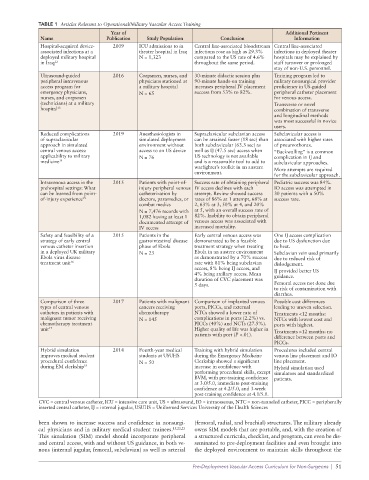
TABLE 1  Articles Relevant to Operational/Military Vascular Access Training
                                     Year of                                                  Additional Pertinent
              Name                  Publication  Study Population        Conclusion              Information
              Hospital-acquired device-  2009  ICU admissions to in   Central line-associated bloodstream  Central line-associated
              associated infections at a       theater hospital in Iraq  infections rose as high as 29.3%   infections in deployed theater
              deployed military hospital       N = 1,323         compared to the US rate of 4.6%   hospitals may be explained by
              in Iraq 12                                         throughout the same period.  staff turnover or prolonged
                                                                                           stay of non-U.S. personnel.
              Ultrasound-guided       2016     Corpsmen, nurses, and   30-minute didactic session plus   Training program led to
              peripheral intravenous           physicians stationed at   90-minute hands-on training   military nonsurgical provider
              access program for               a military hospital  increases peripheral IV placement   proficiency in US-guided
              emergency physicians,            N = 65            success from 53% to 82%.  peripheral catheter placement
              nurses, and corpsmen                                                         for venous access.
              (technicians) at a military                                                  Transverse or novel
              hospital 13                                                                  combination of transverse
                                                                                           and longitudinal methods
                                                                                           was most successful in novice
                                                                                           users.
              Reduced complications   2019     Anesthesiologists in   Supraclavicular subclavian access   Subclavicular access is
              of supraclavicular               simulated deployment   can be attained faster (18 sec) than  associated with higher rates
              approach in simulated            environment without   both subclavicular (63.3 sec) as   of pneumothorax.
              central venous access:           access to an US device   well as IJ (47.5 sec) access when   “Backwalling” is a common
              applicability to military        N = 76            US technology is not available   complication in IJ and
              medicine 14                                        and is a reasonable tool to add to   subclavicular approaches.
                                                                 warfighter’s toolkit in an austere   More attempts are required
                                                                 environment.
                                                                                           for the subclavicular approach.
              Intravenous access in the   2015  Patients with point-of-  Success rate of obtaining peripheral  Pediatric success was 84%.
              prehospital settings: What       injury peripheral venous  IV access declines with each   IO access was attempted in
              can be learned from point-       catheterization by   attempt. Review showed success   30 patients with a 50%
              of-injury experience 15          doctors, paramedics, or  rates of 86% at 1 attempt, 68% at   success rate.
                                               combat medics     2, 63% at 3, 50% at 4, and 20%
                                               N = 7,476 records with   at 5, with an overall success rate of
                                               1,082 having at least 1   82%. Inability to obtain peripheral
                                               documented attempt of   venous access was associated with
                                               IV access         increased mortality.
              Safety and feasibility of a   2015  Patients in the   Early central venous access was   One IJ access complication
              strategy of early central        gastrointestinal disease   demonstrated to be a feasible   due to US dysfunction due
              venous catheter insertion        phase of Ebola    treatment strategy when treating   to heat.
              in a deployed UK military        N = 23            Ebola in an austere environment   Subclavian vein used primarily
              Ebola virus disease                                as demonstrated by a 70% success   due to reduced risk of
              treatment unit 16                                  rate with 81% being subclavian   dislodgement.
                                                                 access, 8% being IJ access, and   IJ provided better US
                                                                 4% being axillary access. Mean   guidance.
                                                                 duration of CVC placement was
                                                                 5 days.                   Femoral access not done due
                                                                                           to risk of contamination with
                                                                                           diarrhea.
              Comparison of three     2017     Patients with malignant  Comparison of implanted venous   Possible cost differences
              types of central venous          cancers receiving   ports, PICCs, and external   leading to uneven selection.
              catheters in patients with       chemotherapy      NTCs showed a lower rate of   Treatments <12 months:
              malignant tumor receiving        N = 145           complications in ports (2.2%) vs.   NTCs with lowest cost and
              chemotherapy treatment                             PICCs (40%) and NCTs (27.5%).   ports with highest.
              unit 17                                            Higher quality of life was higher in   Treatments >12 months: no
                                                                 patients with port (P <.01).
                                                                                           difference between ports and
                                                                                           PICCs.
              Hybrid simulation       2014     Fourth-year medical   Training with hybrid simulation   Procedures included central
              improves medical student         students at USUHS  during the Emergency Medicine   venous line placement and IO
              procedural confidence            N = 50            Clerkship showed a significant   line placement.
              during EM clerkship 18                             increase in confidence with   Hybrid simulation used
                                                                 performing procedural skills, except   simulators and standardized
                                                                 BVM, with pre-training confidence   patients.
                                                                 at 3.0/5.0, immediate post-training
                                                                 confidence at 4.2/5.0, and 3-week
                                                                 post-training confidence at 4.1/5.0.
              CVC = central venous catheter, ICU = intensive care unit, US = ultrasound, IO = intraosseous, NTC = non-tunneled catheter, PICC = peripherally
              inserted central catheter, IJ = internal jugular, USUHS = Uniformed Services University of the Health Sciences


              been shown to increase success and confidence in nonsurgi-  (femoral, radial, and brachial) structures. The military already
              cal physicians and in military medical student trainees. 15,22,23   owns SIM models that are portable, and, with the creation of
              This simulation (SIM) model should incorporate peripheral   a structured curricula, checklist, and program, can even be dis-
              and central access, with and without US guidance, in both ve-  seminated to pre-deployment facilities and even brought into
              nous (internal jugular, femoral, subclavian) as well as arterial   the deployed environment to maintain skills throughout the

                                                                Pre-Deployment Vascular Access Curriculum for Non-Surgeons  |  51

