


Page 52 - JSOM Spring 2023
P. 52
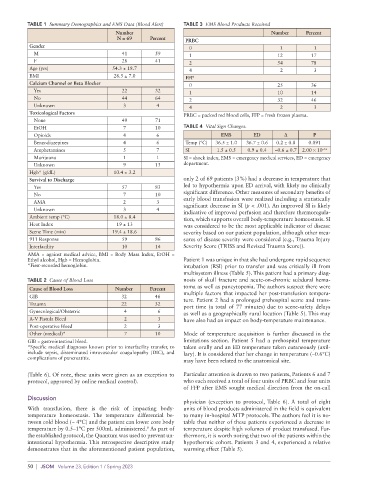
TABLE 1  Summary Demographics and EMS Data (Blood Alert)  TABLE 3  EMS Blood Products Received
                                       Number                                             Number     Percent
                                       N = 69     Percent     PRBC
           Gender                                              0                             1          1
             M                           41         59         1                            12         17
             F                           28         41         2                            54         78
           Age (yrs)                  54.3 ± 18.7              4                             2          3
           BMI                        28.5 ± 7.0              FFP
           Calcium Channel or Beta Blocker                     0                            25         36
             Yes                         22         32         1                            10         14
             No                          44         64         2                            32         46
             Unknown                     3          4          4                             2          3
           Toxicological Factors                             PRBC = packed red blood cells, FFP = fresh frozen plasma.
             None                        49         71
             EtOH                        7          10       TABLE 4  Vital Sign Changes.
             Opioids                     4          6                    EMS        ED        Δ        P
             Benzodiazepines             4          6         Temp (°C)  36.5 ± 1.0  36.7 ± 0.6  0.2 ± 0.8  0.091
             Amphetamines                5          7         SI        1.5 ± 0.5  0.9 ± 0.4  –0.6 ± 0.7  2.00 × 10 –16
             Marijuana                   1          1        SI = shock index, EMS = emergency medical services, ED = emergency
             Unknown                     9          13       department.
           Hgb* (g/dL)                10.4 ± 3.2
           Survival to Discharge                             only 2 of 69 patients (3%) had a decrease in temperature that
             Yes                         57         83       led to hypothermia upon ED arrival, with likely no clinically
             No                          7          10       significant difference. Other measures of secondary benefits of
                                                             early blood transfusion were realized including a statistically
             AMA                         2          3        significant decrease in SI (p < .001). An improved SI is likely
             Unknown                     3          4        indicative of improved perfusion and therefore thermoregula-
           Ambient temp (°C)          18.0 ± 8.4             tion, which supports overall body-temperature homeostasis. SI
           Heat Index                  19 ± 13               was considered to be the most applicable indicator of disease
           Scene Time (min)           19.4 ± 18.6            severity based on our patient population, although other mea-
           911 Response                  59         86       sures of disease severity were considered (e.g., Trauma Injury
           Interfacility                 10         14       Severity Score (TRISS and Revised Trauma Score)).
          AMA = against medical advice, BMI = Body Mass Index, EtOH =
          Ethyl alcohol, Hgb = Hemoglobin.                   Patient 1 was unique in that she had undergone rapid sequence
          *First-recorded hemoglobin.                        intubation (RSI) prior to transfer and was critically ill from
                                                             multisystem illness (Table 5). This patient had a primary diag-
          TABLE 2  Cause of Blood Loss                       nosis of skull fracture and acute-on-chronic subdural hema-
           Cause of Blood Loss         Number     Percent    toma as well as pancytopenia. The authors suspect there were
           GIB                           32         46       multiple factors that impacted her post-transfusion tempera-
                                                             ture. Patient 2 had a prolonged prehospital scene and trans-
           Trauma                        22         32       port time (a total of 77 minutes) due to scene-safety delays
           Gynecological/Obstetric        4          6       as well as a geographically rural location (Table 5). This may
           A-V Fistula Bleed              2          3       have also had an impact on body-temperature maintenance.
           Post-operative Bleed           2          3
           Other (medical)*               7         10       Mode of temperature acquisition is further discussed in the
          GIB = gastrointestinal bleed.                      limitations section. Patient 5 had a prehospital temperature
          *Specific medical diagnoses known prior to interfacility transfer, to   taken orally and an ED temperature taken cutaneously (axil-
          include sepsis, disseminated intravascular coagulopathy (DIC), and   lary). It is considered that her change in temperature (–0.6°C)
          complications of pancreatitis.
                                                             may have been related to the anatomical site.

          (Table 6). Of note, these units were given as an exception to   Particular attention is drawn to two patients, Patients 6 and 7
          protocol, approved by online medical control).     who each received a total of four units of PRBC and four units
                                                             of FFP after EMS sought medical direction from the on-call
          Discussion
                                                             physician (exception to protocol, Table 6). A total of eight
          With transfusion, there  is the risk of impacting body-   units of blood products administered in the field is equivalent
          temperature homeostasis.  The temperature differential be-  to many in-hospital MTP protocols. The authors feel it is no-
          tween cold blood (~ 4°C) and the patient can lower core body   table that neither of these patients experienced a decrease in
          temperature by 0.5–1°C per 500mL administered.  As part of   temperature despite high volumes of product transfused. Fur-
                                                 8
          the established protocol, the Quantum was used to prevent un-  thermore, it is worth noting that two of the patients within the
          intentional hypothermia. This retrospective descriptive study   hypothermic cohort. Patients 3 and 4, experienced a relative
          demonstrates that in the aforementioned patient population,   warming effect (Table 5).

          50  |  JSOM   Volume 23, Edition 1 / Spring 2023

