


Page 51 - JSOM Spring 2023
P. 51
were documented in the EHR by nursing staff, and served as   hospital chart.  Table 2 describes causes of blood loss, and
              the “post-transfusion temperature.” If patients were taken di-    Table 3 describes the blood products received by type.
              rectly to the OR upon arrival, the first documented OR tem-
              perature served as the post-transfusion temperature. For any   FIGURE 2  Study population.
              interfacility transports, the post-transfusion temperature was
              taken from the first set of vitals upon arrival to the receiving   N = 58,500        N = 58,406
              facility.                                            total PHAS patient transports    ineligible
                                                                                                  (no indication
              Outcome Measures                                                                    for, or criteria
              The primary outcome of interest was the number of patients    N = 94               not met for blood
              who arrived to the ED with temperatures <36°C. An additional   potentially eligible patients  transfusion)
              analysis assessed the patient’s post-transfusion temperature as   (met Blood Alert criteria)
              compared to pre-transfusion temperature. Secondary outcome
              measures included pre- and post-transfusion shock index (SI),
              first-recorded hemoglobin (Hgb), and any additional blood
              products given over four hours following ED arrival.          N = 94
                                                                       transfused patients
                                                                     (consented, obtained IV         N = 11
              Data Collection                                                                       excluded
                                                                  access and initiated transfusion)
                                                                                                    (no EMS
              Over the course of 19 months, two EHRs were used for data                            temperature
              acquisition:  ESO (https://www.eso.com/)  for all prehospital                     documented, didn’t
              data, and Epic (https://www.epic.com/) for all ED or inpatient                     survive transport)
              data. Data from 94 adult patients receiving EMS blood prod-   N = 83
              ucts were reviewed. Inclusion criteria were (1) patients age >18   (survived to ED, EMS
              years who received blood products and were transported to an   temperature documented)  N = 14
              ED by PHAS, with (2) a full set of vital signs recorded both                          excluded
              before and after ED arrival (temperature, heart rate (HR), re-                         (no ED
              spiratory rate, oxygen saturation, and blood pressure). Exclu-  N = 69               temperature
              sion criteria included (1) patients age <18 years of age and (2)   included in the study   obtained or
              patients who did not survive to ED arrival or (3) did not have   population          documented)
              complete vital signs recorded at ED arrival. Patient demo-
              graphic data were gathered for descriptive statistical analysis.  ED = emergency department, EMS = emergency medical services,
                                                                 PHAS = Prisma Health Ambulance Service, IV = intravenous.
              Statistical Analysis                               Main Measurements
              Sixty-nine patients met inclusion criteria and were thus ana-  Sixty-four of 69 patients arrived to the ED normothermic, and
              lyzed for their demographics (age, gender, body mass index   67 of 69 patients did not experience hypothermia due to tem-
              (BMI)), initial EMS vital signs (including shock index (SI)), and   perature loss. For all 69 patients analyzed, the mean initial pre-
              initial vital signs upon arrival to the ED. Total number of units   hospital temperature (°C) was 36.5 ± 1.0, and the mean initial
              and type of blood product (PRBC and/or FFP) transfused were   ED temperature was 36.7 ± 0.6, demonstrating no statistically
              recorded. Additional factors identified were type of transport   significant change in temperature (0.2 ± 0.8, p = .09) pre- or
              (911 versus interfacility), ambient temperature, heat index,   post-transfusion (Table 4). SI showed a statistically significant
              scene time, and transport time. Ambient temperatures and heat   decrease following transfusion: 1.5 ± 0.5 to 0.9 ± 0.4 (p < .001)
              indices were obtained from the National Weather Service on-  (Table 4).
              line archives, from a central location thought to best represent
                                                12
              these factors across the general transport area.  Other elements   Pre-transfusion, 11 patients (16%) were hypothermic by their
              abstracted included first-recorded Hgb at the hospital, whether   EMS temperature. Of those, only three patients (4%) arrived
              or not the patient received blood in the ED, and whether or not   hypothermic to the ED; these patients are designated as Pa-
              they received a massive transfusion protocol (MTP). Further   tients 3, 4, and 5 (Table 5). Patients 3 and 4 each had improve-
              documented were any routine home medications for exogenous   ments in their body temperature upon ED arrival.
              heart rate or blood pressure control (calcium-channel blockers
              or beta blockers), toxicological factors (urine drug screen), sur-  Two patients (Patients 1 and 2) who were normothermic upon
              vival to admission, and survival to discharge.     initial EMS evaluation arrived hypothermic to the ED (Table
                                                                 5). Two additional patients (Patients 3 and 4), who were hy-
                                                                 pothermic prior to ED arrival, had improvements in their tem-
              Results
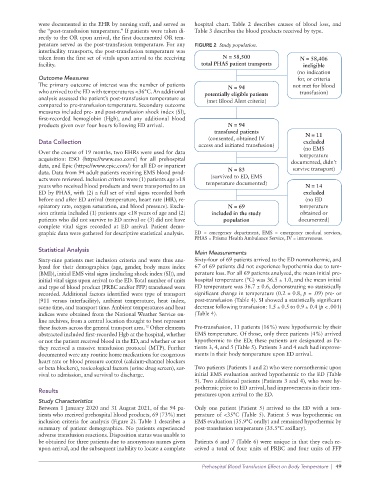
                                                                 peratures upon arrival to the ED.
              Study Characteristics
              Between 1 January 2020 and 31 August 2021, of the 94 pa-  Only one patient (Patient 5) arrived to the ED with a tem-
              tients who received prehospital blood products, 69 (73%) met   perature of <35°C (Table 5). Patient 5 was hypothermic on
              inclusion criteria for analysis (Figure 2). Table 1 describes a   EMS evaluation (35.9°C orally) and remained hypothermic by
              summary of patient demographics. No patients experienced   post-transfusion temperature (35.5°C axillary).
              adverse transfusion reactions. Disposition status was unable to
              be obtained for three patients due to anonymous names given   Patients 6 and 7 (Table 6) were unique in that they each re-
              upon arrival, and the subsequent inability to locate a complete   ceived a total of four units of PRBC and four units of FFP

                                                                   Prehospital Blood Transfusion Effect on Body Temperature  |  49

