


Page 111 - JSOM Spring 2023
P. 111
which 47.8% (n = 11) of patients in the low group, 13.9% (n = 5)   respectively, p = .215). However, on linear regression decreased
              of patients in the moderate group, and 20.0% (n = 4) of patients   % FVC was inversely very weakly correlated with both longer
              in the high group had a pneumothorax (P = .028). Additionally,   hospital LOS (r = –0.282, p = .006) and longer ICU LOS (r =
              an increased number of rib fractures was very weakly correlated   –0.197, p = .041). Overall, patients discharged to a non-home
              (r 0.30) with a reduced % pFVC (r = –0.235, p = .037).  location had a lower average % pFVC than those discharged
                                                                 to home (mean = 34.24%, standard deviation = 8.03%, vs.
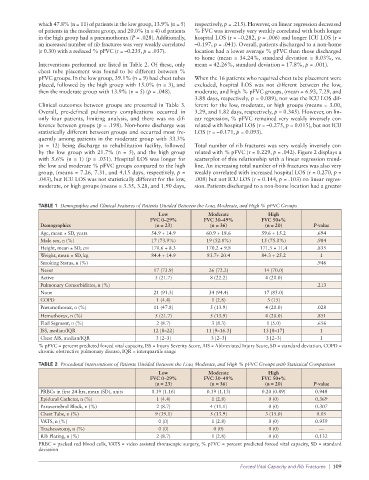
              Interventions performed are listed in Table 2. Of these, only   mean = 42.26%, standard deviation = 17.8%, p = .001).
              chest tube placement was found to be different between %
              pFVC groups. In the low group, 39.1% (n = 9) had chest tubes   When the 16 patients who required chest tube placement were
              placed, followed by the high group with 15.0% (n = 3), and   excluded, hospital LOS was not different between the low,
              then the moderate group with 13.9% (n = 5) (p = .048).  moderate, and high % pFVC groups, (mean = 6.93, 7.29, and
                                                                 3.88 days, respectively, p = 0.089), nor was the ICU LOS dif-
              Clinical outcomes between groups are presented in Table 3.   ferent for the low, moderate, or high groups (means = 3.00,
              Overall, pre-defined pulmonary complications occurred in   3.29, and 1.82 days, respectively, p = 0.345). However, on lin-
              only four patients, limiting analysis, and there was no dif-  ear regression, % pFVC remained very weakly inversely cor-
              ference between groups (p = .198). Non-home discharge was   related with hospital LOS (r = –0.275, p = 0.015), but not ICU
              statistically different between groups and occurred most fre-  LOS (r = –0.171, p = 0.093).
              quently among patients in the moderate group with 33.3%
              (n = 12) being discharge to rehabilitation facility, followed   Total number of rib fractures was very weakly inversely cor-
              by the  low  group with 21.7%  (n =  5), and  the high  group   related with % pFVC (r = 0.229, p = .042). Figure 2 displays a
              with 5.6% (n = 1) (p = .031). Hospital LOS was longer for   scatterplot of this relationship with a linear regression trend-
              the low and moderate % pFVC groups compared to the high   line. An increasing total number of rib fractures was also very
              group, (means = 7.26, 7.31, and 4.15 days, respectively, p =   weakly correlated with increased hospital LOS (r = 0.270, p =
              .043), but ICU LOS was not statistically different for the low,   .008) but not ICU LOS (r = 0.144, p = .103) on linear regres-
              moderate, or high groups (means = 3.35, 3.28, and 1.90 days,   sion. Patients discharged to a non-home location had a greater


              TABLE 1  Demographic and Clinical Features of Patients Divided Between the Low, Moderate, and High % pFVC Groups
                                                     Low             Moderate            High
                                                  FVC 0–29%         FVC 30–49%        FVC 50+%
              Demographics                          (n = 23)          (n = 36)          (n = 20)        P-value
              Age, mean ± SD, years               54.9 + 14.9       60.9 + 18.6       59.6 + 15.2       .694
              Male sex, n (%)                     17 (73.9%)        19 (52.8%)        15 (75.0%)        .984
              Height, mean ± SD, cm               170.6 + 8.3       170.2 + 9.8       171.5 + 11.4      .835
              Weight, mean ± SD, kg               84.4 + 14.9        83.7+ 20.4       84.3 + 25.2         1
              Smoking Status, n (%)                                                                     .946
              Never                                17 (73.9)         26 (72.2)         14 (70.0)
              Active                                5 (21.7)          8 (22.2)          4 (20.0)
              Pulmonary Comorbidities, n (%)                                                            .213
              None                                 21 (91.3)         34 (94.4)         17 (85.0)
              COPD                                  1 (4.4)           1 (2.8)           3 (15)
              Pneumothorax, n (%)                  11 (47.8)          5 (13.9)          4 (20.0)        .028
              Hemothorax, n (%)                     5 (21.7)          5 (13.9)          4 (20.0)        .851
              Flail Segment, n (%)                  2 (8.7)           3 (8.3)           1 (5.0)         .656
              ISS, median/IQR                      12 [8–22]        11 [9–16.3]        13 [8–17]          1
              Chest AIS, median/IQR                 3 [2–3]           3 [2–3]           3 [2–3]           1
              % pFVC = percent predicted forced vital capacity, ISS = Injury Severity Score, AIS = Abbreviated Injury Score, SD = standard deviation, COPD =
              chronic obstructive pulmonary disease, IQR = interquartile range

              TABLE 2  Procedural Interventions of Patients Divided Between the Low, Moderate, and High % pFVC Groups with Statistical Comparison
                                                     Low             Moderate            High
                                                  FVC 0–29%         FVC 30–49%        FVC 50+%
                                                    (n = 23)          (n = 36)          (n = 20)        P-value
              PRBCs in first 24-hrs, mean (SD), units  0.39 (1.16)   0.39 (1.13)       0.20 (0.89)      0.948
              Epidural Catheter, n (%)              1 (4.4)           1 (2.8)            0 (0)          0.369
              Paravertebral Block, n (%)            2 (8.7)           4 (11.1)           0 (0)          0.307
              Chest Tube, n (%)                     9 (39.1)          5 (13.9)          3 (15.0)        0.05
              VATS, n (%)                            0 (0)            1 (2.8)            0 (0)          0.959
              Tracheostomy, n (%)                    0 (0)             0 (0)             0 (0)           —
              Rib Plating, n (%)                    2 (8.7)           1 (2.8)            0 (0)          0.132
              PRBC = packed red blood cells, VATS = video assisted thorascopic surgery, % pFVC = percent predicted forced vital capacity, SD = standard
              deviation

                                                                               Forced Vital Capacity and Rib Fractures  |  109

