


Page 110 - JSOM Spring 2023
P. 110
long-lasting implications for returning to duty and medical   For purposes of analysis, patients were grouped based on pre-
          readiness. A study found that combat thoracic injury led to   sentation % pFVCs into three groups: % pFVC 0–29% (low),
          statistically significant odds of abnormal spirometry by pul-  30–49% (moderate), and >50% (high). 10–12  Primary outcomes
          monary function testing (PFTs). 8                  were defined as pulmonary complications to include pneumo-
                                                             nia, acute respiratory distress syndrome (ARDS), pulmonary
          Many protocols for admission and management of rib frac-  embolism (PE), retained hemothorax, empyema, aspiration,
          tures are based on the number of ribs broken and the age of   required intubation, and ICU readmission or escalation of
          the patient, as opposed to metrics of pulmonary physiology   care. Due to the potential confounding factor of chest tube
                             9
          of the individual patient.  One long-established reliable metric   management on LOS, a separate analysis was conducted ex-
          that can be simply performed at the bedside is FVC.  This is   cluding patients with a pneumothorax or hemothorax that
                                                    9
          defined as the total volume of air that can be exhaled force-  required a chest tube to be placed.
          fully. In retrospective studies, FVC < 30% predicted is associ-
          ated with increased pulmonary complications; however, there   SPSS Statistics 28 (IBM, https://www.ibm.com/spss) was used
          are no prospective data on spirometry for prognostication. 9  to perform all statistical analysis. ANOVA and linear regres-
                                                             sion with Pearson correlation was used to evaluate relation-
          This study prospectively evaluates patients suffering multiple   ships between continuous variables, and Spearman correlation
          rib fractures using an assessment of FVC, hypothesizing that   was used for rank order (% pFVC groups) variables. T-tests
          an increased % pFVC is associated with improved outcomes,   were used to compare continuous variable means between
          to include decreased rates of complications and reductions in   outcome groups (discharge destination). A Chi-squared trend
          ICU LOS, hospital LOS, and discharge to a rehabilitation or   test was used for comparison of % pFVC groups and categor-
          long-term care facility. As the US military and partners pre-  ical variables. Finally, the overall study design and manuscript
          pare for future conflicts such as large-scale combat (LSCO)   submission was completed under the Strengthening the Re-
          and multi-domain operations (MDO), the ability to effectively   porting of Observational Studies in Epidemiology (STROBE)
          triage, diagnose, and manage blunt chest trauma patients in   statement guidelines and reporting requirements.
          theater for prolonged periods of time could help determine
          how to best utilize medical resources in environments in which   Results
          medical assets and critical care evacuation are limited.
                                                             During the study period, 181 patients were admitted with
                                                             three or more rib fractures. Twenty-six patients were excluded,
          Methods
                                                             and FVC was not measured for 73 patients. This resulted in a
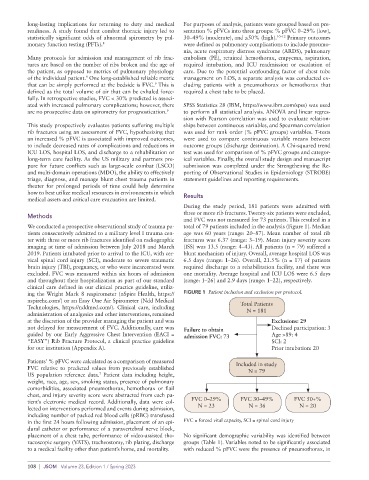
          We conducted a prospective observational study of trauma pa-  total of 79 patients included in the analysis (Figure 1). Median
          tients consecutively admitted to a military level I trauma cen-  age was 60 years (range: 20–87). Mean number of total rib
          ter with three or more rib fractures identified on radiographic   fractures was 6.37 (range: 3–19). Mean injury severity score
          imaging at time of admission between July 2018 and March   (ISS) was 13.5 (range: 4–43). All patients (n = 79) suffered a
          2019. Patients intubated prior to arrival to the ICU, with cer-  blunt mechanism of injury. Overall, average hospital LOS was
          vical spinal cord injury (SCI), moderate to severe traumatic   6.5 days (range: 1–26). Overall, 21.5% (n = 17) of patients
          brain injury (TBI), pregnancy, or who were incarcerated were   required discharge to a rehabilitation facility, and there was
          excluded. FVC was measured within six hours of admission   one mortality. Average hospital and ICU LOS were 6.5 days
          and throughout their hospitalization as part of our standard   (range: 1–26) and 2.9 days (range: 1–22), respectively.
          clinical care defined in our clinical practice guideline, utiliz-
          ing the Wright Mark 8 respirometer (nSpire Health, https://  FIGURE 1  Patient inclusion and exclusion per protocol.
          nspirehc.com/) or an Easy One Air Spirometer (Ndd Medical             Total Patients
          Technologies,  https://nddmed.com/). Clinical care, including           N = 181
          administration of analgesics and other interventions, remained
          at the discretion of the provider managing the patient and was                  Exclusions: 29
          not delayed for measurement of FVC. Additionally, care was   Failure to obtain    Declined participation: 3
          guided by our Early Aggressive Chest Intervention (EACI =   admission FVC: 73   Age >89: 4
          “EASY”) Rib Fracture Protocol, a clinical practice guideline                    SCI: 2
          for our institution (Appendix A).                                               Prior intubation: 20

          Patients’ % pFVC were calculated as a comparison of measured        Included in study
          FVC relative to predicted values from previously established            N = 79
          US population reference data.  Patient data including height,
                                  7
          weight, race, age, sex, smoking status, presence of pulmonary
          comorbidities, associated pneumothorax, hemothorax or flail
          chest, and injury severity score were abstracted from each pa-
          tient’s electronic medical record. Additionally, data were col-  FVC 0–29%   FVC 30–49%   FVC 50+%
          lected on interventions performed and events during admission,   N = 23  N = 36          N = 20
          including number of packed red blood cells (pRBC) transfused
          in the first 24 hours following admission, placement of an epi-  FVC = forced vital capacity, SCI = spinal cord injury
          dural catheter or performance of a paravertebral nerve block,
          placement of a chest tube, performance of video-assisted tho-  No significant demographic variability was identified between
          racoscopic surgery (VATS), tracheostomy, rib plating, discharge   groups (Table 1). Variables noted to be significantly associated
          to a medical facility other than patient’s home, and mortality.  with reduced % pFVC were the presence of pneumothorax, in

          108  |  JSOM   Volume 23, Edition 1 / Spring 2023

