


Page 90 - JSOM Winter 2022
P. 90
-Combat-Gauze.htm) and XSTAT (RevMedx,  https://www.  (0.025mg/kg intramuscularly [IM]) for analgesia. Then, injec-
          revmedx.com/xstat/). We hypothesized that in a swine model   tion of tiletaminezolazepam (Telazol 4mg/kg IM) was used
          of severe junctional hemorrhage, a multiagent strategy using   for induction and 5% isoflurane in oxygen via facemask used
          the iTClamp in conjunction with XSTAT or Combat Gauze   for initial anesthesia. The swine were intubated and ventilated
          would be faster to apply and as effective in hemorrhage con-  with 100% oxygen. The tidal volume and ventilation rate were
          trol as compared to the traditional method of Combat Gauze   adjusted to maintain an end-tidal partial pressure of carbon
          packing with pressure dressing application.        dioxide (Etco ) of 40 ± 2mmHg. Anesthesia was maintained
                                                                        2
                                                             with 2% isoflurane added to 100% oxygen gas via respirator.
                                                             Lactated Ringer’s (LR) was administered at 5mL/kg/h through
          Materials and Methods
                                                             an ear vein. Blood pressure (systolic and diastolic), mean arte-
                                                             rial pressure (MAP), heart rate (HR), and respiratory rate (RR)
          Materials
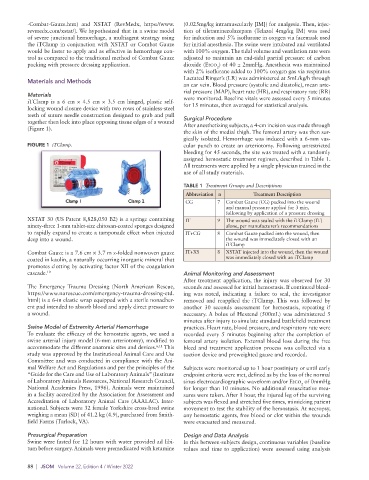
          iTClamp is a 6 cm × 4.5 cm × 3.5 cm hinged, plastic self-   were monitored. Baseline vitals were assessed every 5 minutes
          locking wound closure device with two rows of stainless-steel   for 15 minutes, then averaged for statistical analysis.
          teeth of suture needle construction designed to grab and pull
          together then lock into place opposing tissue edges of a wound   Surgical Procedure
          (Figure 1).                                        After anesthetizing subjects, a 4-cm incision was made through
                                                             the skin of the medial thigh. The femoral artery was then sur-
                                                             gically isolated. Hemorrhage was induced with a 6-mm vas-
          FIGURE 1  iTClamp.                                 cular punch to create an arteriotomy. Following unrestricted
                                                             bleeding for 45 seconds, the site was treated with a randomly
                                                             assigned hemostatic treatment regimen, described in Table 1.
                                                             All treatments were applied by a single physician trained in the
                                                             use of all study materials.

                                                             TABLE 1  Treatment Groups and Descriptions
                                                              Abbreviation  n       Treatment Description
                                                              CG        7  Combat Gauze (CG) packed into the wound
                                                                           and manual pressure applied for 3 min,
                                                                           following by application of a pressure dressing
          XSTAT 30 (US Patent 8,828,050 B2) is a syringe containing   IT  9  The wound was sealed with the iTClamp (IT)
          ninety-three 1-mm tablet-size chitosan-coated sponges designed   alone, per manufacturer’s recommendations
          to rapidly expand to create a tamponade effect when injected   IT+CG   8  Combat Gauze packed into the wound, then
          deep into a wound.                                               the wound was immediately closed with an
                                                                           iTClamp
          Combat Gauze is a 7.6 cm × 3.7 m z-folded nonwoven gauze   IT+XS  8  XSTAT injected into the wound, then the wound
          coated in kaolin, a naturally occurring inorganic mineral that   was immediately closed with an iTClamp
          promotes clotting by activating factor XII of the coagulation
          cascade. 10                                        Animal Monitoring and Assessment
                                                             After treatment application, the injury was observed for 30
          The Emergency  Trauma Dressing (North  American Rescue,   seconds and assessed for initial hemostasis. If continued bleed-
          https://www.narescue.com/emergency-trauma-dressing-etd.  ing was noted, indicating a failure to seal, the investigator
          html) is a 6-in elastic wrap equipped with a sterile nonadher-  removed and reapplied  the iTClamp. This  was followed by
          ent pad intended to absorb blood and apply direct pressure to   another 30 seconds assessment for hemostasis, repeating if
          a wound.                                           necessary. A bolus of Hextend (500mL) was administered 5
                                                             minutes after injury to simulate standard battlefield treatment
          Swine Model of Extremity Arterial Hemorrhage       practices. Heart rate, blood pressure, and respiratory rate were
          To evaluate the efficacy of the hemostatic agents, we used a   recorded every 5 minutes beginning after the completion of
          swine arterial injury model (6-mm arteriotomy), modified to   femoral artery isolation. External blood loss during the free
          accommodate the different anatomic sites and devices. 6,11  This   bleed and treatment application process was collected via a
          study was approved by the Institutional Animal Care and Use   suction device and preweighted gauze and recorded.
          Committee and was conducted in compliance with the Ani-
          mal Welfare Act and Regulations and per the principles of the   Subjects were monitored up to 1 hour postinjury or until early
          “Guide for the Care and Use of Laboratory Animals” (Institute   endpoint criteria were met, defined as by the loss of the normal
          of Laboratory Animals Resources, National Research Council,   sinus electrocardiographic waveform and/or Etco  of 0mmHg
                                                                                                   2
          National Academies Press, 1996). Animals were maintained   for longer than 10 minutes. No additional resuscitative mea-
          in a facility accredited by the Association for Assessment and   sures were taken. After 1 hour, the injured leg of the surviving
          Accreditation of Laboratory Animal Care (AAALAC). Inter-  subjects was flexed and stretched five times, mimicking patient
          national. Subjects were 32 female Yorkshire cross-bred swine   movement to test the stability of the hemostasis. At necropsy,
          weighing a mean (SD) of 41.2 kg (4.9), purchased from Smith-  any hemostatic agents, free blood or clot within the wounds
          field Farms (Turlock, VA).                         were evacuated and measured.

          Presurgical Preparation                            Design and Data Analysis
          Swine were fasted for 12 hours with water provided ad libi-  In this between-subjects design, continuous variables (baseline
          tum before surgery. Animals were premedicated with ketamine   values and time to application) were assessed using analysis

          88  |  JSOM   Volume 22, Edition 4 / Winter 2022

