


Page 8 - JSOM Winter 2022
P. 8
FEATURE ARTICLES                                   Unit Collective Medical Training in the 75th Ranger Regi-
          Comparison of Warming Capabilities Between Buddy Lite,   ment: Four programs have been developed to train individ-
          enFlow, and Thermal Angel for US Army Medical Personnel   ual  and  collective  tasks  that
          in Austere Conditions: A Literature Review: The purpose of   sustain the Ranger casualty
          this literature review is to examine the three most common   response system: (1) Ranger
          battery-operated IV fluid warmers as determined by type and   First Responder, (2) Advanced
          quantity listed on the  Mission  Table of Organization and   Ranger First Responder, (3)
          Equipment (MTOE) of organic mobile medical units.  Ranger Medic Assessment and
                                                             Validation, and (4) Casualty
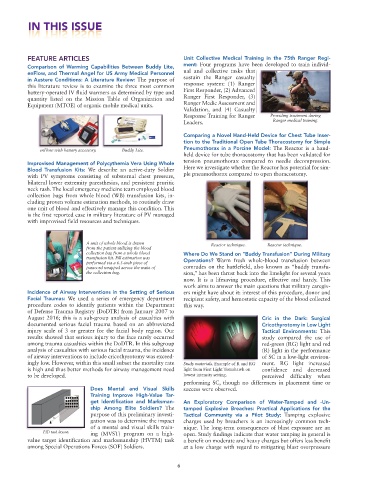
                                                             Response Training for Ranger   Providing treatment during
                                                             Leaders.                     Ranger medical training.

                                                             Comparing a Novel Hand-Held Device for Chest Tube Inser-
                                                             tion to the Traditional Open Tube Thoracostomy for Simple
                                                             Pneumothorax in a Porcine Model: The Reactor is a hand-
              enFlow with battery accessory.  Buddy Lite.
                                                             held device for tube thoracostomy that has been validated for
          Improvised Management of Polycythemia Vera Using Whole   tension pneumothorax compared to needle decompression.
          Blood Transfusion Kits:  We describe an active-duty Soldier   Here we investigate whether the Reactor has potential for sim-
          with PV symptoms consisting of substernal chest pressure,   ple pneumothorax compared to open thoracostomy.
          bilateral lower extremity paresthesias, and persistent pruritic
          neck rash. The local emergency medicine team employed blood
          collection bags from whole blood (WB) transfusion kits, in-
          cluding proven volume estimation methods, to routinely draw
          one unit of blood and effectively manage this condition. This
          is the first reported case in military literature of PV managed
          with improvised field resources and techniques.


                             A unit of whole blood is drawn           Reactor technique.  Reactor technique.
                             from the patient utilizing the blood
                             collection bag from a whole blood   Where Do We Stand on “Buddy Transfusion” During Military
                             transfusion kit. Fill estimation was   Operations?  Warm fresh whole-blood transfusion between
                             performed via a 6.5-inch piece of
                             paracord wrapped across the waist of   comrades on the battlefield, also known as “buddy transfu-
                             the collection bag.             sion,” has been thrust back into the limelight for several years
                                                             now. It is a lifesaving procedure, effective and hardy.  This
                                                             work aims to answer the main questions that military caregiv-
          Incidence of Airway Interventions in the Setting of Serious   ers might have about it: interest of this procedure, donor and
          Facial Traumas:  We used a series of emergency department   recipient safety, and hemostatic capacity of the blood collected
          procedure codes to identify patients within the Department   this way.
          of Defense Trauma Registry (DoDTR) from January 2007 to
          August 2016; this is a sub-group analysis of casualties with                 Cric in the Dark: Surgical
          documented serious facial trauma based on an abbreviated                     Cricothyrotomy in Low Light
          injury scale of 3 or greater for the facial body region. Our                 Tactical Environments:  This
          results showed that serious injury to the face rarely occurred               study compared the use of
          among trauma casualties within the DoDTR. In this subgroup                   red-green (RG) light and red
          analysis of casualties with serious facial trauma, the incidence             (R) light in the performance
          of airway interventions to include cricothyrotomy was exceed-                of SC in a low-light environ-
          ingly low. However, within this small subset the mortality rate   Study materials. Example of R and RG  ment. RG light increased
          is high and thus better methods for airway management need   light from First Light Tomahawk on   confidence and decreased
          to be developed.                                   lowest intensity setting.  perceived difficulty when
                                                             performing SC, though no differences in placement time or
                               Does Mental and Visual Skills   success were observed.
                               Training Improve High-Value Tar-
                               get Identification and Marksman-  An  Exploratory  Comparison  of  Water-Tamped  and  -Un-
                               ship Among Elite Soldiers? The   tamped Explosive Breaches: Practical Applications for the
                               purpose of this preliminary investi-  Tactical Community via a Pilot Study: Tamping  explosive
                               gation was to determine the impact   charges  used  by  breachers  is  an  increasingly  common  tech-
                               of a mental and visual skills train-  nique. The long-term consequences of blast exposure are an
               PID task layout.  ing (MVST) program on a high-  open. Study findings indicate that water tamping in general is
          value target identification and marksmanship (HVTM) task   a benefit on moderate and heavy charges but offers less benefit
          among Special Operations Forces (SOF) Soldiers.    at a low charge with regard to mitigating blast overpressure


                                                           6

