


Page 121 - JSOM Winter 2022
P. 121
grouping, using microscopes and glass slides when available.   Medical Equipment
              Other equipment used included home-made centrifuges, bam-  At Chungkai, trained engineer and medical orderly Private
                                                7
              boo needles, and rubber stethoscope tubing.  Lieutenant Col-  Gordon Vaughan, RAMC, recycled cutlery into scalpels, re-
              onel M. E. Barrett KVF (Kedah Volunteer Force) undertook   tractors, and curettes, and added a metal frame to a hacksaw
              blood transfusions at Chungkai Hospital camp in Thailand,   blade for surgical amputations. Proctoscopes and even a sig-
              describing this work in his report written in late 1945. 15  moidoscope were created using recycled tin cans, with water-
                                                                 tight joints sealed by folding, crimping, or soldering, the solder
              At Chungkai, men queued for rudimentary blood compatibil-  extracted from cans.  Blades were sharpened on stones, giving
                                                                                19
              ity testing after a day’s work. FEPOW medical artist Gunner   a razor edge. 22,23
              Ashley Old of the Sherwood Foresters regiment documented
                                                      16
              both the queues and also a transfusion in progress  (Figure   As senior operating room assistant,  Vaughan documented
              2). Blood from the donor was collected in a vessel and, in   all 4,577 operations performed at the three largest hospital
              the absence of sodium citrate, was stirred for several minutes   camps in Thailand.  He fashioned grafting needles, enabling
                                                                                24
                                                  15
              with a bamboo whisk to remove the fibrin clot.  Defibrinated   skin grafts for tropical ulcers: a piece of copper tube had a coin
              blood was transferred to a suspended, upturned Japanese beer   soldered on the end, with the coin slotted to take three or four
              bottle with its base removed, sealed with a cork stopper, with   steel hypodermic needles set at an angle. 23
              a bamboo spigot placed in the stopper connected to rubber
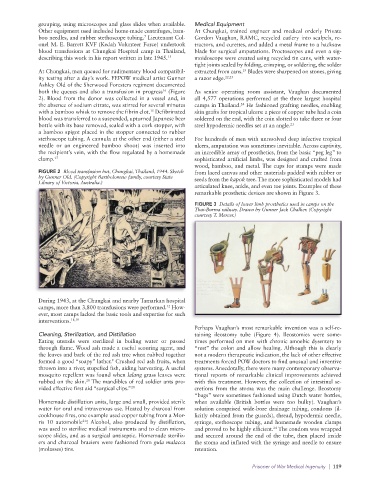
              stethoscope tubing. A cannula at the other end (either a steel   For hundreds of men with unresolved deep infective tropical
              needle or an engineered bamboo shoot) was inserted into   ulcers, amputation was sometimes inevitable. Across captivity,
              the recipient’s vein, with the flow regulated by a homemade   an incredible array of prosthetics, from the basic “peg leg” to
              clamp. 17                                          sophisticated artificial limbs, was designed and crafted from
                                                                 wood, bamboo, and metal. The cups for stumps were made
              FIGURE 2  Blood transfusion hut, Chungkai, Thailand, 1944. Sketch   from laced canvas and other materials padded with rubber or
              by Gunner Old. (Copyright Bartholomew family, courtesy State   seeds from the kapok tree. The more sophisticated models had
              Library of Victoria, Australia.)
                                                                 articulated knee, ankle, and even toe joints. Examples of these
                                                                 remarkable prosthetic devices are shown in Figure 3.
                                                                 FIGURE 3  Details of lower limb prosthetics used in camps on the
                                                                 Thai-Burma railway. Drawn by Gunner Jack Chalker. (Copyright
                                                                 courtesy T. Mercer.)


              During 1943, at the Chungkai and nearby Tamarkan hospital
              camps, more than 3,800 transfusions were performed.  How-
                                                       12
              ever, most camps lacked the basic tools and expertise for such
              interventions. 18,19
                                                                 Perhaps Vaughan’s most remarkable invention was a self-re-
              Cleaning, Sterilization, and Distillation          taining ileostomy tube (Figure 4). Ileostomies were some-
              Eating utensils were sterilized in boiling water or passed   times performed on men with chronic amoebic dysentery to
              through flame. Wood ash made a useful scouring agent, and   “rest” the colon and allow healing. Although this is clearly
              the leaves and bark of the red ash tree when rubbed together   not a modern therapeutic indication, the lack of other effective
                                      9
              formed a good “soapy” lather.  Crushed red ash fruits, when   treatments forced POW doctors to find unusual and inventive
              thrown into a river, stupefied fish, aiding harvesting. A useful   systems. Anecdotally, there were many contemporary observa-
              mosquito repellent was found when lalang grass leaves were   tional reports of remarkable clinical improvements achieved
              rubbed on the skin.  The mandibles of red soldier ants pro-  with this treatment. However, the collection of intestinal se-
                             20
              vided effective first aid “surgical clips.” 20     cretions from the stoma was the main challenge. Ileostomy
                                                                 “bags” were sometimes fashioned using Dutch water bottles,
              Homemade distillation units, large and small, provided sterile   when available (British bottles were too bulky).  Vaughan’s
              water for oral and intravenous use. Heated by charcoal from   solution comprised wide-bore drainage tubing, condoms (il-
              cookhouse fires, one example used copper tubing from a Mor-  licitly obtained from the guards), thread, hypodermic needle,
                            21
              ris 10 automobile !  Alcohol, also produced by distillation,   syringe, stethoscope tubing, and homemade wooden clamps
              was used to sterilize medical instruments and to clean micro-  and proved to be highly efficient.  The condom was wrapped
                                                                                          24
              scope slides, and as a surgical antiseptic. Homemade steriliz-  and secured around the end of the tube, then placed inside
              ers and charcoal braziers were fashioned from gula malacca   the stoma and inflated with the syringe and needle to ensure
              (molasses) tins.                                   retention.

                                                                                   Prisoner of War Medical Ingenuity  |  119

