


Page 114 - JSOM Winter 2022
P. 114
We undertook this study to better characterize the influence   We collected data on patient demographics, prehospital clin-
          of ARDS in combat casualties from recent combat operations   ical parameters, procedures performed, aeromedical evacu-
          between 2003 and 2015. We hypothesized that risk from mor-  ation, and laboratory data. Specifically, patient age, gender,
          tality from ARDS would be higher for an explosive mechanism   weight, height, race, ICD-9 codes, ISS, and Current Procedural
          of  injury  (MOI),  increased  injury  severity  score, early  vital   Terminology (CPT) codes for complications were extracted.
          sign abnormalities, laboratory derangements, and increased   MOI was categorized as gunshot wound, explosion, motor ve-
          amounts of blood product transfusion.              hicle collision, or other. Ventilator data could not be reliably
                                                             collected and was omitted. Fluid volumes of resuscitation and
          Methods                                            blood transfusion within the first 24 hours after injury was
                                                             also calculated.  Any additional recorded medical complica-
          Study Design and Participants                      tions were also collected.
          Approval for this study was obtained from the US Army In-
          stitute of Surgical Research and Brooke Army Medical Center   Statistical Analysis
          Institutional Review Board. While maintaining full compliance   Univariate analysis of mortality was performed with signifi-
          with the Department of Health and Human Services’ Health   cance set at p ≤ .05. The χ  or Fisher exact tests were used for
                                                                                 2
          Insurance Portability and Accountability Act, we conducted a   categorical data. Median and interquartile range (IQR) were
          retrospective study of all US Servicemembers 18 years old or   reported,  and Wilcoxon  rank-sum tests  were  performed  for
          older serving in theaters of operation from 2003 to 2015 using   continuous and nonnormally distributed variables. Significant
          the DoDTR, formerly the Joint Theater Trauma Registry, by   factors were then included in a multivariable logistic regres-
          ICD-9 code listed as ARDS/respiratory failure. We retrieved all   sion model for mortality. Statistical analysis was conducted
          DoDTR ARDS patients. ARDS is classically defined according   using JMP version 13.2 (SAS Institute Inc., https://www.sas.
          to Berlin Criteria: having bilateral opacities, a Pao :Fio  ratio   com/en_us/home.html).
                                                 2
                                                     2
          (PFR) <300, imaging suggestive of noncardiogenic pulmonary
          edema, acute onset within 7 days of injury, and no evidence
                            12
          of cardiac dysfunction.  However, for this study, we defined   Results
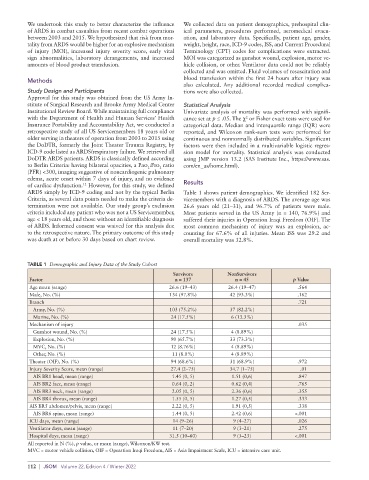
          ARDS simply by ICD-9 coding and not by the typical Berlin   Table 1 shows patient demographics. We identified 182 Ser-
          Criteria, as several data points needed to make the criteria de-  vicemembers with a diagnosis of ARDS. The average age was
          termination were not available. Our study group’s exclusion   26.6 years old (21–31), and 96.7% of patients were male.
          criteria included any patient who was not a US Servicemember,   Most patients served in the US Army (n = 140, 76.9%) and
          age < 18 years old, and those without an identifiable diagnosis   suffered their injuries in Operation Iraqi Freedom (OIF). The
          of ARDS. Informed consent was waived for this analysis due   most common mechanism of injury was an explosion, ac-
          to the retrospective nature. The primary outcome of this study   counting for 67.6% of all injuries. Mean ISS was 29.2 and
          was death at or before 30 days based on chart review.  overall mortality was 32.8%.


          TABLE 1  Demographic and Injury Data of the Study Cohort
                                                          Survivors        NonSurvivors
           Factor                                         n = 137             n = 45             p Value
           Age mean (range)                             26.6 (19–43)        26.4 (19–47)          .564
           Male, No. (%)                                134 (97.8%)         42 (93.3%)            .162
           Branch                                                                                 .721
            Army, No. (%)                               103 (75.2%)         37 (82.2%)
            Marine, No. (%)                              24 (17.5%)          6 (13.3%)
           Mechanism of injury                                                                    .035
            Gunshot wound, No. (%)                       24 (17.5%)          4 (8.89%)
            Explosion, No. (%)                           90 (65.7%)         33 (73.3%)
            MVC, No. (%)                                 12 (8.76%)          4 (8.89%)
            Other, No. (%)                               11 (8.0%)           4 (8.89%)
           Theater (OIF), No. (%)                        94 (68.6%)         31 (68.9%)            .972
           Injury Severity Score, mean (range)           27.4 (2–75)        34.7 (1–75)            .01
            AIS BR1 head, mean (range)                   1.45 (0, 5)         1.51 (0,6)           .847
            AIS BR2 face, mean (range)                   0.64 (0, 2)         0.62 (0,4)           .765
            AIS BR3 neck, mean (range)                   2.05 (0, 5)         2.36 (0,6)           .355
            AIS BR4 thorax, mean (range)                 1.55 (0, 5)         1.27 (0,5)           .333
           AIS BR5 abdomen/pelvis, mean (range)          2.22 (0, 5)         1.91 (0,5)           .338
            AIS BR6 spine, mean (range)                  1.44 (0, 5)         2.42 (0,6)          <.001
           ICU days, mean (range)                        14 (9–26)           9 (4–27)             .026
           Ventilator days, mean (range)                 11 (7–20)           9 (3–21)             .275
           Hospital days, mean (range)                  31.5 (10–60)         9 (3–23)            <.001
          All reported in N (%), p value, or mean (range), Wilcoxon/KW test.
          MVC = motor vehicle collision, OIF = Operation Iraqi Freedom, AIS = Asia Impairment Scale, ICU = intensive care unit.

          112  |  JSOM   Volume 22, Edition 4 / Winter 2022

