


Page 64 - JSOM Fall 2022
P. 64
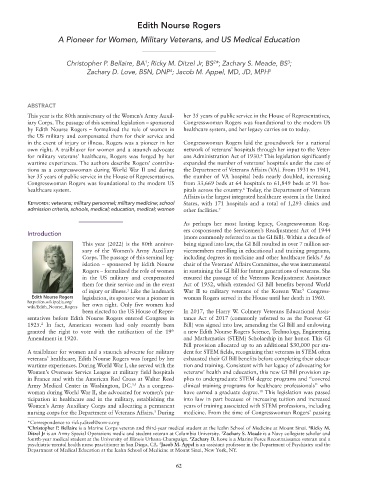
Edith Nourse Rogers
A Pioneer for Women, Military Veterans, and US Medical Education
3
1
Christopher P. Bellaire, BA ; Ricky M. Ditzel Jr, BS *; Zachary S. Meade, BS ;
2
4
Zachary D. Love, BSN, DNP ; Jacob M. Appel, MD, JD, MPH 5
ABSTRACT
This year is the 80th anniversary of the Women’s Army Auxil her 35 years of public service in the House of Representatives,
iary Corps. The passage of this seminal legislation – sponsored Congresswoman Rogers was foundational to the modern US
by Edith Nourse Rogers – formalized the role of women in healthcare system, and her legacy carries on to today.
the US military and compensated them for their service and
in the event of injury or illness. Rogers was a pioneer in her Congresswoman Rogers laid the groundwork for a national
own right. A trailblazer for women and a staunch advocate network of veterans’ hospitals through her input to the Veter
for military veterans’ healthcare, Rogers was forged by her ans Administration Act of 1930. This legislation significantly
6
wartime experiences. The authors describe Rogers’ contribu expanded the number of veterans’ hospitals under the care of
tions as a congresswoman during World War II and during the Department of Veterans Affairs (VA). From 1931 to 1941,
her 35 years of public service in the House of Representatives. the number of VA hospital beds nearly doubled, increasing
Congresswoman Rogers was foundational to the modern US from 33,669 beds at 64 hospitals to 61,849 beds at 91 hos
healthcare system. pitals across the country. Today, the Department of Veterans
6
Affairs is the largest integrated healthcare system in the United
Keywords: veterans; military personnel; military medicine; school States, with 171 hospitals and a total of 1,293 clinics and
admission criteria, schools, medical; education, medical; women other facilities. 7
As perhaps her most lasting legacy, Congresswoman Rog
ers cosponsored the Servicemen’s Readjustment Act of 1944
Introduction
(more commonly referred to as the GI Bill). Within a decade of
This year (2022) is the 80th anniver being signed into law, the GI Bill resulted in over 7 million ser
sary of the Women’s Army Auxiliary vicemembers enrolling in educational and training programs,
Corps. The passage of this seminal leg including degrees in medicine and other healthcare fields. As
8
islation – sponsored by Edith Nourse chair of the Veterans’ Affairs Committee, she was instrumental
Rogers – formalized the role of women in sustaining the GI Bill for future generations of veterans. She
in the US military and compensated ensured the passage of the Veterans Readjustment Assistance
them for their service and in the event Act of 1952, which extended GI Bill benefits beyond World
of injury or illness. Like the landmark War II to military veterans of the Korean War. Congress
9
1
Edith Nourse Rogers legislation, its sponsor was a pioneer in woman Rogers served in the House until her death in 1960.
https://en.wikipedia.org/ her own right. Only five women had
wiki/Edith_Nourse_Rogers
been elected to the US House of Repre In 2017, the Harry W. Colmery Veterans Educational Assis
sentatives before Edith Nourse Rogers entered Congress in tance Act of 2017 (commonly referred to as the Forever GI
1925. In fact, American women had only recently been Bill) was signed into law, amending the GI Bill and endowing
2
granted the right to vote with the ratification of the 19 a new Edith Nourse Rogers Science, Technology, Engineering
th
Amendment in 1920. and Mathematics (STEM) Scholarship in her honor. This GI
Bill provision allocated up to an additional $30,000 per stu
A trailblazer for women and a staunch advocate for military dent for STEM fields, recognizing that veterans in STEM often
veterans’ healthcare, Edith Nourse Rogers was forged by her exhausted their GI Bill benefits before completing their educa
wartime experiences. During World War I, she served with the tion and training. Consistent with her legacy of advocating for
Women’s Overseas Service League at military field hospitals veterans’ health and education, this new GI Bill provision ap
in France and with the American Red Cross at Walter Reed plies to undergraduate STEM degree programs and “covered
Army Medical Center in Washington, DC. As a congress clinical training programs for healthcare professionals” who
3,4
woman during World War II, she advocated for women’s par have earned a graduate degree. This legislation was passed
10
ticipation in healthcare and in the military, establishing the into law in part because of increasing tuition and increased
Women’s Army Auxiliary Corps and allocating a permanent years of training associated with STEM professions, including
nursing corps for the Department of Veterans Affairs. During medicine. From the time of Congresswoman Rogers’ passing
5
*Correspondence to ricky.ditzel@somc.org
2
1 Christopher P. Bellaire is a Marine Corps veteran and thirdyear medical student at the Icahn School of Medicine at Mount Sinai. Ricky M.
Ditzel Jr is an Army Special Operations medic and student veteran at Columbia University. Zachary S. Meade is a Navy collegiate scholar and
3
4
fourthyear medical student at the University of Illinois UrbanaChampaign. Zachary D. Love is a Marine Force Reconnaissance veteran and a
psychiatricmental health nurse practitioner in San Diego, CA. Jacob M. Appel is an assistant professor in the Department of Psychiatry and the
5
Department of Medical Education at the Icahn School of Medicine at Mount Sinai, New York, NY.
62
62

