


Page 35 - JSOM Fall 2022
P. 35
concurrently), immediately after a skill is performed (i.e., adja performed until mastery is achieved before introducing the el
cent feedback), and minutes to days after an event (i.e., delayed ement back into overly stressful situations that are producing
42
feedback). When students are interrupted and given concur subpar results and creating bad habits. 119
rent feedback, they may not process the feedback particularly
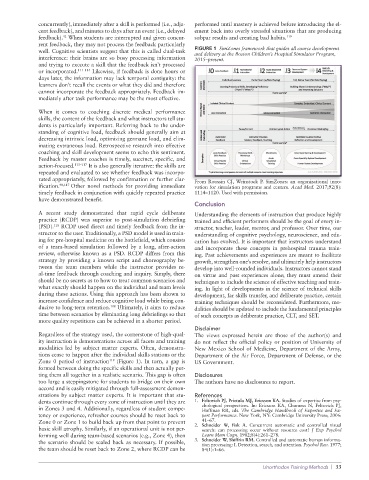
well. Cognitive scientists suggest that this is called dualtask FIGURE 1 SimZones framework that guides all course development
and delivery at the Boston Children’s Hospital Simulator Program,
interference: their brains are so busy processing information 2015–present.
and trying to execute a skill that the feedback isn’t processed
or incorporated. 111–114 Likewise, if feedback is done hours or
days later, the information may lack temporal contiguity: the
learners don’t recall the events or what they did and therefore
cannot incorporate the feedback appropriately. Feedback im
mediately after task performance may be the most effective.
When it comes to coaching discrete medical performance
skills, the content of the feedback and what instructors tell stu
dents is particularly important. Referring back to the under
standing of cognitive load, feedback should generally aim at
decreasing intrinsic load, optimizing germane load, and elim
inating extraneous load. Retrospective research into effective
coaching and skill development seems to echo this sentiment.
Feedback by master coaches is timely, succinct, specific, and
actionfocused. 115–117 It is also generally iterative: the skills are
repeated and evaluated to see whether feedback was incorpo
rated appropriately, followed by confirmation or further clar From Roussin CJ, Weinstock P. SimZones: an organizational inno
ification. 98,117 Other novel methods for providing immediate vation for simulation programs and centers. Acad Med. 2017;92(8):
timely feedback in conjunction with quickly repeated practice 1114–1120. Used with permission.
have demonstrated benefit.
Conclusion
A recent study demonstrated that rapid cycle deliberate Understanding the elements of instruction that produce highly
practice (RCDP) was superior to postsimulation debriefing trained and efficient performers should be the goal of every in
118
(PSD). RCDP used direct and timely feedback from the in structor, teacher, leader, mentor, and professor. Over time, our
structor to the user. Traditionally, a PSD model is used in train understanding of cognitive psychology, neuroscience, and edu
ing for prehospital medicine on the battlefield, which consists cation has evolved. It is important that instructors understand
of a teambased simulation followed by a long, afteraction and incorporate these concepts in prehospital trauma train
review, otherwise known as a PSD. RCDP differs from this ing. Past achievements and experiences are meant to facilitate
strategy by providing a known script and choreography be growth, strengthen one’s resolve, and ultimately help instructors
tween the team members while the instructor provides re develop into wellrounded individuals. Instructors cannot stand
altime feedback through coaching and inquiry. Simply, there on virtue and past experiences alone; they must amend their
should be no secrets as to how to treat common scenarios and techniques to include the science of effective teaching and train
what exactly should happen on the individual and team levels ing. In light of developments in the science of technical skills
during these actions. Using this approach has been shown to development, far skills transfer, and deliberate practice, certain
increase confidence and reduce cognitive load while being con training techniques should be reconsidered. Furthermore, mo
ducive to longterm retention. Ultimately, it aims to reduce dalities should be updated to include the fundamental principles
118
time between scenarios by eliminating long debriefings so that of such concepts as deliberate practice, CLT, and SET.
more quality repetitions can be achieved in a shorter period.
Disclaimer
Regardless of the strategy used, the cornerstone of highqual The views expressed herein are those of the author(s) and
ity instruction is demonstrations across all facets and training do not reflect the official policy or position of University of
modalities led by subject matter experts. Often, demonstra New Mexico School of Medicine, Department of the Army,
tions cease to happen after the individual skills stations or the Department of the Air Force, Department of Defense, or the
Zone 0 period of instruction (Figure 1). In turn, a gap is US Government.
119
formed between doing the specific skills and then actually put
ting them all together in a realistic scenario. This gap is often Disclosures
too large a steppingstone for students to bridge on their own The authors have no disclosures to report.
accord and is easily mitigated through fullassessment demon
strations by subject matter experts. It is important that stu References
dents continue through every zone of instruction until they are 1. Feltovich PJ, Prietula MJ, Ericsson KA. Studies of expertise from psy
in Zones 3 and 4. Additionally, regardless of student compe chological perspectives. In: Ericsson KA, Charness N, Feltovich PJ,
Hoffman RR, eds. The Cambridge Handbook of Expertise and Ex-
tency or experience, refresher courses should be reset back to pert Performance. New York, NY: Cambridge University Press; 2006:
Zone 0 or Zone 1 to build back up from that point to prevent 41–67.
basic skill atrophy. Similarly, if an operational unit is not per 2. Schneider W, Fisk A. Concurrent automatic and controlled visual
search: can processing occur without resource cost? J Exp Psychol
forming well during teambased scenarios (e.g., Zone 4), then Learn Mem Cogn. 1982;8(4):261–278.
the scenario should be scaled back as necessary. If possible, 3. Schneider W, Shiffrin RM. Controlled and automatic human informa
tion processing: I. Detection, search, and attention. Psychol Rev. 1977;
the team should be reset back to Zone 2, where RCDP can be 84(1):1–66.
Unorthodox Training Methods | 33

