


Page 147 - JSOM Summer 2022
P. 147
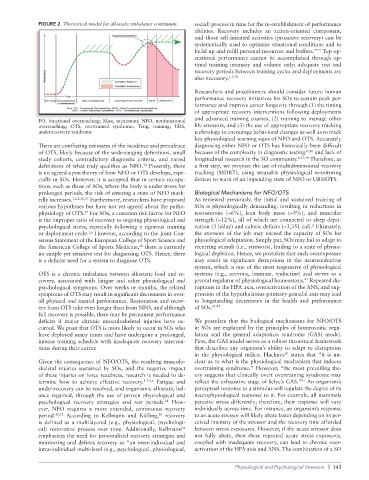
FIGURE 2  Theoretical model for allostatic imbalance continuum.  social) process in time for the re-establishment of performance
                                                                 abilities. Recovery includes an action-oriented component,
                                                                 and those self-initiated activities (proactive recovery) can be
                                                                 systematically used to optimize situational conditions and to
                                                                                                         34
                                                                 build up and refill personal resources and buffers.”  Top op-
                                                                 erational  performance  cannot  be  accomplished  through  op-
                                                                 timal training intensity and volume only; adequate rest and
                                                                 recovery periods between training cycles and deployments are
                                                                 also necessary. 1,5,39

                                                                 Researchers and practitioners should consider future human
                                                                 performance recovery initiatives for SOs to sustain peak per-
                                                                 formance and improve career longevity through (1) the timing
                                                                 of appropriate recovery interventions following deployments
              FO, functional overreaching; Max, maximum; NFO, nonfunctional   and advanced training courses, (2) training to manage other
              overreaching; OTS, overtrained syndrome; Trng, training; URS,   life stressors, and (3) the use of appropriate recovery tracking
                under-recovery syndrome                          technology to encourage behavioral changes as well as to track
                                                                 key physiological warning signs of NFO and OTS. Accurately
              There are conflicting estimates of the incidence and prevalence   diagnosing either NFO or OTS has historically been difficult
              of OTS, likely because of the wide-ranging definitions, small   because of the complexity in diagnostic testing 37,40  and lack of
              study cohorts, contradictory diagnostic criteria, and varied   longitudinal research in the SO community. 6,37,39  Therefore, as
              definitions of what truly qualifies as NFO.  Presently, there   a first step, we propose the use of multidimensional recovery
                                                34
              is no agreed-upon theory of how NFO or OTS develops, espe-  tracking (MDRT), using wearable physiological monitoring
              cially in SOs. However, it is accepted that in certain occupa-  devices to warn of an impending state of NFO or URS/OTS.
              tions, such as those of SOs, where the body is under stress for
              prolonged periods, the risk of entering a state of NFO mark-  Biological Mechanisms for NFO/OTS
              edly increases. 1,2,6,36,37  Furthermore, researchers have proposed   As reviewed previously, the initial and sustained training of
              various hypotheses but have not yet agreed about the patho-  SOs is physiologically demanding, resulting in reductions in
              physiology of OTS.  For SOs, a common risk factor for NFO   testosterone  (-6%), lean body mass  (-5%), and muscular
                             37
              is the improper ratio of recovery to ongoing physiological and   strength (-12%), all of which are connected to sleep depri-
              psychological stress, especially following a rigorous training   vation (3 h/day) and caloric deficits (-3,351 cal).  Ultimately,
                                                                                                       2
              or deployment cycle.  However, according to the Joint Con-  the stressors of the job may exceed the capacity of SOs for
                              1,6
              sensus Statement of the European College of Sport Science and   physiological adaptation. Simply put, SOs may fail to adapt to
              the American College of Sports Medicine,  there is currently   recurring stimuli (i.e., stressors), leading to a state of physio-
                                               38
              no simple yet sensitive test for diagnosing OTS. Hence, there   logical depletion. Hence, we postulate that such overexposure
              is a definite need for a system to diagnose OTS.   may result in significant disruptions in the neuroendocrine
                                                                 system, which is one of the most responsive of physiological
              OTS is a chronic imbalance between allostatic load and re-  systems  (e.g.,  nervous,  immune,  endocrine)  and  serves  as  a
              covery, associated with fatigue and other physiological and   pivotal regulator of physiological homeostasis.  Repeated dis-
                                                                                                     41
              psychological symptoms. Over weeks or months, the related   ruptions in the HPA axis, overactivation of the ANS, and sup-
              symptoms of OTS may result in significant decrements in over-  pression of the hypothalamus-pituitary-gonadal axis may lead
              all physical and mental performance. Restoration and recov-  to longstanding decrements in the health and performance
              ery from OTS take even longer than from NFO, and although   of SOs. 42-47
              full recovery is possible, there may be permanent performance
              deficits  if major chronic  musculoskeletal  injuries  have oc-  We postulate that the biological mechanisms for NFO/OTS
              curred. We posit that OTS is more likely to occur in SOs who   in SOs are explained by the principles of homeostatic regu-
              have deployed many times and have undergone a prolonged,   lation and the general adaptation syndrome (GAS) model.
              intense training schedule with inadequate recovery interven-  First, the GAS model serves as a robust theoretical framework
              tions during their career.                         that describes any organism’s ability to adapt to disruptions
                                                                                              41
                                                                 in the physiological milieu. Hackney  states that “it is un-
              Given the consequence of NFO/OTS, the resulting musculo-  clear as to what is the physiological mechanism that induces
              skeletal injuries sustained by SOs, and the negative impact   overtraining syndrome.” However, “the most prevailing the-
              of these injuries on force readiness, research is needed to de-  ory suggests that clinically overt overtraining syndrome may
                                                                                                    41
              termine how to achieve effective recovery. 1-3,5,6  Fatigue and   reflect the exhaustive stage of Selye’s GAS.”  An organism’s
              under-recovery can be resolved, and organismic allostatic bal-  perceptual response to a stimulus will regulate the degree of its
              ance regained, through the use of proven physiological and   neurophysiological response to it. For example, all mammals
              psychological recovery strategies and rest periods.  How-  perceive stress differently; therefore, their response will vary
                                                       28
              ever, NFO  requires  a  more  extended,  continuous  recovery   individually across time. For instance, an organism’s response
              period. 28,32  According to Kellmann and Kölling,  recovery   to an acute stressor will likely abate faster depending on its per-
                                                     28
              is defined as a multilayered (e.g., physiological, psychologi-  ceived intensity of the stressor and the recovery time afforded
              cal) restorative process over time. Additionally, Kellmann    between stress exposures. However, if the acute stressor does
                                                            34
              emphasizes the need for personalized recovery strategies and   not fully abate, then these repeated acute stress exposures,
              monitoring and defines recovery as “an inter-individual and   coupled with inadequate recovery, can lead to chronic over-
              intra-individual multi-level (e.g., psychological, physiological,   activation of the HPA axis and ANS. The combination of a SO

                                                                              Physiological and Psychological Stressors   |  143

