


Page 54 - JSOM Fall 2021
P. 54
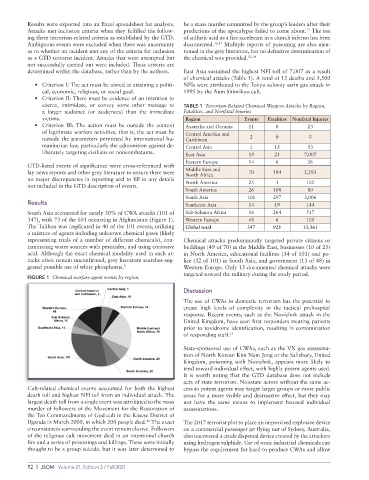
Results were exported into an Excel spreadsheet for analysis.   be a mass murder committed by the group’s leaders after their
                                                                                                     11
          Attacks met inclusion criteria when they fulfilled the follow-  predictions of the apocalypse failed to come about.  The use
          ing three terrorism-related criteria as established by the GTD.   of sulfuric acid as a fire accelerant in a church inferno has been
          Ambiguous events were excluded when there was uncertainty   documented. 12,13  Multiple reports of poisoning are also men-
          as to whether an incident met any of the criteria for inclusion   tioned in the grey literature, but no definitive determination of
          as a GTD terrorist incident. Attacks that were attempted but   the chemical was provided. 12,14
          not successfully carried out were included. These criteria are
          determined within the database, rather than by the authors.  East Asia sustained the highest NFI toll of 7,007 as a result
                                                             of chemical attacks (Table 1). A total of 12 deaths and 5,500
            •  Criterion I: The act must be aimed at attaining a politi-  NFIs were attributed to the Tokyo subway sarin gas attack in
               cal, economic, religious, or social goal.     1995 by the Aum Shinrikyo cult.
            •  Criterion II: There must be evidence of an intention to
               coerce,  intimidate, or convey some  other message to   TABLE 1  Terrorism-Related Chemical Weapon Attacks by Region,
               a larger audience (or audiences) than the immediate   Fatalities, and Nonfatal Injuries
               victims.                                       Region             Events  Fatalities  Nonfatal Injuries
            •  Criterion III: The action must be outside the context   Australia and Oceania  11  0   23
               of legitimate warfare activities, that is, the act must be   Central America and
               outside the parameters permitted by international hu-  Caribbean    2       0          0
               manitarian law, particularly the admonition against de-  Central Asia  1    15         53
               liberately targeting civilians or noncombatants.  East Asia        19       21       7,007
                                                              Eastern Europe      14       6          36
          GTD-listed events of significance were cross-referenced with
          lay news reports and other grey literature to ensure there were   Middle East and    70  184  2,293
                                                              North Africa
          no major discrepancies in reporting and to fill in any details
          not included in the GTD description of events.      North America       25       1         102
                                                              South America       26      108         80
                                                              South Asia          101     297       3,006
          Results                                             Southeast Asia      14       19        144
          South Asia accounted for nearly 30% of CWA attacks (101 of   Sub-Saharan Africa  16  264   517
          347), with 73 of the 101 occurring in Afghanistan (Figure 1).   Western Europe  48  6      100
          The Taliban was implicated in 40 of the 101 events, utilizing   Global total  347  921    13,361
          a mixture of agents including unknown chemical gases (likely
          representing trials of a number of different chemicals), con-  Chemical attacks predominantly targeted private citizens  or
          taminating water sources with pesticides, and using corrosive   buildings (49 of 70) in the Middle East, businesses (10 of 25)
          acid. Although the exact chemical modality used in such at-  in North America, educational facilities (34 of 101) and po-
          tacks often remain unconfirmed, grey literature searches sug-  lice (32 of 101) in South Asia, and government (13 of 48) in
          gested possible use of white phosphorus. 9         Western Europe. Only 13 documented chemical attacks were
                                                             targeted toward the military during the study period.
          FIGURE 1  Chemical warfare agent events by region.

                                                             Discussion
                                                             The use of CWAs in domestic terrorism has the potential to
                                                             create high levels of complexity in the tactical prehospital
                                                             response. Recent events, such as the Novichok attack in the
                                                             United Kingdom, have seen first responders treating patients
                                                             prior to toxidrome identification, resulting in contamination
                                                             of responding staff. 15
                                                             State-sponsored use of CWAs, such as the VX gas assassina-
                                                             tion of North Korean Kim Nam Jong or the Salisbury, United
                                                             Kingdom, poisoning with Novichok, appears more likely to
                                                             tend toward individual effect, with highly potent agents used.
                                                             It is worth noting that the GTD database does not include
                                                             acts of state terrorism. Nonstate actors without the same ac-
          Cult-related chemical events accounted for both the highest   cess to potent agents may target larger groups or more public
          death toll and highest NFI toll from an individual attack. The   areas for a more visible and destructive effect, but they may
          largest death toll from a single event was attributed to the mass   not have the same means to implement focused individual
          murder of followers of the Movement for the Restoration of   assassinations.
          the Ten Commandments of God cult in the Kasese District of
          Uganda in March 2000, in which 200 people died.  The exact   The 2017 terrorist plot to place an improvised explosive device
                                                 10
          circumstances surrounding the event remain elusive. Followers   on a commercial passenger jet flying out of Sydney, Australia,
          of the religious cult movement died in an intentional church   also uncovered a crude dispersal device created by the attackers
          fire and a series of poisonings and killings. These were initially   using hydrogen sulphide. Use of toxic industrial chemicals can
          thought to be a group suicide, but it was later determined to   bypass the requirement for hard-to-produce CWAs and allow


          52  |  JSOM   Volume 21, Edition 3 / Fall 2021

