


Page 39 - JSOM Spring 2020
P. 39
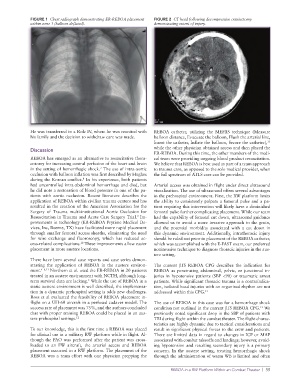
FIGURE 1  Chest radiograph demonstrating ER-REBOA placement   FIGURE 2  CT head following decompressive craniectomy
              within zone 1 (balloon deflated).                  demonstrating extent of injury.


              He was transferred to a Role IV, where he was reunited with   REBOA  catheter,  utilizing  the  MEFIIS  technique  (Measure
              his family and the decision to withdraw care was made.  balloon distance, Evacuate the balloon, Flush the arterial line,
                                                                 Insert the catheter, Inflate the balloon, Secure the catheter),
                                                                                                               13
              Discussion                                         while the other physician obtained access and then placed the
                                                                 ER-REBOA. During this time, the other members of the medi-
              REBOA has emerged as an alternative to resuscitative thora-  cal team were providing ongoing blood product resuscitation.
              cotomy for increasing central perfusion of the heart and brain   We believe that REBOA is best used as part of a team approach
              in the setting of hemorrhagic shock.  The use of intra-aortic   to trauma care, as opposed to the solo medical provider, when
                                          7
              occlusion with balloon inflation was first described by Hughes   the full spectrum of ATLS care can be provided.
              during the Korean conflict.  In his experience, both patients
                                   8
              had uncontrolled intra-abdominal hemorrhage and died, but   Arterial access was obtained in flight under direct ultrasound
              he did note a restoration of blood pressure in one of the pa-  visualization. The use of ultrasound offers several advantages
              tients with aortic occlusion. Recent literature describes the   in the prehospital environment. First, the RW platform limits
                application of REBOA within civilian trauma centers and has   the ability to consistently palpate a femoral pulse and a pa-
              resulted in the creation of the American Association for the   tient requiring this intervention will likely have a diminished
              Surgery of Trauma multi-institutional Aortic Occlusion for   femoral pulse further complicating placement. While our team
              Resuscitation in Trauma and Acute Care Surgery Trial.  Im-  had the capability of femoral cut down, ultrasound guidance
                                                          9
              provements in technology (ER-REBOA Prytime Medical De-  allowed us to avoid a more invasive approach to the groin,
              vices, Inc, Boerne, TX) have facilitated more rapid placement   and  the potential morbidity  associated  with  a  cut down  in
              through smaller femoral access sheaths, eliminating the need   this dynamic environment. Additionally, intrathoracic injury
              for wire exchange and fluoroscopy, which has reduced ac-  should be ruled out prior to placement of the REBOA catheter,
              cess-related complications.  These improvements allow easier   which was accomplished with the E-FAST exam, our preferred
                                  10
              placement in more austere locations.               noninvasive technique to diagnose thoracic injuries in the aus-
                                                                 tere setting.
              There have been several case reports and case series demon-
              strating the application of REBOA in the austere environ-  The current JTS REBOA CPG describes the indication for
              ment. 4–6,11  Northern et al. used the ER-REBOA in 20 patients   REBOA as penetrating abdominal, pelvic, or junctional in-
              treated in an austere environment with NCTH, although long-  juries in hypotensive patients (SBP <90) or traumatic arrest
              term survival data are lacking.  While the use of REBOA in a   patients. While significant thoracic trauma is a contraindica-
                                     5
              static austere environment is well described, the implementa-  tion, isolated head injuries with an organized rhythm are not
              tion in a dynamic prehospital setting is adds new challenges.   addressed within this CPG. 13
              Ross et al evaluated the feasibility of REBOA placement in-
              flight on a UH-60 aircraft in a perfused cadaver model. The   The use of REBOA in this case was for a hemorrhage shock
              success rate of placement was 75%, and the authors concluded   condition not outlined in the current JTS REBOA CPG.  We
                                                                                                            13
              that with proper training REBOA could be placed in an aus-  previously noted significant drop in the SBP of patients with
              tere prehospital settings. 12                      TBI during flight within the combat theater. The flight charac-
                                                                 teristics are highly dynamic due to tactical considerations and
              To our knowledge, this is the first time a REBOA was placed   result in significant physical forces to the crew and patients.
              for clinical use in a military RW platform while in flight. Al-  There are limited data in regard to changes in ICP or MAP
              though the PAO was performed after the patient was cross-  associated with combat takeoffs and landings; however, avoid-
              loaded  to an  FW aircraft,  the  arterial  access  and  REBOA   ing hypotension and resulting secondary injury is a primary
              placement occurred in a RW platform. The placement of the   concern. In the austere setting, treating hemorrhagic shock
              REBOA was a team effort with one physician prepping the   through the administration of warm WB is limited and often

                                                                       REBOA in a RW Platform Within an Combat Theater  |  35

