


Page 36 - JSOM Spring 2020
P. 36
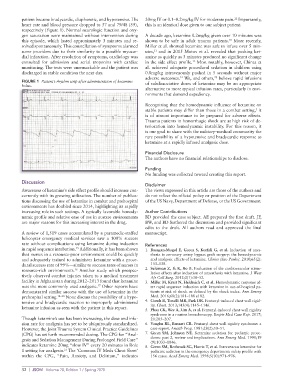
patient became bradycardic, diaphoretic, and hypotensive. His   20mg IV or 0.1–0.2mg/kg IV for moderate pain.  Importantly,
                                                                                                  22
          heart rate and blood pressure dropped to 37 and 79/48 (59),   this is an identical dose given to our subject patient.
          respectively (Figure 1). Normal neurologic function and oxy-
          gen saturation were maintained without intervention during   A decade ago, ketamine 0.2mg/kg given over 10 minutes was
          this episode, which lasted approximately 3 minutes and re-  shown to be safe in adult trauma patients.  More recently,
                                                                                                10
          solved spontaneously. This constellation of symptoms alarmed   Miller et al. showed ketamine was safe to infuse over 5 min-
          some providers due to their similarity to a possible myocar-  utes,  and in 2015 Motov et al. revealed that pushing ket-
                                                                 11
          dial infarction. After resolution of symptoms, cardiology was   amine as quickly as 3 minutes produced no significant change
          consulted for admission and serial troponins with cardiac   in the side effect profile.  Most notably, however, Chinta et
                                                                                12
          monitoring. The tests were unremarkable and the patient was   al. achieved adequate procedural sedation in children using
          discharged in stable condition the next day.       0.8mg/kg intravenously pushed in 5 seconds without major
                                                             adverse outcomes.  We, and others,  believe rapid infusions
                                                                                          23
                                                                           14
          FIGURE 1  Patient’s rhythm strip after administration of ketamine   of subdissociative doses of ketamine may be an appropriate
          bolus.
                                                             alternative to more typical infusion rates, particularly in envi-
                                                             ronments that demand expediency.
                                                             Recognizing that the hemodynamic influence of ketamine on
                                                             stable patients may differ than those in a combat setting,  it
                                                                                                           3
                                                             is of utmost importance to be prepared for adverse effects.
                                                             Trauma patients in hemorrhagic shock are at high risk of de-
                                                             terioration into hemodynamic instability. For this reason, it
                                                             is our goal to share with the military–medical community the
                                                             rare possibility of a hypotensive and bradycardic response to
                                                             ketamine at a rapidly infused analgesic dose.

                                                             Financial Disclosure
                                                             The authors have no financial relationships to disclose.

                                                             Funding
                                                             No funding was collected toward creating this report.
          Discussion
                                                             Disclaimer
          Awareness of ketamine’s side effect profile should increase con-  The views expressed in this article are those of the authors and
          currently with its growing utilization. The number of publica-  do not reflect the official policy or position of the Department
          tions discussing the use of ketamine in combat and prehospital   of the US Navy, Department of Defense, or the US Government.
          environments has doubled since 2014, highlighting its rapidly
          increasing role in such settings. A typically favorable hemody-  Author Contributions
          namic profile and relative ease of use in austere environments   BD provided the case subject. AE prepared the first draft. JF,
          are major reasons for this increasing interest in the drug.  BW, and BD furthered the discussion and provided significant
                                                             edits to the draft. All authors read and approved the final
          A review of 1,519 cases accumulated by a paramedic-staffed   manuscript.
          helicopter emergency medical services saw a 100% success
          rate without complications using ketamine during induction   References
          in rapid sequence intubation.  Additionally, it has been shown   1.  Basagan-Mogol E, Goren S, Korfali G, et al. Induction of anes-
                                15
          that nurses in a resource-poor environment could be quickly   thesia in coronary artery bypass graft surgery: the hemodynamic
          and adequately trained to administer ketamine with a proce-  and analgesic effects of ketamine. Clinics (Sao Paulo). 2010;65(2):
          dural success rate of 99%—similar to success rates of nurses in   133–138.
          resource-rich environments.  Another study which prospec-  2.  Suleiman Z, Ik K, Bo B. Evaluation of the cardiovascular stimu-
                                16
          tively observed combat injuries taken to a medical treatment   lation effects after induction of anaesthesia with ketamine. J West
                                                               Afr Coll Surg. 2012;2(1):38–52.
          facility in Afghanistan during 2012–2013 found that ketamine   3.  Miller M, Kruit N, Heldreich C, et al. Hemodynamic response af-
          was the most commonly used analgesic.  Other reports have   ter rapid sequence induction with ketamine in out-of-hospital pa-
                                         17
          demonstrated similar success with the use of ketamine in the   tients at risk of shock as defined by the shock index. Ann Emerg
          prehospital setting. 18–20  None discuss the possibility of a hypo-  Med. 2016;68(2):181–188 e182.
          tensive and bradycardic reaction to improperly administered   4.  Coruh B, Tonelli MR, Park DR. Fentanyl-induced chest wall rigid-
                                                               ity. Chest. 2013;143(4):1145–1146.
          ketamine infusion as seen with the patient in this report.  5.  Phua CK, Wee A, Lim A, et al. Fentanyl-induced chest wall rigidity
                                                               syndrome in a routine bronchoscopy. Respir Med Case Rep. 2017;
          Though ketamine’s use has been increasing, the dose and infu-  20:205–207.
          sion rate for analgesia has yet to be ubiquitously standardized.   6.  Vaughn RL, Bennett CR. Fentanyl chest wall rigidity syndrome: a
          However, the Joint Trauma System Clinical Practice Guidelines   case report. Anesth Prog. 1981;28(2):50–51.
          (CPG) has set forth recommended dosing. The CPG for “Anal-  7.  Green SM, Johnson NE. Ketamine sedation for pediatric proce-
          gesia and Sedation Management During Prolonged Field Care”   dures: part 2, review and implications. Ann Emerg Med. 1990;19
                                                               (9):1033–1046.
          indicates ketamine 20mg “slow IV” every 20 minutes in Role   8.  Green SM, Rothrock SG, Harris T, et al. Intravenous ketamine for
          1 setting for analgesia.  The ‘Common IV Meds Cheat Sheet’   pediatric sedation in the emergency department: safety profile with
                            21
          within the CPG,  “Pain, Anxiety,  and  Delirium,” indicates   156 cases. Acad Emerg Med. 1998;5(10):971–976.

          32  |  JSOM   Volume 20, Edition 1 / Spring 2020

